
Wealth: why is the top 1% selling stocks?
Stocks are a middle class investment
Investment Banking has lots of different and interesting specialties.

After retiring from banking I’ve been teaching Finance and Fintech to Masters students in London. I tend to do a fair amount of career coaching as well, as I genuinely want to help students succeed, and typically University career staff are generalists, and don’t understand Investment Banking. I advise Finance students that matter what your skills and interest, there is likely an Investment Banking job for you; it’s just a matter of understanding the business, and seeing how you fit in to different roles across the Front, Middle and Back Office. Although I spent
MOST OF MY CAREER IN THE FRONT OFFICE

either on or close to trading floors, I networked well and tend to know people across the firm. And, of course, other banks. I still maintain expansive professional connections, and regularly get together to socialise and talk shop. Over the past year or so I’ve been hearing from some buddies working in Wealth Management that many of their clients were either lightening up, or completely dumping stocks. These guys manage either High Net Worth, HNW and Very High Net Worth, VHNW individuals, so personal fortunes of between one million to perhaps thirty million dollars.
I only
RECENTLY FOUND TIME TO INVESTIGATE THIS
using both sources that are subscription only (and I can’t reproduce due to licensing issues) and data publicly available to retail (source published here). The chart below shows the percentage of stocks held by the wealthiest 1% of the population.
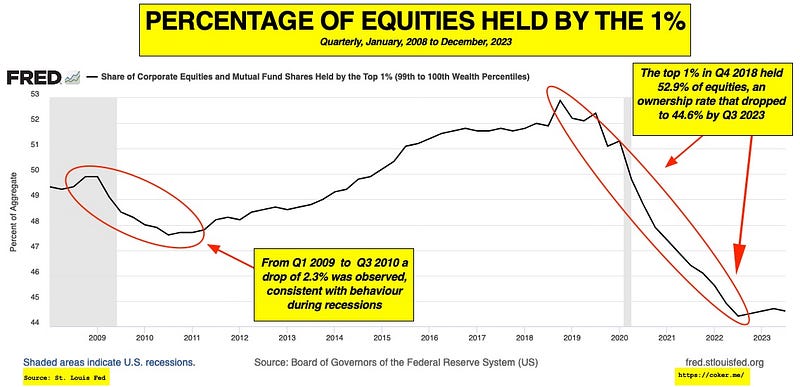
We see a reduction of 2.3% in the aftermath of The Global Financial Crisis, but considering the scale of that financial near-disaster, some net selling of stocks was to be expected. This cohort gradually increased their share of equities owned from 47% in Q2 2010 to a near term high of 52.9% in Q4 2018. Then this cohort began selling, to a near term low of 44.6% in Q3, 2023, a rate it has essentially stayed at as 2024 progresses. So a reasonable question is what are they doing with their money? The
PANDEMIC AND POST PANDEMIC MARKETS

were strange places, considering the sharp increase in the number of retail investors who entered the market for the first time, meme stocks, Wall Street Bets, NFTs and other displays of what can only be called Financial Idiocy. So one possible explanation is the 1% were only too happy to sell their shares at absurdly high prices to retail. Another emerged as interest rates rose. The chart below shows the yields on The US 10Y Note and the US 30Y Bond
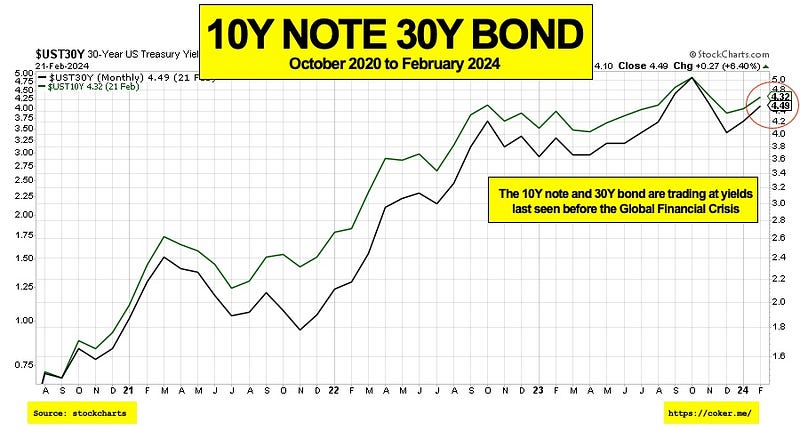
The 10Y Note is yielding 4.32%, while the 30Y Bond is yielding 4.49%. Note these are risk free yields; unlike other assets such as stocks, you are guaranteed this cash return every year for either ten or thirty years, after which you’ll your capital will be repaid. So moving capital into risk free assets, is a definite possibility. Another alternative might be physical assets, as I described here
is moving capital into what I often call tangible real physical assets; stuff, in other words. Considering the relatively high inflation we’re now experiencing, equities are an inferior choice compared to physical assets. And this isn’t idle speculation; money managers such as Yale, achieve superior results simply by diversifying across equities, bonds, and illiquid, physical assets
So I believe High Net Worth and Ultra High Net Worth individuals are reducing their allocation of stocks, due to a combination of irrational equity market valuation, high risk free interest rates and high inflation. At the same time though, we know
THE SHARE OF CORPORATE EQUITIES
and mutual fund shares held by America’s middle class is increasing, if for no other reason that the 1% is moving capital out of stocks. So, increasingly
Stocks are a middle class investment
Visit us at DataDrivenInvestor.com
Subscribe to DDIntel here.
Have a unique story to share? Submit to DDIntel here.
Join our creator ecosystem here.
DDIntel captures the more notable pieces from our main site and our popular DDI Medium publication. Check us out for more insightful work from our community.
DDI Official Telegram Channel: https://t.me/+tafUp6ecEys4YjQ1


