
We Were Never Truly Authentic
Merriam-Webster's word of the year has arrived
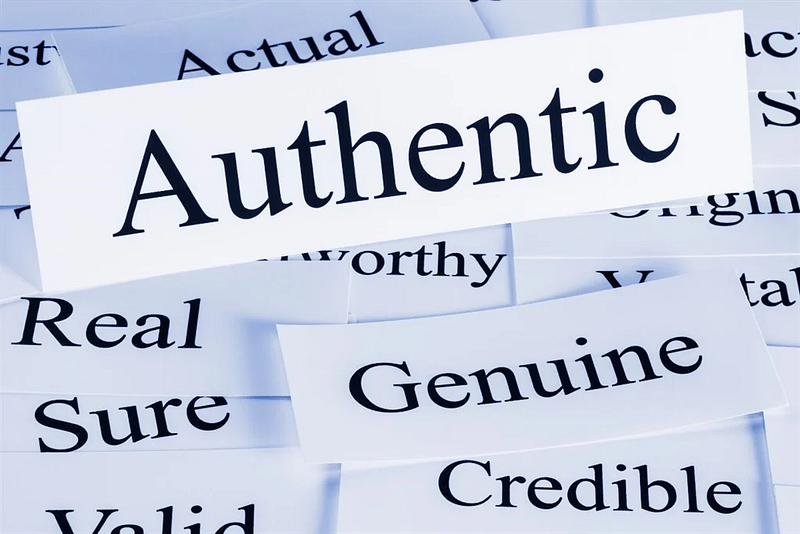
Twenty years have passed since Merriam-Webster started to promote the word of the year. The time for the anniversary word has come, and that is authentic. During these twenty years of publishing what people search for online, the company itself has tried to be authentic when it comes to its devotion to words. That is, according to their entry, to be “true to their own spirit.”
From democracy to bailout, from socialism to capitalism, from science to culture, feminism and justice, pandemic to vaccine, and, lastly, gaslighting, Merriam-Webster's endeavor is attempting to fix, almost photographically, our times as they pass in a single word, a representation, a word-image, that defines our leading problems and/or interests.
But what is authenticity? What does it mean to be authentic or, on the contrary, inauthentic, either in your thoughts or actions?
Of course, to fulfil their marketing needs, the company behind the dictionary is distributing their own input on the word to news outlets. And it is a busy and crowded input, to say the least. As is typical of dictionaries, it fails to educate us enough as well.
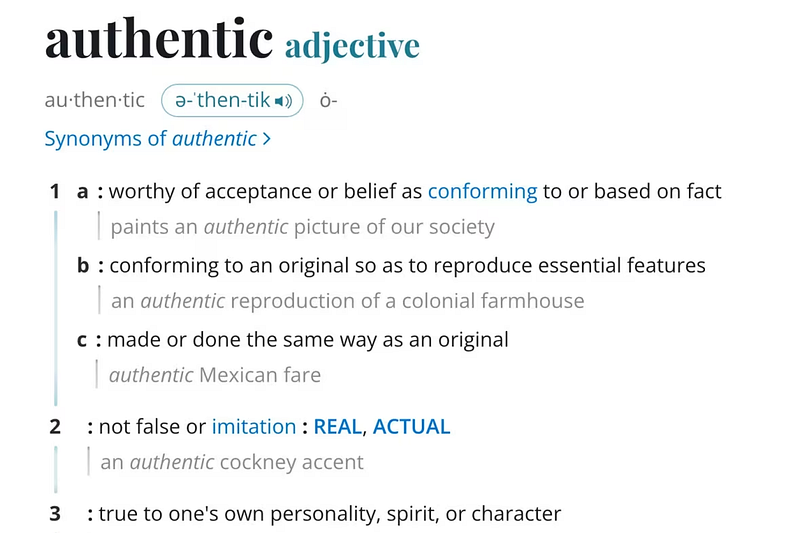
As stated in the quotation above, to be true to one's needs, desires, and beliefs is to be considered authentic. In this instance, the question of what all this means reemerges once again. Many conundrums accompanying the idea of authenticity are related to problems in ethics, socioeconomics, epistemology, and beyond. And, indeed, a great deal of energy in the philosophical departments around the world and at different times was spent in finding out what exactly means, when concerned with a person, to be authentic.
As is often the case with languages, a word may have overlapping or contradictory meanings, coexisting throughout its lengthy history of usage. In Merriam-Webster’s entry, however, we can find at least one obvious issue at play. That is the non-person-related meaning of the word when correlating it with the person-related one. When used in the manner of the former, we do, in reality, mean a copy of the original (“an authentic reproduction of a colonial farmhouse”; “authentic Mexican fare”), even though it is a faithful copy.
At first glance, it seems like there is a problem here entirely different from the person-related one. Or is there? In what follows, I will briefly sketch the intellectual history surrounding the debate and, eventually, connect it meaningfully with our here-and-now.
The dualistic interpretation
If we do hold a dualistic belief about the notion of personhood; there might be some similarities of interest between the non-person and person-related interpretations. That doctrine is usually attributed to the long, sinuous lines of the philosophical school of so-called ‘rationalism.’ The latter appeared on the scene of ideas at the dawn of modernity. We can trace its embryo, though, at least as far back as Plato.
According to dualism, the body and the mind (or the soul, for that matter) are separate entities. Most of the formulations in that vein support an essence that precedes our existence. That is, the mind/soul exists before the body and, therefore, before its experience of and in the world. Everything is more or less already there, huddled and enclosed in itself, waiting for an opportunity to express its interiority and to overflow beyond. All our ideas, knowledge, talents, and possibilities are hushed in anticipation.
Hence the premise that there is something common to all human beings with respect to their mind/soul which is rational, ethical, in a quest for knowledge and freedom, and so forth. It might be derived from God or nature, but in the end, it is always already formed and steady. An idea that the Enlightenment, especially the French one, pushed to its limits. To put it briefly, there are principles (in the original meaning of beginnings) that, if we follow them, will lead us to a state beyond the dreads, the sufferings, and the illusions of the body and its senses.
On a similar note, to be authentic will mean to follow those principles and to realise —through your body and life—your individual or common human essence that overcomes the boundaries of the empirical world. For the organization and execution of the “Mexican fare” (the body) somewhere in the segregated neighbourhoods in the US to bear as much resemblance to the original “Mexican fare” (the mind).
One can easily see why a proposition like that could—mildly put—be used as an excuse to perform horrific things to ‘fellow’ human beings. If they don’t conform to or meet your or your group's understanding and shared principles, then they are not human enough. That’s why the Enlightenment has so much to do with colonialism. One can even make the argument that the possibility of a superior race can already be found dormant here.
It seems like becoming an authentic human being based on the concept of personal or species-based essence is, firstly, an empty container for a variety of other notions and, secondly, carries the weight of law (of nature or some other absolute entity, perhaps?), turning, in the end, into a standard under which deviance is evaluated.
The complementary existentialist take
Thanks to the existentialists (Jean-Paul Sartre, most prominently in his essay “Existentialism is Humanism"), the previous, overly limiting intellectual heritage was about to be overcome by a predominantly individualistic and, at least at first glance, more empirical tendency. Sartre went for reversing the initial premise by claiming that “existence precedes essence.” Or, in other words, he argues that we are first born, and just after, our essence is being formed as a result of our immediate experience and development in and through the world and others.
Sartre did not come up with that view by his own means. It was Martin Heidegger’s early and most prominent work, “Being and Time,” that influenced his ideas about the specificity of human existence and the need to reimagine it.
The celebrated German thinker, who was also a devoted Nazi, distinguishes between acting authentically and inauthentically. Initially, Heidegger’s existential analysis was only concerned with Dasein (or what is usually translated as being-(t)here) in its ‘everydayness’ (Alltäglichkeit). And for him, there is nothing worse than to exist amid everydayness. Why so? Because that is where the habits and, hence, the inauthenticity as such are being formed. In his own words, Dasein
… always understands itself in terms of its existence — in terms of a possibility of itself: to be itself or not itself. Dasein has either chosen these possibilities itself, or got itself into them [in sie hineingeraten], or grown up in them already. (Being and Time, p. 12)
Choosing one’s own “possibilities” has a priority over getting oneself “into them" or being “grown-up” (read ‘educated’ or ‘nurtured’) within. That is a place where one is forced or limited to become something other than oneself. Heidegger will go on and say that
… because Dasein is in each case essentially its own possibility this entity can in its being “choose” itself, win itself; it can lose itself or never win itself but only “seem” to.
In this “seem to” resides the everydayness, the inauthenticity. By “losing” itself, Dasein, or we as persons, quite often—according to both Heidegger and Sartre—solely seem to be governed by ourselves. We are guided either by circumstances or by something beyond them that escapes the authentic principles of... well, our essence. Never mind that the latter is—according to this formulation at least—constituted ex post facto.
They both are trapped, in their attempts to get out of the web of contradictions between the notions of existence and essence, in that same web. What would that essence—formed by experience, sociality, conditionality, and individual reflection—be, if not something that must be adjusted to new experiences, new socialities and conditionalities, and new, more complex reflections?
But to be fair to their work, Sartre and Heidegger somehow return to the original charge of the word authentic. For the Ancients, the adjective αὐθεντικός was derived from the verb αὐθέντης, one of the meanings of which was to commit suicide. Sartre and Heidegger defined suicide, in my own words, as the most authentic act a human being is capable of. Sartre served it with the example of being a German soldier working in a camp during WWII who always has a choice, and Heidegger—since he was a Nazi—in the context of some other either ethically or physically unbearable conditions, thus embracing our finitude.
Still, it is here where the idea of “following your own lead” lies. To follow yourself, your talents and callings, or to stand by yourself—to be authentic, in other words—will always refer to the belief in some form of primordial essence that each of us already has (fixed and) in waiting.
This resembles, to a great extent, the contemporary jargon of life coaches and other charlatans, but also of identity politics (with all my respect, support, and solidarity for the struggles of marginalized groups of any kind). It gives us nothing but headaches and the disappointment of missing our true selves.
Suicide as a virtue
According to Peter Sokolowski, a Merriam-Webster lexicologist, in 2023 “we see […] a kind of crisis of authenticity." And we see this all around us, even here, where more than a few people claim to have found the right means to reach our own authentic language, writing style, behaviour, etc.
To a greater extent, what he says should be read in the context of "post-truth" (another word on Merriam-Webster’s list), post-democracy, climate change, the Anthropocene, war after war after war, and the advent of AI, where everything blurs before our gaze. It feels like even Turing cannot truly help us. Sokolowski goes even further, claiming that
We sometimes don’t believe our own eyes or our own ears. We are now recognizing that authenticity is a performance itself.
In other words, the ‘post-modern’ spectacle that we witness is a result of the strive for authenticity, which is never really accomplished and always turns into a spectacle of its merit. Authenticity as a performance. It sounds like, in the end, to reach it, we should all go back to Christianity’s interpretation of it—to be, quite literally, naked before God, not before ourselves, and certainly not before others.
It would not be over the top to suggest a not-so-literal interpretation of the word, however. If we address this in a more metaphorical sense, it could open up before us much more meaningful and beneficial horizons. Referring back to the suicidal connotation complementing its initial semantic charge, I will make a suggestion here.
Namely, to be ‘authentic,’ we might have to commit a true suicide. Not one that will necessarily put our lives to an end, but surely one that will devote ourselves to change. A constant one, for that matter. We have reached a point at which, to embody authenticity at its highest, we must be able to go beyond our prejudices, beliefs, and essence. To sublate all of them, committing a kind of harakiri, disemboweling everything we were ever taught. So that we have the possibility of a life to fight for.
One can argue, in conclusion, that we were never authentic. Neither as individuals nor as a group. We strive to overcome any essentiality, even if unconsciously at times.
To put it differently, we might have always been preparing for this moment. A short instance in which the “crisis in authenticity” reveals itself as the only possibility to be authentic.
It is, I believe, time for suicide. Just not the literal one we are heading for if we are to keep doing what we have been doing for quite some time now.


