
We Were Being Educated
Richard Dawkins On The Purpose Of Lectures And Personal Reflections
Richard Dawkins’ writings (not including his twitter feed) are remarkably able to evoke a sense of wonder in his readers. He was for me one of the earliest cultivators of this intellectual crop through his toils in the field of evolutionary biology and scientific education. When I had the chance to shake his hand as he signed my copy of The Ancestor’s Tale, I told him that he had a profound impact on who I had become over the recent years. “A positive one I hope,” he retorted jokingly.
The title of the first book of his two volume memoir is one so appropriate and subtly profound that I’ve often wished I could have conjured it myself. But then, he didn’t create it either, reminding me that there is nothing wrong with borrowing and giving credit; that the desire for complete originality will always remain unfulfilled. There’s nothing wrong with this, we just ought to provide due credit to the giants upon whose shoulders we stand. (Did Newton even create that phrase from thin air?)
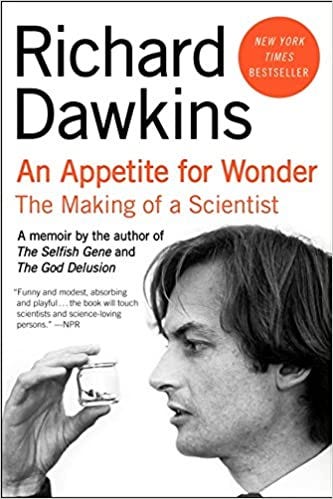
Among the many insights and information gleaned from An Appetite for Wonder: The Making of a Scientist is a view on the purpose of lectures that will benefit university students and professors alike. And just what does Dawkins say the purpose of a lecture is?
“It is not to imbibe information, and there is therefore no point in doing what I did (and what virtually all undergraduates do), which is take notes so slavishly that there is no attention left over for thinking…
The purpose of a lecture should not be to impart information. There are books, libraries, nowadays the internet, for that. A lecture should inspire and provoke thought… A good lecturer thinking aloud, reflecting, musing, rephrasing for clarity, hesitating and then grasping, varying the pace, pausing for thought, can be a role model in how to think about a subject and how to transmit a passion for it. If a lecturer drones information as though reading it, the audience might as well read it — possibly in the lecturer’s own book.”
He doesn’t think note taking is itself bad and advises jotting down something that sparks a thought or is interesting enough to want to look up later. The common impossibility of treating lectures in this way is the sad result of this not being the actual purpose of lectures in practice. I can only speak for American college students of course, and I also won’t claim this is never possible. It’s just far too common that lectures are intended to dispense information rather than inspire.
Classes are frequently lecture based in that the primary source of information is the lecture. Students have to slavishly take notes and often have record whole lectures on audio or video, lest they miss something that will be found on the coming exam. (There might not be any alternative when there’s no assigned textbook for the class.)
The exam of course is unlikely to assess one’s grasp of the material or, more importantly, their ability to think creatively and critically within their field of study. (These skills ought to translate into all conflicts and confusions in life as well, if one can be said to be meaningfully well educated.) Exams aren’t useless- the retention of information is important- but I have increasingly seen the reliance on tests as a tangible symptom of an educational system that is, on its best days, far from its full potential. The problem is especially pronounced in schooling below the college level too.
Dawkins was fortunate in a way almost all of us are not. He attended Oxford University and within the Zoology department had the privilege of profiting from the university’s prestigious tutorial system. There were lectures, but their purpose was different, and most of what he actually learned was through his tutorials. Here are nerdishly exciting examples of what his tutorials were like. The first is from the school term when the biologist Niko Tinbergen was his tutor.
“Each week my tutorial assignment was to read one DPhil (Oxford-speak for PhD) thesis. My essay was to be a combination of DPhil examiner’s report, review of the history of the subject in which the thesis fell, proposal for follow-up research, and theoretical and philosophical discussion of the issues that the thesis raised. Never one moment did it occur to either tutor or pupil to wonder whether this assignment would be directly useful for answering some exam question.”
Then another term when Arthur Cain was his tutor.
“Dr. Cain had me reading nothing but books on history and philosophy. It was up to me to work out the connections between zoology and the books I was reading. I did, and I loved it. I’m not saying my juvenile essays on the philosophy of biology were any good — with hindsight I know they weren’t — but I can say that I have never forgotten the exhilaration of writing them, or the feeling of being a real scholar as I read in the library.”
The same was true for his essays on “standard zoological topics” such as one on the circulatory system of starfish. They do not have blood, but instead pump seawater through their bodies. Dawkins recalls this specialized system for the same reason he recalls many other specialized topics. He once wrote an essay on it.
“I remember the bare facts about starfish plumbing, but it is not the facts that matter. What matters is the way in which we were encouraged to discover them…We went to the library and looked up books old and new; we followed trails of original research papers until we had made ourselves as nearly world authorities on the topic as it is possible to become in a week…one didn’t just read about starfish hydraulics, or whatever the topic was: for that one week, I remember that I slept, ate and dreamed starfish hydraulics. Tube feet marched behind my eyelids, hydraulic pedicellariae quested and sea water pulsed through my dozing brain. Writing my essay was the catharsis, and the tutorial was the justification for the entire week…We were being educated…”
These pages filled me with teeming excitement the summer before I entered by first year as an undergraduate biology student at what was to me my dream college. Despite my depression from an overwhelming absence of free time- stolen from me by chemistry courses and my inability to pass the class examinations with enough wiggle room to stave off a sincere fear of failing- I began college feeling I too was being educated. I loved it. There my friends and I pridefully studied until three in the morning for an exam we had five hours later. We were driven by caffeine, a sincere love of the quest for knowledge, and our certainty of being on its sure path. We not only got A’s on the exam, we really learned the information, how it fit into the big picture of life, and how scientific research is conducted. (I also distinctly remember one night when I and two friends were studying past midnight for a chemistry exam. As a distraction I showed them a lecture by the physicist Lawrence Krauss, in which he introduced us to a non-Euclidean triangle consisting of three ninety-degree corners. We set to work at the chalkboard with our combined knowledge of mathematics in a wonder-driven attempt to grasp this anti-intuitive concept. I am sorry to say I never did, though I never returned to it with similar effort.)
In my biology classes we were challenged in a meaningful way, just as we were in our freshman seminar class. Our itchy intellects got a well needed scratch in our first year seminar class too. There we read works from luminaries like Marx, Menghzi, Jefferson, Plato, Locke, Darwin, Sappho, Galileio, and many more. And this was only my freshman year! Like Dawkins, hindsight assures me my juvenile essays that centered on these works were not great, and in four more years I may feel the same about my current writing too. But that would only be a sign of improvement.
Keeping Dawkins in mind I tried to put down my pencil in my later years at university whenever it was possible, which was infrequent after making the financially responsible but intellectually dulling decision to transfer schools. This only made me appreciate my favorite professors all the more, and there have been some illuminating influences in my four years at university. But I occasionally find myself longing for the attitude and culture of that first year before transferring, where the work never seemed unnecessary, and it all fit together. Despite everything I’ve learned at my second college, I know why I’ve missed it so much: I was being educated.


