
We Watched Anime Before It Was Cool
Before most Americans knew words like anime and manga, kids grew up watching Japanese animated shows dubbed and edited for American audiences.
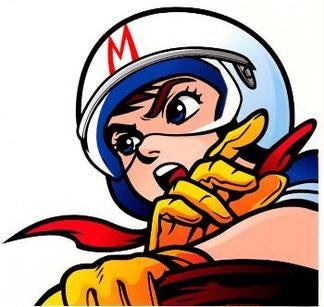

The ones I remember the most are: Speed Racer … Astro Boy … Marine Boy … Kimba the White Lion…
Speed Racer
Speed Racer was the most popular one at my school. (Note: The series is known as Mach GoGoGo, or Mahha GōGōGō, in Japan.) Most of us watched Speed Racer when we got home from school. Kids at school would sing the catchy theme song. They would sometimes make fun of the dubbing — or gripe about the characters they didn’t like. (I wasn’t a huge fan of the monkey, Chim-Chim. But I didn’t hate him to Scrappy-Doo levels.)
One year, I borrowed my brother’s motorcycle helmet so I could go trick-or-treating as Speed Racer. (The helmet was the wrong color, but it was a real helmet.) I also played out scenes from Speed Racer during recess.
Years later, my local comic book shop sold English-language reprints of the Japanese Racer X comic. Right away, I recognized Racer X as a character from Speed Racer. If Racer X had his own comic book, then that meant … so did Speed Racer! Speed Racer was a … manga!
By this time, I knew what a manga was. They had just become easier to find in the U.S., usually as flat comic book issues rather than in the manga book format (tankōbon). At this time, these reprints were usually printed in the Western style, left to right (known as “flipping” and “flopping”) — something that causes consternation among artists and fans alike.
So if there was a Speed Racer manga, that meant the original TV show had to be … an anime. Did that mean I had watched an anime?!
Yes, it did!
Astro Boy
Astro Boy (known as Mighty Atom, or Tetsuwan Atomu, in Japan) is considered to be a formative anime TV series. Like the original manga, Astro Boy was extremely popular in Japan. In 1963, NBC decided to show it in the United States. This decision turned out to be incredibly impactful. Of course, as is true for many of these shows, it was shown with changes and edits beyond just the dubbing.
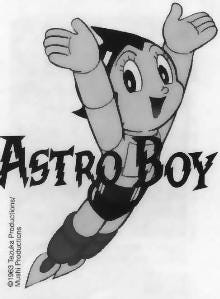
At the time, we were too young to appreciate that this was the first Japanese animated TV show to make it to the United States television market. We simply liked seeing a kid who was a flying robot powerful enough to beat up giant monsters but who was also a great kid. Like so many of these shows, this program was about far more than big battles. But if you want to see a bit of battle, you can see a preview of the original Japanese version here.
Today, manga and anime fans know Astro Boy was a seminal series from Osamu Tezuka (Tezuka Osamu in Japan), who is considered “the Father of Manga,” “the Godfather of Manga,” and even “the God of Manga.”
Today I learned that in the final episode (shown only in Japan at the time), Astro Boy destroyed himself to save the Earth. And I thought it was sad when Johnny Sokko lost his Flying Robot!
Marine Boy
Marine Boy (known as Undersea Boy Marine, or Kaitai Shonen Marine, in Japan) started as an anime rather than as a manga. Marine Boy swam to the U.S. shores months after Astro Boy.
Marine Boy was one of my favorites because of swimming. At the time, I was learning to swim at summer camp. Going underwater was a struggle. So I often wished I had oxygum like Marine Boy — an invention that let him breathe underwater. (Nowadays, I have no problem going underwater, but I’d still love to have oxygum.)
On top of that, Marine Boy rode a dolphin! And he had great hair, as you can see in this preview clip (courtesy of Warner Brothers).
Kimba the White Lion
Kimba the White Lion was like a treat held just in front of me and then yanked away. I found it in the TV listings and thought it sounded great, but it didn’t come on locally. At the time, only a TV station in Washington, D.C. played the show. So I tried to watch it by tuning to Channel 20 and then holding the antenna. All I saw was a fuzzy screen with a promising show just behind the static.
Now, I can watch the trailer on YouTube (courtesy of Nozomi Entertainment) and realize what I missed.
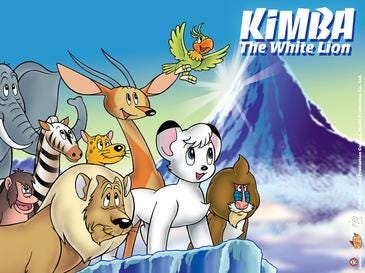
Kimba the White Lion is famous because many people think Disney’s The Lion King … borrowed … its plot and characters. There was even a joke about this in a Simpsons episode. Are the allegations true? Who knows? Maybe the creators saw the show when growing up but didn’t remember it clearly enough to remember that they were taking anything from it. Maybe, like me, they had to watch it while holding the antenna.
Today I learned that this is another series that came from Osamu Tezuka. The original manga is known as Jungle Emperor, and the anime is known as Jungle Emperor Leo.
We Loved Them, Even If Our Parents Didn’t
As young as we were, we knew these shows came from Japan. If the Japanese characters and lip-syncing didn’t clue us in, our parents often griped about “cheap Japanese cartoons.” (As if certain American companies weren’t skimping on animation!) We were part of anime fandom without realizing it.
All these shows are available to view again, along with reboots. You can also find reprints of the manga. So you can rediscover them — or introduce them to new generations. Maybe you’ll realize that the fun adventure shows you loved had lots of hidden layers.
If you like my stories, or if you want to read more stories by authors like me, please click here to upgrade to full membership. This is an affiliate link, meaning I receive a financial incentive for new referrals.