We should rethink our views to communicate more effectively: Lana Del Rey’s recent controversy
An analysis of her post in relation to biases and fallacies, intersectional feminism, language and effective communication

When I first read Lana’s post, I immediately started feeling some kind of anger towards her and a feeling of injustice. But I wasn’t 100% able to eloquently explain why. So I decided to delve into it and analyze it in depth — what’s wrong with her ideas and the way she communicates these. This might help us (and Lana, hopefully) to prevent the same communication mistakes in the future and to ensure that our point won’t get lost in translation.
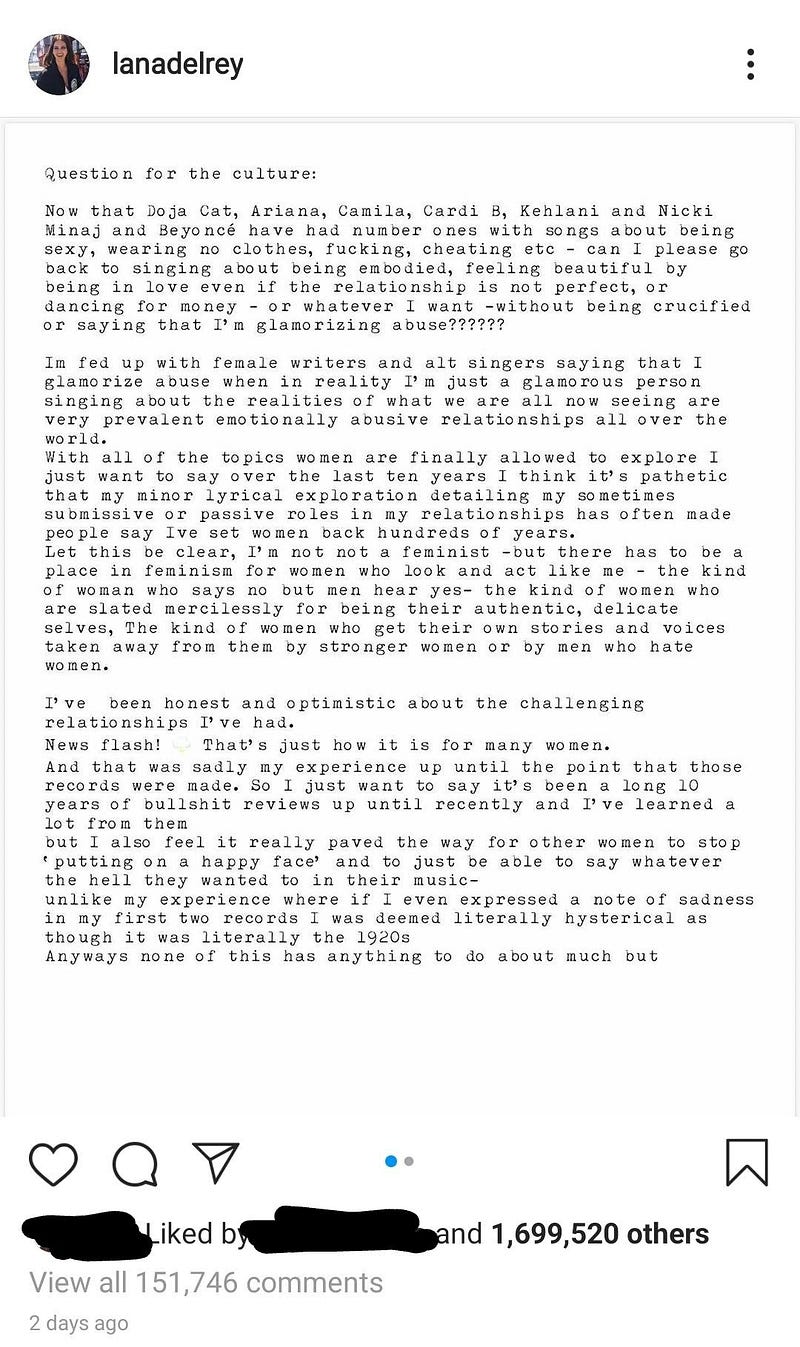
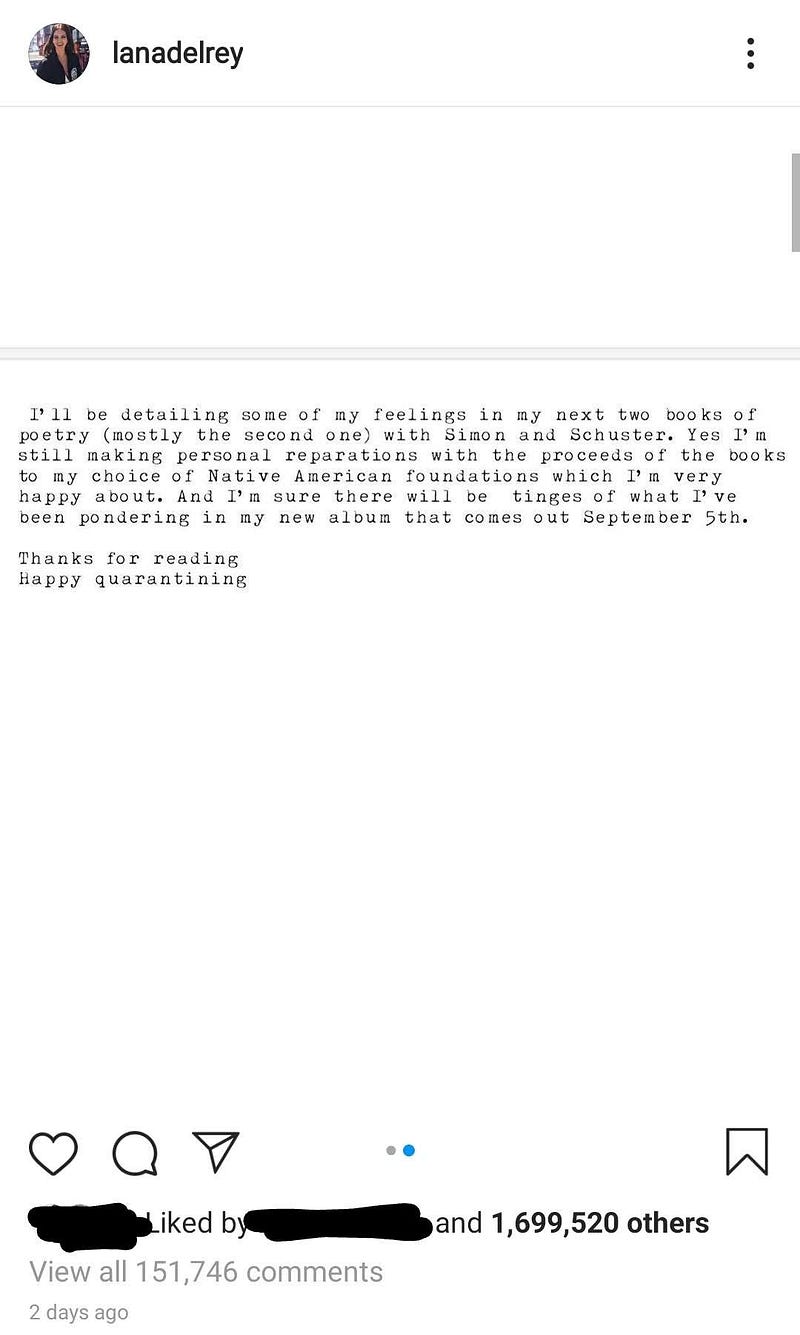
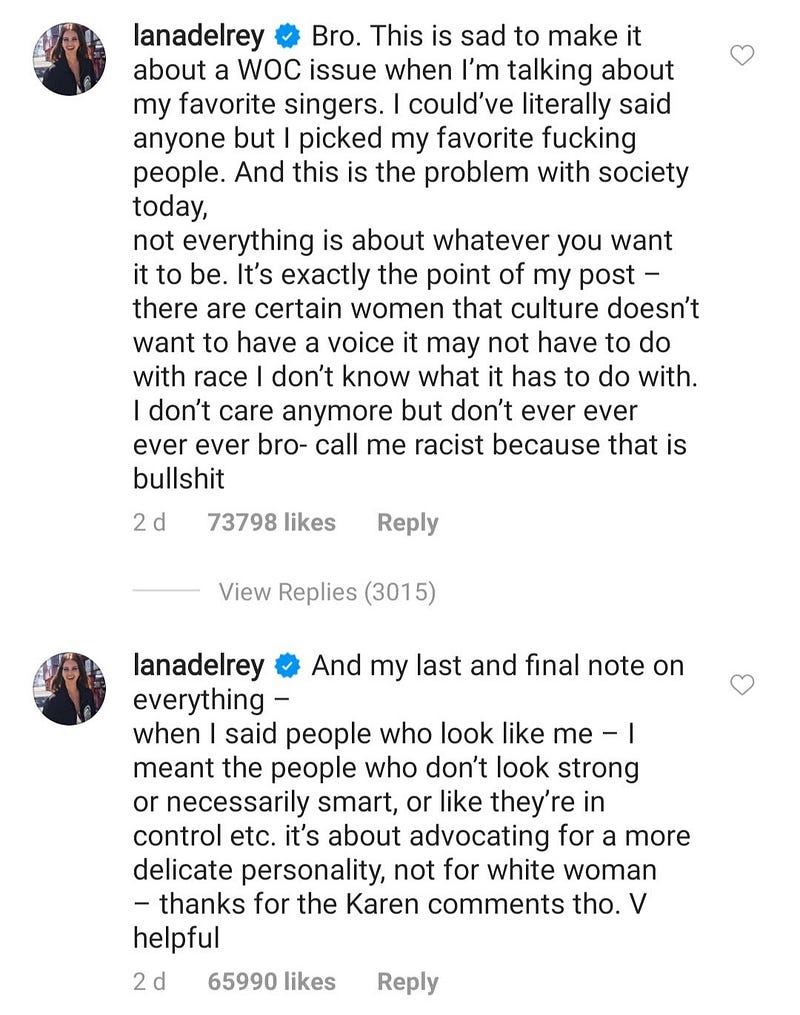
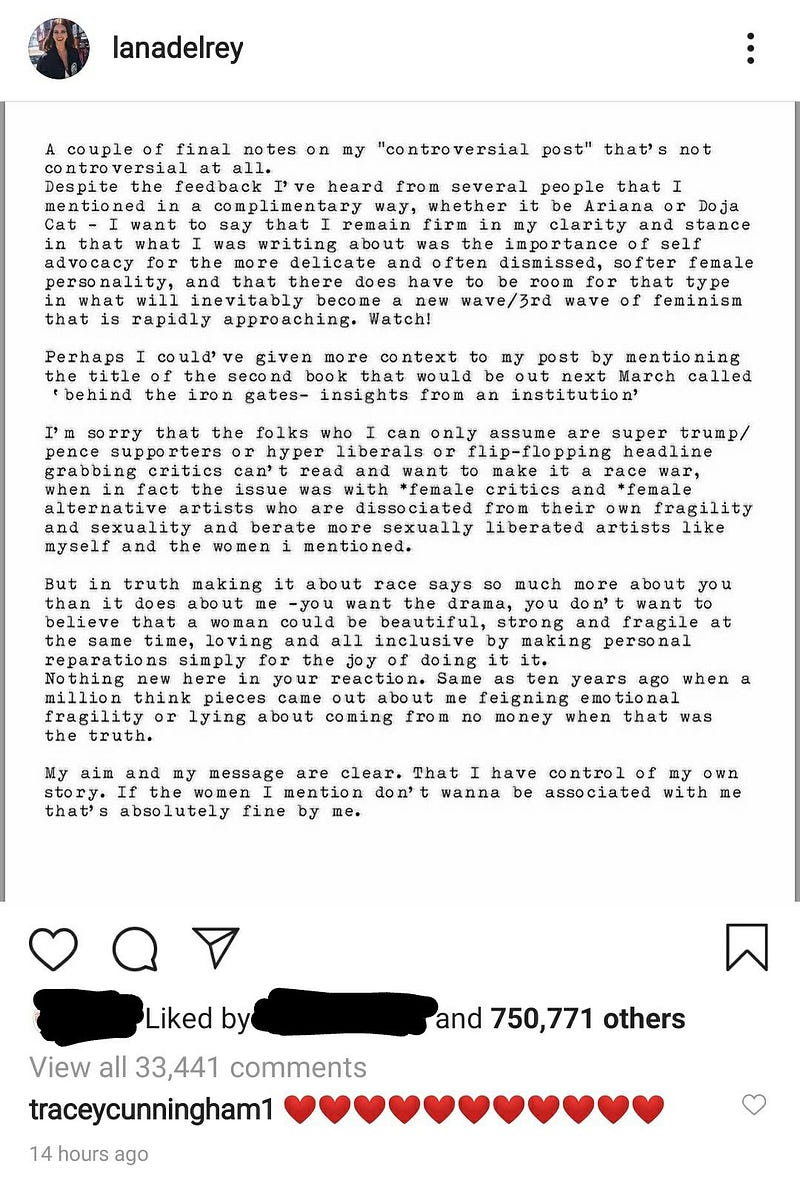
For those who have no idea what I’m talking about; I’ve posted screenshots below of her posts on Instagram this week. In short, she feels her artistry has been unfairly criticized for glamorizing abuse, and calls on people to stop. In doing so, she involves several black female artists (Beyoncé, Nicki Minaj, Cardi B, Doja Cat, Kehlani) and basically says that they have achieved success and landed on #1 while exploring themes of sex and wearing no clothes, while comparing it to hers of feeling beautiful, embodied and in love in an imperfect relationship. She received a lot of critiques, mainly on her striking choice of mostly women of colour. Though I do feel for the fact that Lana has received some hate over time, and I am always hesitant to criticize someone when they have legitimate concerns — this is really not the way to make your point. If she would have changed her ideas and her manner of communication, more people would have seen and understood the point she initially wanted to make and would have been able to empathize with her.
Let’s dive into it.
Biases and fallacies
Lana falls into several biases in her thinking. The first is a confirmation bias. Her initial belief is that the voices of women like her are being silenced. When some of her fans comment positive things, while others criticize her, she is reluctant to take the critiques to heart. She deletes some of the negative comments and takes her fans’ support as reassurance that she is doing the right thing.
The other and more prevalent bias in her posts is the backfire effect. Her beliefs are challenged in the backlash and comments, but she doubles down in the subsequent posts and believes even more strongly. She speaks out on her initial concerns, gets criticized, so her natural conclusion is that women like her are indeed really being silenced. It is taken as another confirmation of her initial belief, even though these were just issues being raised. People are not silencing her point, merely challenging it. Lana is not willing to consider other viewpoints and dismisses the issues and concerns of her critics. She takes no accountability. She feels attacked. She gets defensive. She gets her ego and feelings hurt. She is the unfair victim. And she continues to dig herself further into her hole.
Now on to some of the fallacies she uses in how she argues her point. To prevent having to engage with criticism, she answers with criticism and and personal attacks. Classic ad hominem. She does not address the issue at all, but rather accuses her critics of turning it into a ‘race war’, and being either trump supporters, hyper liberals, or flip-floppers.
She also has personal incredulity — because she is unaware of how something works, she made it out to be like it’s probably not true. She does not understand the concerns of WOC nor how intersectional feminism or microaggressions work, so she quickly dismisses them. And continues on her own point again.
Lastly, she sees a lot of things in the world as black or white. There are only a handful of possibilities — others don’t exist. In reality, it’s way more nuanced than that and it’s reductive of the underlying issues that have been addressed.
Biases and fallacies are fatal to communication. They obscure rational and honest dialogue, and prevent an opportunity to learn from each other, and other viewpoints. It makes it easy to turn it into personal attacks, and distract from the issue at hand. Now, people are focused on the person making the point, and their hurt feelings. Lana’s points that people shouldn’t criticize her artistry, and that women are often silenced are completely lost.
Views on feminism… or any other subject you’re planning to address
Of course this might seem obvious to you all, but apparently it needs to be said for some people. You need to know what you’re talking about — or at least know the basics, and acknowledge your lack of expertise.
In Lana’s case this is her lack of basic feminist knowledge. She states that there should be a place in feminism for women who are ‘delicate’, have their voices taken away, and are often dismissed — with Lana often framed as some kind of dainty and lolita type of figure. She then says that there will be a third wave of feminism that is rapidly approaching. Feminism has historically fought for women like that, and are still fighting for it to this day. By saying ‘there should be a place for…’, she implies that there isn’t, when it is clear that she doesn’t know the fight and premise of feminism. She is not only not acknowledging the history, and the fight behind it, but also using the hard-fought for privilege that her predecessors have granted her.
To make matters worse, she also doesn’t realize that the 3rd wave of feminism has started long ago. The wave of intersectionality, and how race and class play a role. Not only does she not realize it, she actively has beliefs that third-wave feminists fight against. She dismisses the struggles, issues, and voices of the WOC who critique her, and just goes on to say how she is ‘dainty’ and is advocating those types. It is well-known that WOC are often portrayed as not delicate, as angry black women, and as hyper masculine and she excludes this whole group and their fight.
So, don’t make a fool out of yourself when you’re trying to communicate a point and make sure to educate yourself beforehand. Try to make sure that people cannot point out the flaws and critique your points this easily. And if the critique does come, use this as a learning opportunity and as an open dialogue. Use the discussion and newfound knowledge to further your initial point that you wanted to communicate, or adjust it.
Language and communication
Lana has a lot of faults in her choice of words. The first and easiest one to fix is that she uses hostile, provocative and negative language. She uses words like ‘pathetic’ — ‘bullshit’ — ‘fucking’ — ‘race war’. This does not foster understanding from her audience and readers, but rather negative emotion. She also frames things in a negative manner. She writes ‘I am not not a feminist, but…’ using a double negative structure. This has a distinct effect from framing it positively, for example ‘I am a feminist if…’. See the difference it makes?
Implicit language is also key. People receive messages regardless if it is communicated explicitly or not. And everyone should be mindful of it. She puts herself of singing about being embodied and feeling beautiful next to the mentioned women who sing about being sexy and wearing no clothes. The latter is to this day still often criticized. Though she does not mention a judgement or opinion on this, it has a direct implication that she thinks she’s better than them. Sure, maybe she didn’t think that way and it wasn’t her intention — but it is still the implicit message she conveyed. Lana also start off her note by saying ‘now that’ they’ve achieved success, and then states her point and call to action. This also results in an implied message that she deserves this, considering that they’ve achieved success. This ultimately results in a microaggression — a negative message to a target person, the WOC. Make sure to think about the effects and the choice of words wisely.
Lana also continues to be dismissive of the critiques, denying people’s views and issues as invalid. ‘Despite the feedback, I was writing about…’ and ‘[they] want to make it …, when in fact the issue was …’. She ultimately frames her intentions and point of view as a fact and the ultimate truth, unwilling to take in other points of view.
Lastly, and maybe even most importantly, she’s divisive and polarizes people. She stereotypes and puts people in a box, pitting everyone against her in a me vs the world type of way. She puts herself against the women she mentioned. She sets herself apart from the ‘female writers and alt singers’ who criticize her. She puts herself as an outsider of society, in saying ‘this is the problem with society today, not everything is about whatever you want it to be’. She puts herself against her critics, typifying them as trump supporters or hyper liberals.
But all of this has a fix.
Takeaways for more effective communication
We can ensure we communicate our point effectively and make ourselves heard and understood, while fostering understanding and empathy by learning from her mistakes.
First, make sure to keep an open mind to other views, and be mindful of the biases and fallacies that we might fall prey to. Try to analyse whether your reaction
- Is objective
- Is rational
- Has a basis (arguments, facts, etc)
Secondly, make sure to educate yourself on the issues you are planning to address, as well as its history. Be open to receiving more information and views on it. Acknowledge that you don’t have infinite knowledge and there is more to learn about it.
Lastly, use effective language and communication. Don’t use hostile language, but use positive and affirmative language. Frame things in a positive way. Make sure to gather your thoughts and that every word you use has a clear purpose. This helps to prevent any implicit messages. Be ready to take responsibility for your thoughts and try to communicate everything in a clear and explicit manner. Acknowledge the other’s view, instead of trying to convince them that your view is the truth. And most importantly, foster a feeling of unity instead of polarization. Make people relate to you, instead of pitting them against you on the other side. In the end, everyone is the same. Everyone is human. Everyone should be able to relate to each other on some kind of level. Find that level, and make use of it to garner understanding.
I would’ve expected someone who prides herself on being a poet, an artist, a lyricist, to be able to communicate in writing more effectively. She knew, very well, that name dropping would bring attention. She wanted to use this attention to further her point. Unfortunately, her message was lost to many of us due to her biases and fallacies, erroneous views on feminism, and use of language. And no, Lana, this comes not from a “hater”, rather from the bottom of my heart as a former fan of your artistry. Which I’ve completely lost respect for in the end. I hope we can all learn from her mistakes.
Audrey Hmt
💭 Connect with me and follow my future publications
Screenshots of her post and comments