avatarDr. Julian Barkan

Free AI web copilot to create summaries, insights and extended knowledge, download it at here

3716

Abstract

m by comparison.</p><p id="a89e">We can all imagine the taste of McDonald’s fries by closing our eyes. That is likely why we remember a lot of addictive foods. <a href="https://www.sciencedirect.com/science/article/abs/pii/S0306987706003100">Studies</a> have shown that salt can be addictive, especially when a person consumes high levels at an early age. But Consumer Reports also found high levels of other chemicals in Lunchables.</p><h2 id="590d">Would you like a pinch of lead with your lunch?</h2><p id="bca3">While none of the products reviewed contained levels outside of the maximum allowable dose limit (MADL), many exceeded 50% of the daily allowable intake for lead.</p><figure id="5d77"><img src="https://cdn-images-1.readmedium.com/v2/resize:fit:800/1*7i_0jyO3lBCXdZHXbXnTUA.png"><figcaption>From <a href="https://www.consumerreports.org/health/lunch-and-snack-packs/should-you-pack-lunchables-for-your-kids-school-lunch-a1165583878/#loads-of-sodium">Consumer Reports</a></figcaption></figure><p id="ca2f">Eric Boring, PhD is the chemist who led the studies by Consumer Reports. “That’s a relatively high dose of heavy metals, given the small serving sizes of the products, which range from just 2 to 4 ounces,” Boring says.</p><p id="2453">While the meals provide only about 15 percent of the 1,600 daily calories that a typical 8-year-old requires, that small amount of food puts them near the daily maximum limit for lead. If half of the MADL for lead comes from these foods, there’s little room for potential exposure from other foods, drinking water, or the environment.</p><p id="9bab">The <a href="https://www.cdc.gov/nceh/lead/prevention/health-effects.htm#:~:text=Lead%20exposure%20occurs%20when%20a,Slowed%20growth%20and%20development">side effects of lead exposure</a> in kids are well-known:</p><ul><li>Damage to the brain and nervous system</li><li>Slowed growth and development</li><li>Learning and behavior problems</li><li>Hearing and speech problems</li></ul><p id="9fa3">Again, the levels of these products are within legally allowable limits and are considered safe. But there’s clearly a ton of room for improvement. “None of the products exceeded any regulatory limits, but many researchers think those limits are far too permissive, given the emerging research about phthalates harms,” <a href="https://www.consumerreports.org/health/lunch-and-snack-packs/should-you-pack-lunchables-for-your-kids-school-lunch-a1165583878/#loads-of-sodium">Boring</a> says.</p><h2 id="38ea">Don’t trust the ultra-process</h2><p id="746c">When I talk to people in my office about nutrition and food, I always repeat a general rule.</p><p id="e073">Look at the ingredients on the label. If there are a bunch of non-food items, it is ultra-processed garbage. This is the <a href="https://www.ewg.org/foodscores/products/044700024553-LunchablesLunchCombinationsTurkeyCheddarWithCrackersTurkeyCheddarWithCrackers/">ingredient list</a> on a typical Lunchables meal:</p><blockquote id="d646"><p>ROAST WHITE TURKEY — CURED — SMOKE FLAVOR ADDED (WHITE TURKEY, WATER, POTASSIUM LACTATE, CONTAINS LESS THAN 2% OF MODIFIED CORNSTARCH, DEXTROSE, SALT, CARRAGEENAN, SODIUM PHOSPHATES, SODIUM DIACETATE, POTASSIUM SALTS, SODIUM ASCORBATE, NATURAL AND ARTIFICIAL FLAVOR, SODIUM NITRITE, SMOKE FLAVOR); CHEDDAR PASTEURIZED PREPARED CHEESE PRODUCT (MÍLK, WATER, MILKFAT, MILK PROTEIN CONCENTRATE, WHEY, WHEY PROTEIN CONCENTRATE, SODIUM CITRATE, SALT, LACTIC ACID, SORBIC ACID AS A PRÉSERVATIVE, CHEESE CULTURE, OLÉORESIN PAPRIKA [COLOR], ENZYMES, ANNATTO [COLOR], WITH SUNFLOWER LECITHIN ADDED FOR SLICE SEPARATION), CONTAINS: MILK; CRACKERS (ENRICHED FLOUR [WHEAT FLOUR, NIACIN, REDUCED IRON, THIAMINE MONONITRATE,

Options

RIBOFLAVIN, FOLIC ACID], PALM OIL, SUGAR, SALT, BAKING SODA, WHEY [FROM MILK], SOY LECITHIN, NATURAL FLAVOR).</p></blockquote><p id="3756"><a href="https://www.merriam-webster.com/dictionary/food">Webster </a>defines food as “material consisting essentially of protein, carbohydrate, and fat used in the body of an organism to sustain growth, repair, and vital processes and to furnish energy.” There is no question that the above thing may resemble food, but a lot of it is not made of food.</p><p id="2321">They do contain the basic building blocks of food and they do supply energy. But do they sustain growth, repair and vital processes? The study in Consumer Reports argues not.</p><p id="804c" type="7">A 2024 review in the medical journal BMJ, found a strong link between ultra-processed foods and an increased risk of anxiety, depression, cardiovascular disease, obesity, type 2 diabetes, and colorectal cancer. Processed meat is the biggest culprit.</p><p id="52cf">Specifically, it is the nitrates and nitrites used in meat processing. <a href="https://journals.plos.org/plosmedicine/article?id=10.1371/journal.pmed.1004149">Correlations </a>have been shown between elevated type 2 diabetes risk and consumption of processed meats.</p><p id="a027" type="7">Eating just 1.75 ounces of processed meat a day raised the risk of heart disease by 18% in a 2023 analysis. Regular unprocessed red meat only increased the risk by 9%. On top of that, ultra processed foods lead to higher caloric intake given they are so devoid in nutrient density.</p><p id="f1fa">“They have all these components — salty crackers and cheese and salty processed meats — designed to hit all of our pleasure centers and make us want to eat more of them,” says <a href="https://www.consumerreports.org/health/lunch-and-snack-packs/should-you-pack-lunchables-for-your-kids-school-lunch-a1165583878/#loads-of-sodium">Erica Kenney</a>, ScD, an assistant professor of public health nutrition at the Harvard T.H. Chan School of Public Health in Boston.</p><h2 id="06dd">School lunches of the future</h2><p id="1cbb">Solutions are not simple, especially when schools are providing free lunches to students. Costs need to be kept down to provide kids with the calories they need, but where those calories are coming from really needs to be taken more into account.</p><p id="6c82">When I was in graduate school I worked with a program that turned abandoned lots into gardens. We would teach kids about growing food and that changed their appreciation of “yucky veggies.” But there was no processing, just food. We saw amazing results in how their knowledge around food grew and taste preferences changed.</p><p id="0069">Replacing “foods” full of processed junk is a start. <b>Schools should consult with certified nutritionists rather than make contracts with food corporations whose goal is to get them addicted to their product.</b> Our kids deserve better and it starts with what they are eating.</p><p id="bca5">Thank you for reading my story. I wish you a healthy life.</p><div id="c2af" class="link-block"> <a href="https://medium.com/@julbarkan/subscribe"> <div> <div> <h2>Get an email whenever Dr. Julian Barkan publishes.</h2> <div><h3>Get an email whenever Dr. Julian Barkan publishes. By signing up, you will create a Medium account if you don't already…</h3></div> <div><p>medium.com</p></div> </div> <div> <div style="background-image: url(https://miro.readmedium.com/v2/resize:fit:320/0*RWoqdYPeoN1Ft4cg)"></div> </div> </div> </a> </div></article></body>

Public Health

We Needed a Study to Say Lunchables Aren’t Healthy?

Consumer Reports asks USDA to remove Lunchables from schools

Pexels

When I saw the recent headlines about Lunchables, I immediately remembered the taste. I remembered the excitement of opening that package and making my pizza or custom crackers. It was a treat for me as my mom usually packed lunch for me.

Looking back, her food was so much better. But as a kid, we want excitement in our food. So when I was able to convince her to buy me a Lunchables, especially since so many of my friends were eating them, I was stoked.

Knowing what I know now, I am shocked at the type of food kids get at school. For example, why are there soda machines in schools? I know the answer has to do with corporations and money, but still. It’s a school. It’s like having a soda machine in a hospital. That does nothing for health or healing. In the same way, bad foods do nothing to help kids learn or thrive, neither in health or education.

Thankfully, we are becoming more aware of what we are consuming and Consumer Reports just put out a study called “Should You Pack Lunchables for Your Kid’s School Lunch?” As it turns out, you shouldn’t.

The salty truth

First, the obvious. For anyone who reads nutrition labels, a lot of processed foods are high in sodium. And overall we eat way more salt than we need. Americans eat on average about 3,400 mg of sodium per day but the recommended limit is less than 2,300 mg per day, or about one teaspoon of salt.

Too much salt leads to issues with blood pressure. The CDC found that more than 1 in 7 U.S. youth ages 12 to 19 had high blood pressure or elevated blood pressure from 2013-2016. And kids with high sodium intake are about 40 percent more likely to develop hypertension than those who have low-sodium diets. We know that unhealthy kids, more often than not, become unhealthy adults. That is why it is so important to help them make the right choices at an early age.

While the tested Lunchables all fell within the daily limit range (otherwise, they would not be allowed to be sold as food), the amount of sodium ranged from 460–740mg. By comparison, a McDonald’s Happy Meal with six chicken nuggets, fries, and apple slices comes in at 670 mg of sodium by comparison.

We can all imagine the taste of McDonald’s fries by closing our eyes. That is likely why we remember a lot of addictive foods. Studies have shown that salt can be addictive, especially when a person consumes high levels at an early age. But Consumer Reports also found high levels of other chemicals in Lunchables.

Would you like a pinch of lead with your lunch?

While none of the products reviewed contained levels outside of the maximum allowable dose limit (MADL), many exceeded 50% of the daily allowable intake for lead.
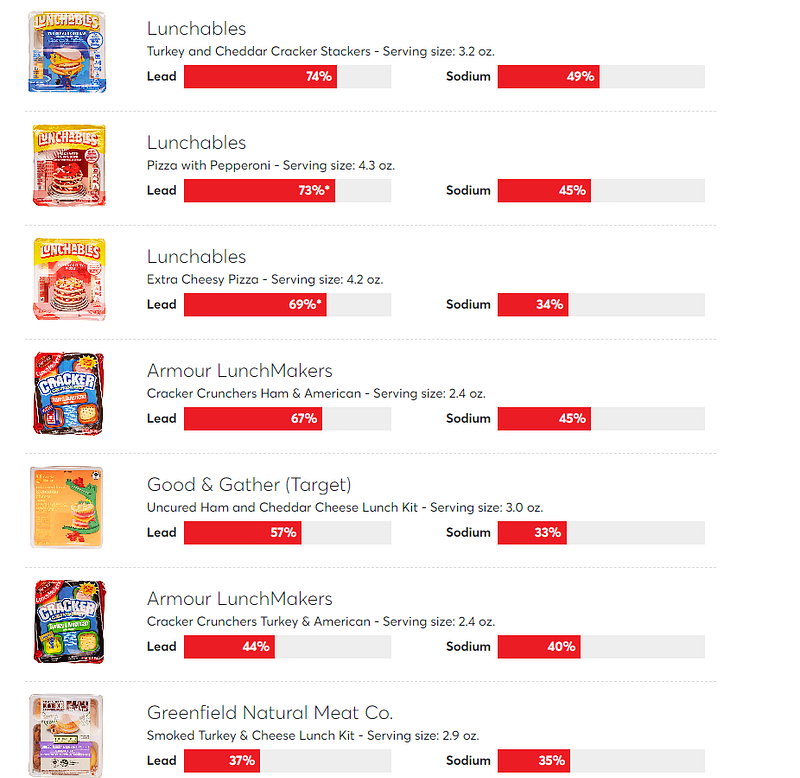
From Consumer Reports

Eric Boring, PhD is the chemist who led the studies by Consumer Reports. “That’s a relatively high dose of heavy metals, given the small serving sizes of the products, which range from just 2 to 4 ounces,” Boring says.

While the meals provide only about 15 percent of the 1,600 daily calories that a typical 8-year-old requires, that small amount of food puts them near the daily maximum limit for lead. If half of the MADL for lead comes from these foods, there’s little room for potential exposure from other foods, drinking water, or the environment.

The side effects of lead exposure in kids are well-known:

  • Damage to the brain and nervous system
  • Slowed growth and development
  • Learning and behavior problems
  • Hearing and speech problems

Again, the levels of these products are within legally allowable limits and are considered safe. But there’s clearly a ton of room for improvement. “None of the products exceeded any regulatory limits, but many researchers think those limits are far too permissive, given the emerging research about phthalates harms,” Boring says.

Don’t trust the ultra-process

When I talk to people in my office about nutrition and food, I always repeat a general rule.

Look at the ingredients on the label. If there are a bunch of non-food items, it is ultra-processed garbage. This is the ingredient list on a typical Lunchables meal:

ROAST WHITE TURKEY — CURED — SMOKE FLAVOR ADDED (WHITE TURKEY, WATER, POTASSIUM LACTATE, CONTAINS LESS THAN 2% OF MODIFIED CORNSTARCH, DEXTROSE, SALT, CARRAGEENAN, SODIUM PHOSPHATES, SODIUM DIACETATE, POTASSIUM SALTS, SODIUM ASCORBATE, NATURAL AND ARTIFICIAL FLAVOR, SODIUM NITRITE, SMOKE FLAVOR); CHEDDAR PASTEURIZED PREPARED CHEESE PRODUCT (MÍLK, WATER, MILKFAT, MILK PROTEIN CONCENTRATE, WHEY, WHEY PROTEIN CONCENTRATE, SODIUM CITRATE, SALT, LACTIC ACID, SORBIC ACID AS A PRÉSERVATIVE, CHEESE CULTURE, OLÉORESIN PAPRIKA [COLOR], ENZYMES, ANNATTO [COLOR], WITH SUNFLOWER LECITHIN ADDED FOR SLICE SEPARATION), CONTAINS: MILK; CRACKERS (ENRICHED FLOUR [WHEAT FLOUR, NIACIN, REDUCED IRON, THIAMINE MONONITRATE, RIBOFLAVIN, FOLIC ACID], PALM OIL, SUGAR, SALT, BAKING SODA, WHEY [FROM MILK], SOY LECITHIN, NATURAL FLAVOR).

Webster defines food as “material consisting essentially of protein, carbohydrate, and fat used in the body of an organism to sustain growth, repair, and vital processes and to furnish energy.” There is no question that the above thing may resemble food, but a lot of it is not made of food.

They do contain the basic building blocks of food and they do supply energy. But do they sustain growth, repair and vital processes? The study in Consumer Reports argues not.

A 2024 review in the medical journal BMJ, found a strong link between ultra-processed foods and an increased risk of anxiety, depression, cardiovascular disease, obesity, type 2 diabetes, and colorectal cancer. Processed meat is the biggest culprit.

Specifically, it is the nitrates and nitrites used in meat processing. Correlations have been shown between elevated type 2 diabetes risk and consumption of processed meats.

Eating just 1.75 ounces of processed meat a day raised the risk of heart disease by 18% in a 2023 analysis. Regular unprocessed red meat only increased the risk by 9%. On top of that, ultra processed foods lead to higher caloric intake given they are so devoid in nutrient density.

“They have all these components — salty crackers and cheese and salty processed meats — designed to hit all of our pleasure centers and make us want to eat more of them,” says Erica Kenney, ScD, an assistant professor of public health nutrition at the Harvard T.H. Chan School of Public Health in Boston.

School lunches of the future

Solutions are not simple, especially when schools are providing free lunches to students. Costs need to be kept down to provide kids with the calories they need, but where those calories are coming from really needs to be taken more into account.

When I was in graduate school I worked with a program that turned abandoned lots into gardens. We would teach kids about growing food and that changed their appreciation of “yucky veggies.” But there was no processing, just food. We saw amazing results in how their knowledge around food grew and taste preferences changed.

Replacing “foods” full of processed junk is a start. Schools should consult with certified nutritionists rather than make contracts with food corporations whose goal is to get them addicted to their product. Our kids deserve better and it starts with what they are eating.

Thank you for reading my story. I wish you a healthy life.

Health
Nutrition
Schools
Children
Food
Recommended from ReadMedium