
We Need to Talk About the Racial Investing Gap
Everyone deserves to have equal opportunities in finance, including women of colour

Investing is a crucial way to build wealth and secure financial future. There are numerous ways people may choose to approach investing: stocks, bonds, high-yield savings accounts, real estate and more. You would expect everyone who has disposable income to consider available investment opportunities. Unfortunately, there is a group of individuals who invest less often than others: women of color. Today we will investigate the reasoning and attempt to find a solution.
Reviewing the numbers: How many women decide to invest?
First of all, let’s look at this financial activity from the gender perspective. Men and women seem to have equal opportunities, yet their investment styles are quite different. What’s painfully different is statistics, according to the SoFi investing platform:
- On average, of those who have recurring deposits, men contribute 48% more than women.
- Men contribute 32% more than women.
- 53% of men choose the most aggressive investment plan, compared to 38% of women.
At the same time, women accomplish particular education- and money-related tasks better than their male counterparts:
- Women pay around $200 per month more on their loans and pay off the loans 10% faster.
- Women earn two-thirds of degrees and half of the masters’ and doctorates.
The existence of the investment gap is evident.
Investment gap starts with a gender pay gap
Payscale.com is reporting that women earn 81 cents for every dollar compared to men. There is the reasoning behind this discrepancy: women stay home to raise children and seek lower paid positions to gain work flexibility so that they can look after their family. However, it explains the gap only up to a certain point — this is where the discrimination comes into play. According to PewResearch.org, “about four-in-ten working women (42%) said they had experienced gender discrimination at work, compared with about two-in-ten men (22%) who said the same.”
The difference in investment strategies: Gender gap
Factors such as education and cultural environment contribute to the gender gap as well. Merril Lynch conducted a survey on women’s financial wellness. Here are the findings:
- “41% of women wish they had invested more of their money.
- The cumulative lifetime earnings gap between men and women at retirement age equals to $1,055,000 (based on earnings from 23 and 65).
- When it comes to managing investments, only about half (52%) of women, say they are confident, compared to 68% of men.”
Acorn recently published statistics about the gender pay gap. It highlights the following differences:
- While admitting the lack of knowledge in investing, only 26% of men cited it as a concern, compared to 37% of women.
- 56% of women admitted to never following the financial markets, compared to 29% of men.
- When asked how much they invested the previous year, 44% of men didn’t invest — much less compared to 57% of women.
- If given $1,000 right now, men would be 2.5 times more likely to invest that money in stocks.
Gender pay gap is worse for people of color
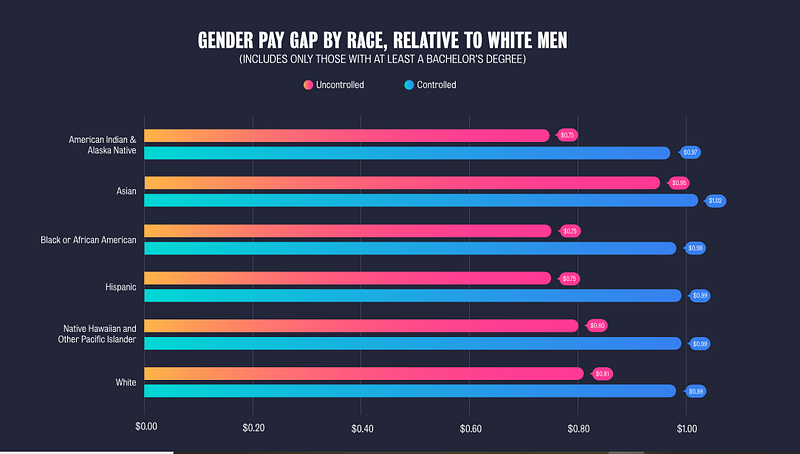
Circling back to Payscale’s report, women of certain ethnic groups earn less than white men and women. American Indian, Alaska Native, Black and Hispanic women end up getting 75 cents for every $1 men make, compared to 81 cents for $1 that white women make.
The graph below demonstrates the gender gap by race — how much women earn compared to men:
How wide is the investment gap compared to caucasian families?
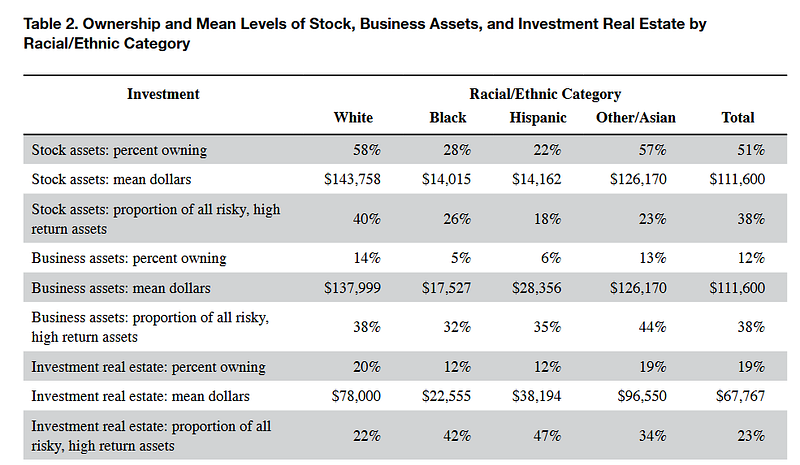
The Association for Financial Counseling and Planning Education researched in 2010 regarding the racial or ethnic differences in high return investment ownership. They found out that “in the 2004 and 2007 Survey of Consumer Finances datasets, 30% of Hispanic, 36% of Black, and 65% of White households had high return investments such as stocks, investment real estate, or private business assets”.
The study has also shown a significant difference between the nature and amount of investments, depending on the family’s racial profile. For instance, 58% of white families owned stocks, compared to only 28% of black and 22% of Hispanic households. The amount of stock investments also varies greatly: white families invested $143,758, black households only had $14,015, and Hispanic homes had $14,162.
Check out the break-down of other investment instruments along with amounts in the table below:
The gap exists in venture capital too
Investing is not the only area signifying gender and race gaps. Start-up funding allocation is an issue as well. According to Entrepreneur.com, only 2.2% of women received Venture Capital funding in 2017, with the total funding amount being $85 billion.
Project Diane reports that “since 2009, black women-led start-ups have raised $289MM in venture/angel funding, with a significant portion of that raised in 2017. This represents .06% of the $424.7 billion in total tech venture funding raised since 2009.”
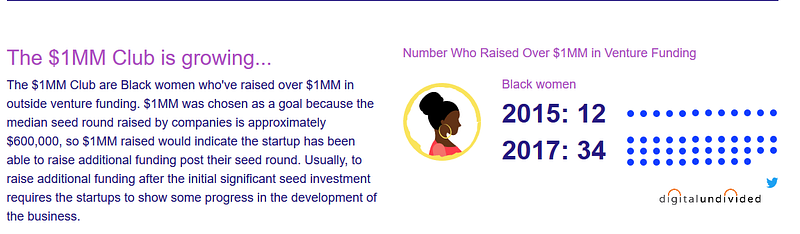
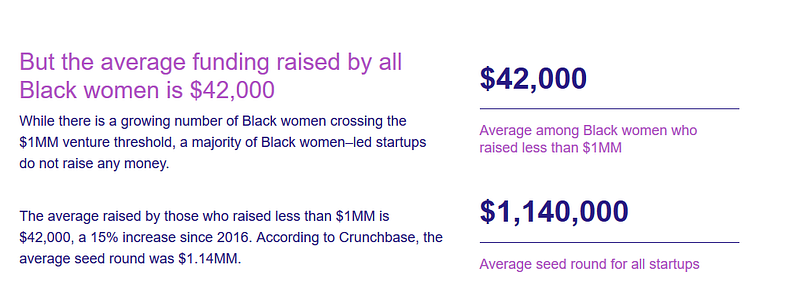
It’s important to note that the One-Million-Club is growing. Having that said, the average funding raised by black women is significantly lower than the overall start-up average:
It is time to make a change
How do we change the narrative and ensure the women of color invest on the same level as females of other ethnic groups?
It starts with education. All women need to understand they should invest, and it will serve them well if they do. We need to minimize the cultural and racial biases, as well as prevent discrimination. Once women believe in their abilities and stop limiting themselves, the statistics will go through a drastic change.
There are several resources you can start with:
- Browngirlsdoinvest.com — an incredible resource, offering numerous programs to teach investment strategies to women of color. They have an investment literacy program, a mentor program, and many other useful materials.
- Peopleofcolorintech.com features a comprehensive guide on Venture Capital, Angel Groups, Incubators, Communities and other groups custom-made for women of color.
- Ellevest.com is a financial Robo-advisor created exclusively for women to invest in their future and retirement, and to build wealth.
- “39 Black Women Investors” and “10 Inspirational Black Women From the Finance Industry” are inspiring articles listing the successful women of color.
- Social Media groups are dedicated to providing women of color with an investment-focused community. Here is an example of such a group: Black Girls Invest.
The world is full of inequality. Life is unfair. But it shouldn’t be this way. It might be difficult to spark a sudden change, but we can get there by taking baby steps. Women need to believe in themselves and start doing, investing and creating. Act now! Change is not easy, but watch what happens years from now. We are building this world for future generations.