
We need to talk about AI and mental health
The scope, benefits and pitfalls of using chat technology for talk therapy

One of my favourite things about the Netflix show A Murder at the End of the World (2023) is the way small details are used to depict our current technological milieu . Whether is the use of Reddit, Alienware laptops, or hacking a wi-fi network by accessing a smart lightbub — this attention to detail roots the narrative (set in a secretive remote retreat patronised by a billionaire). The show was irresistible viewing for a geek like me.
Without giving away too many spoilers, it is interesting that using AI for emotional management turns out to be a key part of solving the identity of the murderer. In my opinion, this was another astute and prescient observation by the show’s creators of our current technological moment.
Broadly, my belief is that “artificial intelligence” was 2023’s Big Tech snakeoil — comparable to earlier scams like NFTs or ebooks that were supposed to be revolutionary technology. There is a popular anecdote about Chinese Premier Zhou Enlai declaring that it is “too soon to tell” the significance of the French Revolution of 1789. My idea about technological revolution cleaves close to Premier Zhou Enlai’s supposed understanding of revolution. It is simply too early to tell if the technology will be revolutionary or not. However, if I was pushed to hazard a guess, then I would bet that one of the most likely applications of Artificial Intelligence chat technology will be in managing mental health.
According to an overview on The National Library of Medicine provided by Francesca Minerva and Alberto Giubilini (in an article titled “Is AI the Future of Mental Healthcare?”), the technology could have the following range of outcomes:
- It could greatly improve outcomes for patients, with relatively small downsides.
- There could be great improvements but the downsides (such as expense or data sharing) will be so significant that it wouldn’t be worth using.
- The best results will be obtained through the collaboration of AI and healthcare practitioners. A study cited by the authors of the paper mentions that ChatGPT’s language was more neutral, empathetic and therefore preferable than that of a human therapist. So, a therapist could use ChatGPT to draft their language and improve the efficacy of their care.
- It might turn out that, despite initial positive outcomes, that humans are actually better overall than AI at performing diagnoses and administering treatments.
Alison Bechdel’s complex graphic novel Are You My Mother? provides a powerful overview of the concept of talk therapy. The novel operates through multiple layers. One thread is autobiographical and details the relationship between Bechdel and her mother. We are flies on the wall as Bechdel goes about her life, falls in and out of relationships (unable to understand her capacity for self-destruction), and suffers from neurotic breakdowns. She also attempts to re-create her mother’s life independent of herself. Another layer is a deep dive into psychoanalytical theory.
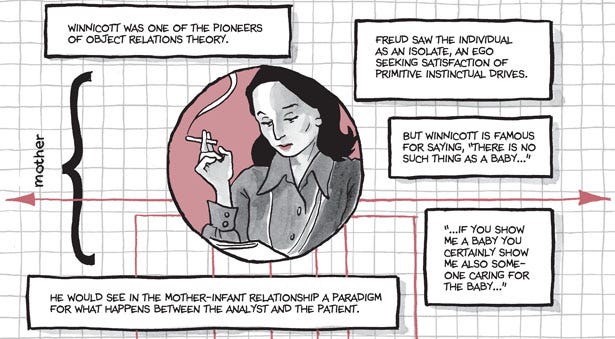
Using biographical research and excerpts from important books, Bechdel sketches the lives of theorists like Donald Winnicott or even Virgina Woolf (who pioneered novels that examined the pysche). Writes Bechdel:
“Winicott was one of the pioneers of the object relations theory. Freud saw the individual as an isolate, an ego seeking satisfaction of primitive instinctual drives. But Winnicott is famous for saying, “There is no such thing as a baby. If you show me a baby you certainly show me also someone caring for the baby.” He would see in the mother-infanct relationship a paradigm for what happens between the analyst and the patient.”
Bechdel also relies heavily on another classic text to theorise the relationship between her childhood and her emotional issues as an adult — Alice Miller’s The Drama of the Gifted Child (1979). To quote Bechdel, again:
“Alice Miller writes that the child who suppresses his own feelings in order to accomodate a parent has been, in a sense, abandoned. ‘Later, when these feelings of being deserted begin to emerge in the analysis of the adult, they are accompanied by such intensity of pain and despair that it is quite clear that these people could not have survived so much pain. That would only have been possible in an empathic, attentive environment, and this they lacked.’ She also says that the mother who requires accommodation from her child is just trying to get what her own mother refused her.”
Alice Miller’s work is controversial for how much emphasis she places on a person’s childhood and their mental makeup. Matt Seaton, writing in The Guardian, says “Alice Miller is to family psychology as Andrea Dworkin was to feminism.” Seaton notes that, “Miller sent an entire generation into therapy when she wrote about how parents scar their children not only by glaring instances of cruelty and physical punishment but also through humiliation, neglect and inattention.” Daphne Merkin, writing in The New York Times (subscription), observed drily that Miller was “the missing link between Freud and Oprah”.
Sigmund Freud (1856–1939), an Austrian nuerologist, is largely credited with founding the “talking cure” movement. According to Pyschology Today:
Psychoanalytic therapy is a form of in-depth talk therapy that aims to bring unconscious or deeply buried thoughts and feelings to the conscious mind so that repressed experiences and emotions, often from childhood, can be brought to the surface and examined. Working together, the therapist and client look at how these early hidden and stifled memories have affected the client’s thinking, behavior, and relationships in adulthood. This therapy is based on Sigmund Freud’s theories about psychoanalysis.
The ideas of Freud found purchase in Vienna, Austria, in the early twentieth century. Freud and other well-known analysts, including Alfred Adler, Carl Jung, and Otto Rank, came together as an organized group, the Wednesday Psychological Society, later known as The Vienna Psychoanalytic Society. The nascent group met in the evenings at the home of Freud to discuss case studies or scientific presentations.
An important part of the Bechdel’s novel highlights her relationship with a series of analysts before she settles and gets obsessed with one. This reveals the complicated nature of trying to get therapy to improve one’s mental health. The novel confirmed to me that seeking help wasn’t just the end of the road, it was only the beginning. Like any kind of complex health issue, it takes some experimentation, and trial and error before a treatment can be found — if at all.
It is this research that I think AI can really help with.
Before the app was made available to the public, I had made some progress towards an objective to make better life decisions. I had started with Daniel Kahneman’s Thinking Fast, Thinking Slow (2011). This led to Mihály Csíkszentmihályi’s work on flow, and like many people in the technology community, I found my way to books like James Clear’s Atomic Habits (2018) or Cal Newport’s Deep Work (2016).
However, it was ChatGPT that connected me to Eckhart Tolle. With Tolle’s ideas about the “pain-body” and using stillness meditation, I finally found solutions that really helped me find focus and escape from negative addiction spirals, such as doom-scrolling. Rather than using ChatGPT as a confidant, I asked it to recommend experts and books on mental health. Of course, the platform always offered any mental health advice with heavy caveats around seeking professional help.
Eckhart Tolle was, at one point, was heavily promoted by Oprah Winfrey. In a way, cable television shows like Oprah Winfrey’s, at the peak of their popularity, acted like mass communion collective talk therapy sessions. This has been atomised through the algorithm predictions of tube videos (a type of highly influential AI that has existed long before 2023), and now, with chat function, one can actually have custom one-to-one chat experiences.
How effective this can be is debatable. In my case, using the AI to research helped me actually the manage the impact of addictive technology and screen time on my life. The broader result and social trends, however, is mixed. As soon as ChatGPT announced customisable versions via Snapchat, one entrepreneuring person quickly offered a chat version of herself via OnlyFans. On the other side, there is one case where an emotionally disturbed individual was “encouraged to kill Queen Elizabeth II” by his AI girlfriend. So, the outcome of this interaction ultimately depends on individuals themselves, their critical reasoning skills and training or how vulnerable and gullible they may be.
Joseph Stiglitz, amongst others, warns in The Scientific American, that failure to regulate AI will result in worsening the divide between the rich and the poor. It makes for worrying reading when reports such as those from The Centre for Social Justice draw a direct correlation between between speech, language, and communication needs (SLCN) and poverty. The report stresses that:
“mental health is a primary concern for the most deprived, contrasting sharply with the general population and highlighting the deep-seated inequalities in mental health access and support.”
The road ahead, as suggested by the earlier quoted report from The National Library of Medicine, forks in two ways. On one hand, AI could help in better provisioning of mental health services, a key requirement to bridge the gap between the rich and the poor. The more likely path, sadly, as economists like Josepth Stiglitz point out, is that the technology will only exacerbate the divide.
There is precious little that talk therapy can do for an individual who is starving to death.


