We need to address hustle culture toxicity: Employees are also human.
The entrepreneurial boom in Silicon Valley laid the foundation for a narrative, a narrative that echoes — ‘Work is worship’ and to be successful and relevant you must work harder than everyone else, You must sacrifice social invitations, family time, health appointments, and as bad as it sounds — your zzz’s. Building an empire doesn’t require sleep, does it?

Rise-and-grind has been glorified all over social media to the point where #grind has over 24 million posts and entrepreneurs, pro athletes, and influencers like Gary Vee constantly motivate us with their 20-hour workdays amassing a following in millions. The billionaire tech CEOs and their folklore have convinced us: Sacrifice your sleep if you want to make a dent in the universe.
But all the honking motivation has brought the rising generation to a dilemma. It’s no secret that today, young workers are facing significant financial pressures — mounting loan debt, higher housing and healthcare costs coupled with lower wages, and on top of that the climate crisis. Gen Z and young millennials are wondering if their elders knew any better when they said, “There’s no success without suffering” — because the feeling is you all hustled like crazy and this is the world we have now.
The narrative suggests you may not be passionate enough if you’re not slogging away. To find a work that seems like play — makes toiling easier. But take this with a pinch of salt: your work is not playing. Even if supposedly, you’ve found your ‘passion’ and landed your dream job, there comes a time when you must confront a grim reality.
Because in today’s cut-throat work culture — you will be navigating demanding deadlines, chasing high targets, often with inadequate compensation, and all the while sacrificing your personal life. Your dream job will turn into a nightmarish ordeal and your once-burning passion? Well, It might just fizzle away into oblivion.
This ‘hustle’ must be carefully examined to see where it leads us.
What does the ‘cult’ of overwork do with toxic productivity?
Hustle culture glorifies working long hours with fewer to no breaks and has simplified the success equation to a linear form:- Effort = Results =Success. Putting talent aside, and being deaf to socioeconomic privileges, it is all about effort. Grind culture can perpetuate the myth that if one is not constantly working, they are not doing enough, often leading to feelings of inadequacy and self-doubt. ‘Hustlers’ hold the following beliefs —
- Longer hours directly correlate with increased productivity
- In material terms, there is always room to achieve and strive for more
We have been sold the glossy American Dream, which is all about the run-after material possessions and prestige. We have come to associate our self-worth with our occupation. From a tender age, society has instilled in us the notion that our value as individuals hinges on our level of productivity. All our lives we are conditioned to be competitive and reach the next milestone, and anything less is seen as an “excuse.”
But for the ones with marginalized identities and social barriers, the concept of ‘grinding hard’ has been a matter of survival — not a status symbol. As a result of the conditionality of self-worth, people have a constant need to do something to maintain it. This is how hustle culture correlates with ‘toxic productivity’ — the perpetual need to be busy, the need to squeeze out every 1440 minutes of the day, sometimes by starting a side hustle, som orng a course that you believe will help you climb the ladder. You feel guilty when you take a breather and you have a complicated relationship with rest.
A study in the Journal of Organizational Behavior showed that people are guilty even when they are sick, they feel guilty in their resting periods and not recuperating quickly enough from their sickness. It shows that the ‘always being on’ mindset has even infiltrated our sick days.
Does working long hours make you more productive?
In the Masters of Scale, podcast with Ariana Huffington (Founder-Huffington Post, CEO-Thrive Global), Reid Hoffman (co-founder of LinkedIn) started the show by saying -
“The real peril lies in believing the myth of the infallible founder. The pervasive tale that you can — and that you must — work inhumanly long hours. Put yourself under enormous stress. Forego sleep, meals, relationships, and life’s other pleasures. And that doing so is a fundamental part of the founder’s journey. I believe that to survive your entrepreneurial journey, you have to learn how to recharge yourself. Call it “balance,” call it “wellness,” and call it “Yin Yang.” Your business and your life depend on it.’’
I couldn’t agree more.
A strong advocate of working inhumanly long hours is none other than the man planning to take us to Mars — Elon Musk, who once declared “Nobody ever changed the world on 40 hours a week”.
I find it appalling that someone who knows rocket science needs help to grasp human science. Founders are often trapped in a fallacy — I am tough and do not need sleep and rest like others, those are for the weak, and as Reid Hoffman pointed out; ‘the myth of the infallible founder’ perpetuates our fast-paced, production-driven world and demands a robot-like efficiency from humans.
Around the turn of the millennium, power shifted to Silicon Valley as tech start-ups became giants like Google and Apple. The tales of founders — portraying themselves as rugged individuals who started from a garage, slept on the factory floors and ignored social & family obligations, soon gained momentum. Enthralled by the bravado of the so-called ‘visionary’ entrepreneur, numerous young individuals were convinced — that engaging in toxic productivity would expedite their journey to becoming the next Steve Jobs.
Nick Srnicek, an American writer and academic sums it up really well when he says —
“Hustle culture ideology says that people are overworking not because they’re economically driven to, but simply because this is the way go-getters get what they want.”
The stories of start-up successes are carefully curated to position the central protagonist as a superhuman. After all, if they could do it, why can’t you? — implicit in this idea is the notion that their achievements are universally replicable, thus fostering an ethos of equitable opportunities. However, I’ve always felt this mindset is inherently flawed as it presumes everyone to be in the same boat, lacking room for basic empathy. For what is the ‘excuse’ for the differently-abled or people with learning difficulties like autism or single parents?
The issue lies in the fact that Hustle Culture primarily caters to able-bodied and privileged individuals. It exhibits a myopic perspective by emphasizing rigid notions of success and a set path. And as we embrace such ideals, we are contributing further to a society that lacks empathy and threatens dystopia.
Slowly but surely, overwork became a cult over the last decade. Hustle Evangelists went all over social media with their bulletproof coffees and 5 AM routines & consequently, its grip was and still is hard to escape, making people romanticize the idea of sheer exhaustion through labor. We should pause and ponder, nevertheless — who are the promoters of this cult? The ones who have brainwashed us into the culture of overworking are — — the managers, owners, and investors.
Despite all the data showing that long hours at work and unattainable workload raise the rate of mistakes and mishaps, and hamper the creativity and productivity of workers, myths about overwork persist because, in a way, it’s convenient for people at the top to convince all the generations to toil away, while they continue to increase their wealth by taking advantage of a rigged global system that allows them to evade their fair share of tax.
Just breathing deeply will not prevent burnout: It’s an occupational phenomenon.
‘Crony capitalism’ as they say, hasn’t just polluted our natural environment but its toxicity spreads to our work environments as well. When corporate greed takes over, people are often treated as mere resources to be exploited, the years of the pandemic made it clear that technology is a double-edged sword. By making us available 24 x 7, the already blurry work-life boundary has been further eroded. There is no such thing as a traditional 9–5, the professional chat group has given access to your boss to send you work-related messages at inconvenient times.
‘Going above and beyond’ the typical job description, is what most companies today expect from a potential candidate. That’s a norm and the hustler — someone who works late into the night, through weekends, and shows up to the office no matter what. Now I am not against the idea of going the extra mile occasionally and having a solid work ethic but what is disheartening is that numerous employees today are gaslighted by their bosses in the name of ‘professional duty’. The majority of workers are guilt-tripped for taking time off for rest or spending time with their families, and this applies even to those with good work records.
Our current work culture is such that we have to defend our right to rest. As employees in the contemporary capitalist world — we are programmed to say ‘YES’ to everything at any time of the day. Refusing to comply with the orders becomes challenging as it could mean you lose your chances of promotion or worse — being labeled as a slacker. Therefore, ‘going above and beyond’ becomes the benchmark of being a good employee, even if it borders on extremism.
This extremism is deeply embedded in us — especially in the Asian work culture. In Japan, there is literally a term ‘Karoshi’, meaning death by overwork, and as per claims, this phenomenon takes thousands of lives every year in the country. When I talk about my motherland India — the most populous country in the world today, we aren’t far behind Japan. Here’s the thing — we have got 1.3 billion people here, all trying to get their slice of the pie which creates a scarcity mindset that permeates everything we do. We’re always on edge, working grueling hours is the norm here and there is no such thing as ‘overtime pay’ because we’re constantly riddled with the anxiety of being replaceable.
And let me tell you about our corporate culture, It’s apathetic. This became painfully clear during the second wave of the pandemic; when on the one hand, people were dying in alarming numbers, and on the other hand, some employers were forcing physical attendance in offices. They had no problem breaking lockdown protocols but didn’t show a slight care about their employees’ well-being.
This ‘go-hard or go-home’ philosophy adopted in our workplaces has implications. Personnel are kept in a fight or flight mode, which triggers stress hormones such as adrenaline and cortisol. Some folks would even carry their stress like a badge of honor until they reach a place of unbearable exhaustion — we call it ‘burnout’.
The World Health Organization (WHO) has officially recognized burnout as an ‘occupational phenomenon’. According to WHO, “Burnout is a syndrome conceptualized as resulting from chronic workplace stress that has not been successfully managed.” Further, the organization adds that — our occupations solely drive burnout phenomena.
Having said that, what is the cure? From ‘taking better care of yourself’ to ‘eating healthy’ we are often advised for individual interventions to treat burnout. For instance, this article from the New York Times suggests practicing deep breathing, finding hobbies, and finding humor in daily life — as a cure.
However, the essay identifies unrealistic deadlines, unpredictable schedules, and responsibilities beyond one’s initial job description as common work stressors. So, I think it’s more sensible to say that we need a paradigm shift in our work culture because it’s not always our inability to handle stress. But the need of the hour is empathetic leaders, not another yoga class, not another meditation app, and not another fancy technique like the Pomodoro.
Generation Z: Slackers or Rebels with a Cause?
Often dubbed as a purposeless, weak, lazy, and entitled generation — the people born between the mid-90s and 2010, are creating heated debates around our current structures of work, & this paves the way for new buzzwords such as ‘Quiet Quitting’, ‘Bare Minimum Mondays’ deriving out of tick-tock viral trends to becoming hot potatoes on mainstream media channels — where we saw our corporate leaders panicking, wrestling and outrightly dissing any ideas of change around our current state of work.
Shortly after the ‘Great Resignation’ in 2022, we saw the emergence of Quiet Quitting becoming a movement in America, sparking discussions like — Is it anti-work or an end-of-hustle culture? From my perspective as a young millennial, I can provide some insight.
As I understand it — Quiet Quitting signifies a refusal to go the extra mile and put in excessive effort without appropriate remuneration or compensation. So technically, one is not quitting their job but they are indeed ‘acting their wage’. The quiet quitter simply follows the job description by not answering emails in the late evenings, working on weekends, or working beyond the agreed business hours.
But the term is quite a misnomer and workers who take part in this movement are facing ridicule, often being described as ‘disengaged’ workers and villainized as people who are not ‘enthusiastic’ about their jobs. The mere act of setting healthy boundaries didn’t go well and the commentary in major publications felt a bit out of place, along the lines of — “doing less at work for having a work-life balance.” It was anti-worker, putting all the blame on the workers’ feet without interrogating as to why exactly the bosses’ were owed those extra hours.
So, The question is — what is the rising generation trying to achieve? Are we against the premise of hard work or is it something else set afoot — a resentment against the current work culture? The answer can be found by looking at how young workers are voicing their sentiments on social media platforms:
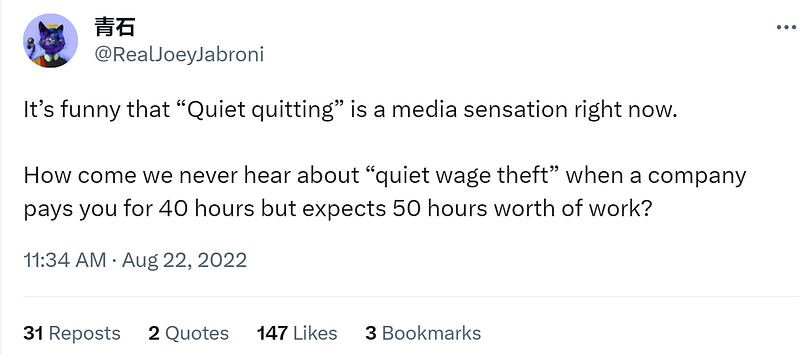
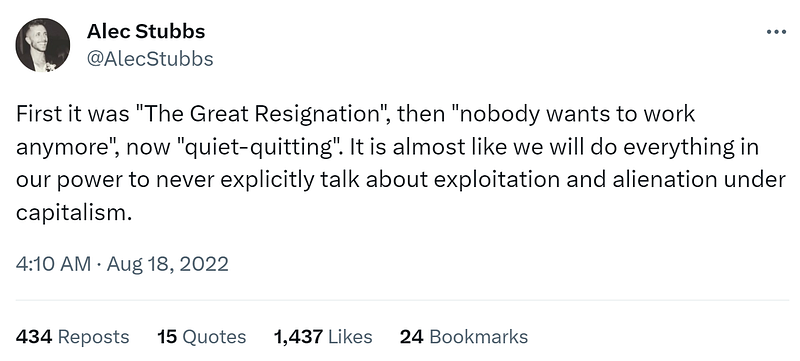
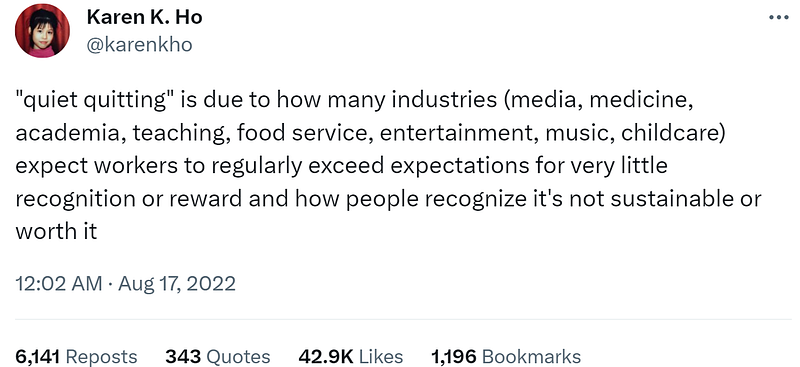
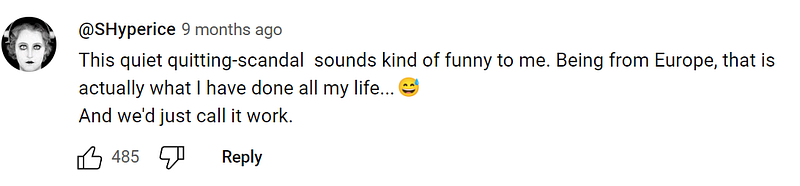
Meanwhile, European workers are finding it hilarious! For them, seeing such a negative term for — ‘Just doing your job’ is unusual. Looking carefully, we see the same sentiments echoed everywhere:
Why should I work 50 hours when they are only paying me for 40?
Why should ‘grind must go on’ when I am not getting a fair share of the pie?
Why should I ‘hustle hard’ when the wage rise never keeps up with inflation?
The many WHYs elucidate that the Quiet Quitting phenomenon has much less to do with ‘work-life balance’ but is a direct response to the long-standing, unfair power and wealth dynamics that have been exploiting salaried employees for decades. Younger millennials and Gen Z can pierce through all the facades of buzzwords like ‘one big family’ and ceaseless motivation to grind, recognizing that these are often used to conceal the unreasonable demands set by employers.
We don’t subscribe to the ‘CULT’ because given the current state of the world, with insane income and wealth differences, it’s not unreasonable to think that the constant doses of ‘push harder’ motivation coming from those in charge are a way to control us. It’s a con trick indeed because rather than acknowledging the need for structural changes and taking collective action towards changing the rules of a rigged game that benefits only a certain segment, it puts workers against workers.
Young workers are often labeled ‘greedy’ or ‘transactional’ because they ask for a livable wage. Yet, global data reveals greed’s true face and who embodies it —
A recent study, published by the non-governmental organization Oxfam International showed a stark contrast between top executives and workers’ compensation. The study showed that the top executives in India earn in just four hours what an average worker earns in a year. The study also revealed, that even as workers faced job losses and pay cuts amid the pandemic, the top-paid CEOs across four countries enjoyed a 9 percent pay hike.
As per a report by Business Insider India, even during the pandemic year corporate pretax profits grew by record trillions; but rather than giving a fair share to the customers and employees, billions of money went back to the shareholders through stock investments. An interesting study by the Economic Policy Institute confirms this point; it states that the productivity-pay gap in the U.S. has significantly increased since 1979. The report further remarks —
“The growing wedge between productivity and typical workers’ pay is income going everywhere but the paychecks of the bottom 80% of workers.”
And so, we conclude that the ‘work hard’ tall tales are serving our managers, and those perched at the top of the pyramid, but not us. Based on our observations, when people go ‘above and beyond’ at work, they are rewarded with — more work, but the annual raise doesn’t acknowledge their extra efforts. While ‘hustlers’ receive — more work, no incentives, and just that, thankless employers get free labor.
The millennials grew up with the idea of a ‘dream job’. Their parents/mentors raised them with the belief that good grades and extra-curricular overachievements would lead them to a career that fulfills their passions, monetarily rewards them, and allows them to retire peacefully with enough security. What they found instead was — meaningless drudgery, fine-tuning themselves with workplace politics, grappling to meet a shiny but often superficial company’s criteria of ‘culture fit’ and then being a part of all the not-so-optional nonsense meetings or the pizza parties or the post-work drinks to conform with the culture.
Managers are constantly questioning whether or not the workers will commit to their work, but when have they taken accountability for their incompetence? They have failed to create proper incentive structures for the ‘hard workers’ and they have failed young college grads as well. While they are frequently found complaining about young workers’ lack of skills and finger-pointing college education, how many of us will credit our job expertise or skills to our managers?
Even after keeping up with the above scenario, complying with the forced mingling and forced laughter in the ‘not-so-happy’ hours, workers find themselves expendable. Is there such a thing as ‘job security’ in today’s world?
The callousness with which personnel has been fired in 2023 tech space — left, right and center tells us that at the snap of a finger, thousands of workers can be displaced. But as an employee, you must gracefully leave, without ‘burning bridges’. As Elizabeth Spires states in this post —
“Perhaps the most appalling aspect of termination by email is the asymmetry between what corporations expect of their workers and how they treat them in return.”
Conclusion
The central question at hand is whether the era of hustle is coming to an end. The answer is NO; hustle culture is not disappearing but rather undergoing an evolution. It’s a rebranding phase of ‘the hustle’ where younger generations are embracing the idea that they can strike a balance between their work ethic and personal life. It’s 2023 and by this time everyone is familiar with the term “GIG economy,” well, a ton of Zoomers are all in, and they’re all about flexibility and grabbing different experiences and skills.
And here’s the kicker — data on Gen Z workers reveal that they highly value authenticity and transparency. They want jobs and companies that match their core values, especially when it comes to being open & genuine. Their motto is ‘Walk The Talk’, and their employers are expected to follow suit. Also, this cohort is the most pro-union generation alive today, according to the Center of American Progress. Whether it was Black Lives Matter, climate change, or abortion rights, the centennials have been at the forefront, on and off social media, always standing in solidarity for important global issues and loud enough to create seismic shifts.
This implies, that instead of going headfirst into the usual rat race, the ‘entitled’ ones are paving their way. They focus on building skills, finding meaningful work, being socially and environmentally aware, and supporting mental well-being. Money isn’t everything for them, they are tossing aside the traditional notions of success. The radical voice within us urges us to shake the paradigm of capitalism, which is exploitative and unsustainable, in favor of fairer, socialist foundations. Moreover, the idea of making limitless sacrifices, so that one could enjoy certain rewards in an unspecified future — seems to be a hoax, especially with the looming climate catastrophe that could disrupt all our plans before we ever reach that point.
It’s time to call the shots. It’s time to initiate a profound cultural transformation and redefine our version of the hustle. There is a better way to work — one that does not reduce human beings to the level of a disposable unit, one that is sustainable, and one that values our humanity over our economic capability.


