
Social Justice & Human Rights
We Need a Materialist Approach to Fighting Racism
On the politics of defining — and resisting — antisemitism
Since the story has been boosted and may be seen widely, I am inserting here a call for donations for Palestinians in Gaza. You can donate directly to a fundraiser I set up with Rebuilding Alliance, which has a strong on the ground presence in Gaza: Rebuilding Alliance (givelively.org) and has provided hot meals for many families already. Also consider donating to UNRWA or Medical Aid for Palestinians .
During the First Intifada (1987–1993), Palestinian artist Sliman Mansour began depicting the erosion of Palestine’s borders by the Israeli military occupation.
Palestinian artists were engaged in a boycott of Israeli goods, and Mansour only had access to local materials that could be accessed without trade with Israel: wood, leather, mud, henna, natural dyes, and found objects.
From a mixture of wood, mud, and natural dyes, he produced a three-dimensional image of Palestine, which he called a Shrinking Object. Viewed in three dimensions, Mansour’s frame increases in size as Palestine recedes from view.
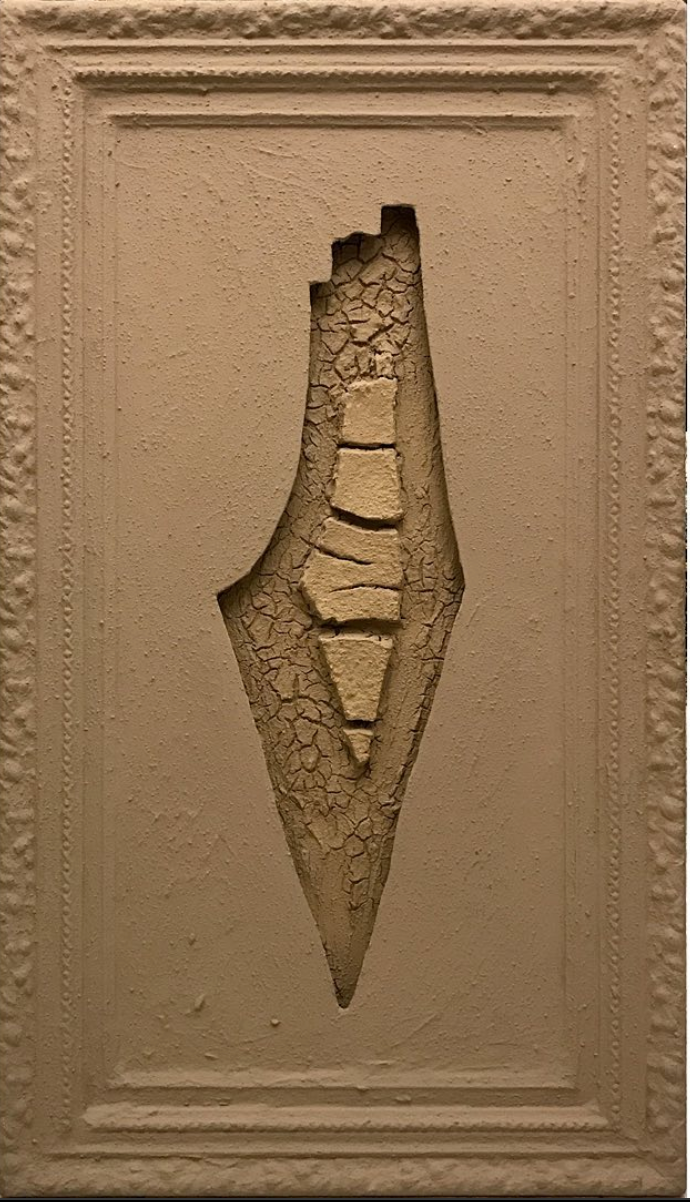
Although it was created in 1996, the image of a shrinking Palestine has become even more resonant today. In the intervening decades, the borders of Palestine have receded further. They have been overtaken by hundreds of Israeli settlements that have effectively erased the border between Palestine and Israel and rendered the concept of a two-state solution obsolete.
I chose “Shrinking Object” as the cover for my book, Erasing Palestine. The image perfectly captures the parallel between the erasure of Palestinian land by the expanding settlement regime and the silencing of Palestinian activism across Europe and North America.
I came to know the settlement regime first-hand in 2011 and 2012 as a postdoctoral fellow at the Van Leer Jerusalem Institute and as a resident of the city of Bethlehem in the West Bank. Six years later, my life was changed forever by the silencing of pro-Palestine activism in the UK.
My book tells the story of how and why I found myself at the epicentre of the UK’s first major conflict over the definition of antisemitism and the censorship of Israel-critical speech.
Checkpoint regime
In 2017, an article I wrote while residing in Bethlehem five years earlier came under scrutiny by an Israeli-British student of mine at the University of Bristol. Entitled Beyond Antisemitism, the article documented the apartheid that I witnessed while living in Palestine and commuting to my place of work in Jerusalem.
The workers alongside whom I stood day after day at Checkpoint 300 during my commute from Bethlehem to Jerusalem waited patiently but with ever-mounting frustration. As dawn extended into early morning, the lines grew exponentially.
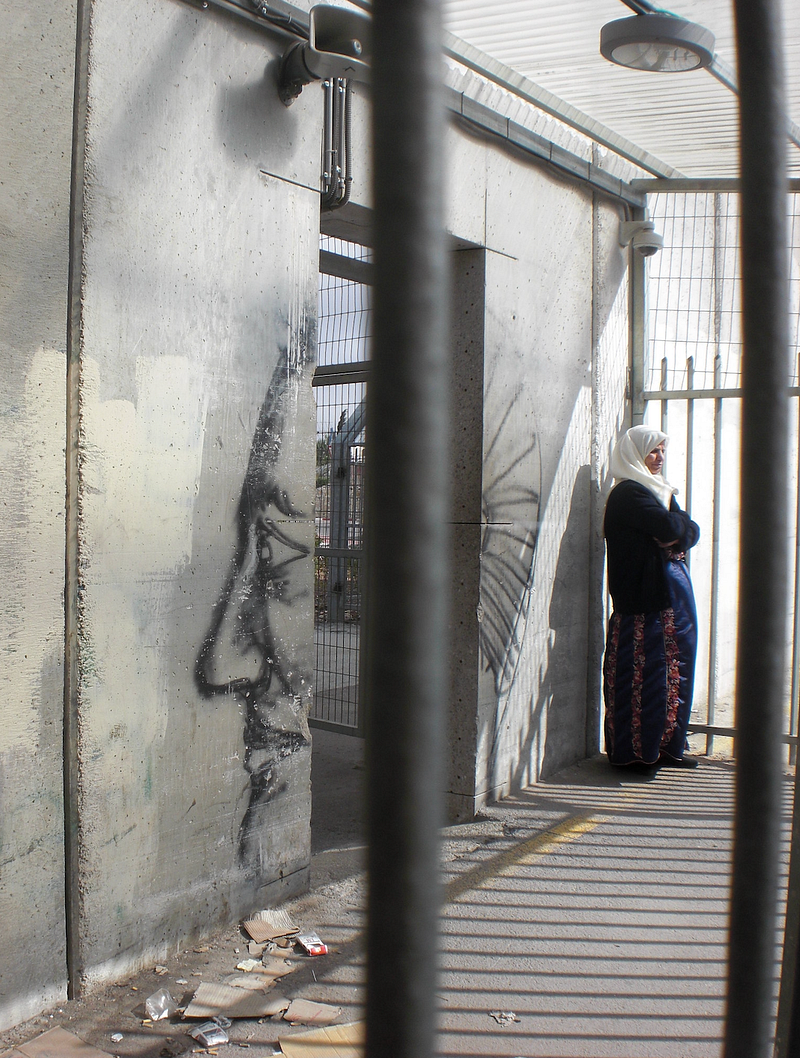
Yet the aisles remained closed. Soldiers stood poised and armed, making no effort to reduce the workers’ waiting time. Delays at checkpoints like these, which bisect the West Bank, wreak havoc on Palestinians’ lives.
Even though the lateness is beyond their control, workers who must pass through these checkpoints risk losing their jobs if they cannot arrive at work on time.
More than once during a year of commuting back and forth, I observed the beginnings of a riot as the workers, tired of waiting in queues that had been motionless for an hour, began to shout. Israeli soldiers would mount the platforms perched high above the ground, point their guns at the crowd, and yell at them to shut up.
Such riots were regular occurrences. The situation has significantly worsened in the years since my departure as the checkpoint regime has expanded along with the growth of the settlements.
Palestinian workers have been crushed to death while waiting at Checkpoint 300. Women have given birth — and their newborn babies have died — while stuck at checkpoints. Palestinians in need of urgent medical care have also died at checkpoints because they could not reach the hospital in time.
The IHRA definition of antisemitism
Amid Israel’s erasure and mutilation of Palestinian land, writers and scholars outside Palestine have become more vocal in criticising the occupation. Increasingly, outspoken academics are targeted by pro-Israel groups that have developed a powerful set of tools for silencing Israel-critical speech. I was no exception.
By the time I came under attack in 2017, US-based academics, including Steven Salaita, had already lost their jobs due to their criticism of Israel.
But what happened to me in 2017 had never happened before in a British university. The accusation of antisemitism was familiar, but the means through which it was assessed were not.
Viewed historically, the university’s response cannot be separated from the fact that, just a few months earlier, the UK government under the leadership of Theresa May had made Britain the first country in the world to adopt the International Holocaust Remembrance Alliance (IHRA) definition of antisemitism.
While the accusation of antisemitism levied against my article was not particularly unique, the university’s application of the IHRA definition set a new precedent for the crackdown on Palestinian activism.
Since then, in the wake of the campaign against Jeremy Corbyn and the controversy over antisemitism in the Labour Party, the so-called IHRA definition has become almost a household word for anyone who is engaged with Palestine or with antisemitism.
But, at the time when I became a target of the definition’s dangerous conflation of Israel-critical speech with antisemitism, it was virtually unknown.
What stands in the way of the fight against antisemitic racism
My book tells the story of how and why the IHRA definition came to be accepted within British universities. I consider the consequences of these adoptions for free speech and Palestinian activism. Writing it has led me to reflect on what antisemitism — which I think is better described as antisemitic racism — actually is and what we can do about it.
Arriving at a more precise and practical understanding of antisemitic racism is crucial for combatting antisemitism as well as for promoting justice for Palestinians and Israelis.
Increasingly in the US and the UK, Palestinian and pro-Palestine activists find their energies consumed by defending themselves against allegations of antisemitism. Such attacks directly limit their ability to act for Palestinian human rights.
The most recent attack on the Palestine movement, embodied in the Economic Activity of Public Bodies bill that is making its way through the UK parliament, will prevent public bodies from divesting from Israel and its illegal settlements. The bill passed the House of Commons on 10 January 2024 and is currently being considered by the House of Lords. If the House of Lords consents, it will become law within the UK.
Pushing back against such legislation is especially challenging due to the taboo over criticism of Israel reinforced by the IHRA definition. In order to overcome these barriers, we desperately need a better understanding of what antisemitic racism is and how we can fight it.
Materialist critique
In my book, I introduce a materialist critique of antisemitism that is grounded in the lived experience of racism across centuries and which rejects the IHRA definition as a legacy of imperialism.
The materialist critique of antisemitic racism is intersectional: it examines the cumulative effect of antisemitism across race, class and gender.
Antisemitic racism, like anti-Black racism, runs deeper than mere individual prejudice. It has little to do with one’s position on Israel. Loving Israel does not make someone immune from antisemitic racism any more than criticising Israel implies hatred of Jews.
All states are legitimate targets of criticism. The right to exist belongs to people, not to any state.
These ideas were first introduced by the maverick Jewish Trotskyite Abram Leon (1918–1944). Leon was a Belgian journalist and revolutionary who wrote his masterpiece, The Jewish Question, under Nazi occupation shortly before being murdered in Auschwitz.
Unlike the IHRA definition, which locates antisemitism in what we say about Israel, Leon’s materialist approach to antisemitic racism recognises the socio-economic roots of the marginalisation of the Jews throughout history.
Leon understood that antisemitic racism is in its most lethal form systemic rather than a semiconscious residue in the minds of individuals.
Faced with the annihilation of the Jewish people, Leon perceived that racism always relates to power, and that the struggle against it requires a radical political transformation that seeks equality for everyone.
Much like the Prevent legislation, which has had a toxic impact on free speech and Muslim lives within the UK, the IHRA definition of antisemitism implicitly criminalises points of view.
Some proponents of the definition reject this charge by arguing that it is not a law, but many IHRA proponents have aimed to give the definition legal status.
Whether or not the definition has legal standing, no one can deny that in practice it has been granted a quasi-legal status. The rhetorical design of the definition creates a moving target, so that any ideology that is hostile to Israeli nationalism runs the risk of being seen as antisemitic.
Structural inequality
The IHRA definition of antisemitism understands anti-Jewish prejudice as a phenomenon that is reducible to a mental attitude rather than an entrenched way of thinking rooted in material conditions.
From this follows the belief that a simple change of attitude can eradicate prejudice. In addition to being naive and unrealistic, such an approach to fighting racism inevitably infringes on free speech due to its focus on ideas and attitudes rather than actions.
Since most prejudice is unconscious, no deeply entrenched form of racism can be overcome simply by a change of mind or an alteration of rhetoric. If we really want to understand where racism comes from and fight against it, we need to look at the deep structures that create social inequality.
The definitional turn that has shaped much recent discussion around antisemitism and other racisms distracts us from racism’s materialist foundations. Proponents of the IHRA definition prefer to isolate antisemitism from anti-Black racism and Islamophobia.
But antisemitism, like anti-Black racism and Islamophobia, is about much more than hate. It is rooted in structural inequality and is perpetuated by those who benefit from injustice.
Throughout history, Jews have been targeted by people with a vested interest in exploiting them. Now, in the 21st century, more than one Palestinian has observed that “Palestinians are the Jews of the Arab world.”
A materialist critique of antisemitism will strengthen the struggle against anti-Jewish racism while advancing Palestinian liberation.
Racism is always about power and is perpetuated by those who benefit from injustice. It will only be eradicated through a radical political transformation that guarantees equality for everyone
For more reflections on Palestinian liberation and the fight against antisemitism, see my list:
Also, you might be interested in this video, produced by Al Jazeera, in which I discuss the role of free speech in Palestine activism.


