
We Must Stop Gauging Health by Body Weight
Our obsession with the scale is bad medicine
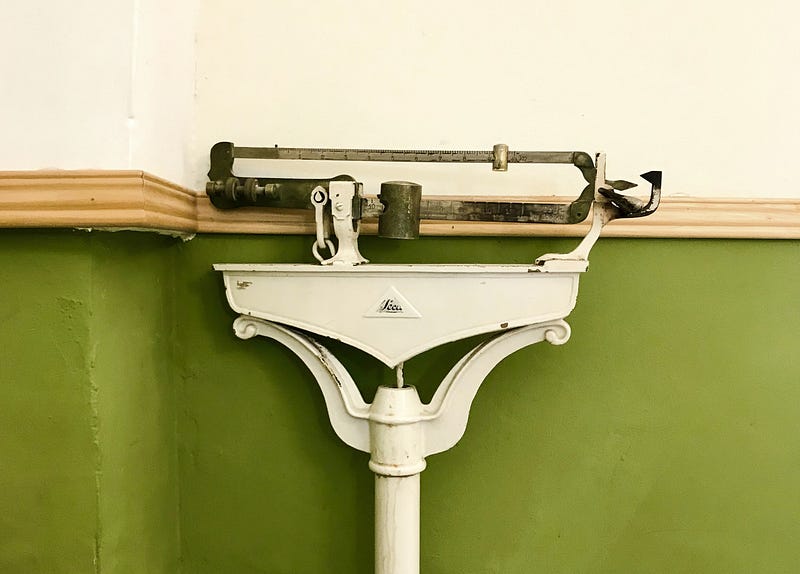
Stepping on the scale at the doctor’s office is no one’s idea of a good time. In all the years I’ve worked in healthcare, I’ve seen a lot of responses: Some people take a deep breath and steel themselves. Some people look away. Some crack jokes.
They take off their shoes. Sometimes they take off their socks, sweaters, or scarves, too. They ask to go to the bathroom first. I’ve even seen people spit out their gum.
Why? To try to be lighter, of course.
We’re obsessed with weight. From medical visits to magazines, the number on the scale has taken on outsized importance. But this is harmful to many people and scientifically dubious.
Weight and health are related, but not as clearly and directly as we pretend they are.
It’s time to do better.
The medical establishment has a weight problem
We weigh people at most medical visits because weight is easy to measure, not because it’s a good marker for health. It’s a proxy for other risk factors, and a pretty poor one, at that.
What if we just. . . stopped weighing people? Imagine if we reserved measuring weight for clinical contexts where it’s medically relevant. Advocates for the Health At Every Size Approach have been saying this for years. Now that the science is clear, though, the message is starting to catch on.
The American Medical Association (AMA) recently called for doctors to stop leaning on body mass index (BMI) as a key health measure. BMI is calculated from weight and height: it’s weight in kilograms divided by the square of height in meters. It has been used for decades to define overweight and obesity, despite its significant limitations.
The shortcomings of the BMI aren’t exactly news. Some healthcare providers and patients are keenly aware of the problems created by medical weight bias. Now that groups like the AMA are calling for change, though, more doctors will likely catch up.
The AMA isn’t known for cutting-edge progressivism. It’s a big, slow-moving, mainstream organization, and as such, tends to err on the side of conservatism and caution. So when the AMA pivots on an established issue like weight, it’s a good indication that the evidence is undeniable.
The establishment has left the chat. BMI is out. There are better ways to identify and treat health risks.
The BMI stinks
The BMI was created to study population-level changes in average body mass, not to assess individual people’s health. Nevertheless, it has been widely used to screen and diagnose individual patients even though it was never properly validated in diverse populations.
That means Black people and white people, women and men, old people and young people, and athletes and sedentary people are all assessed using the same measure and the same standards, even though the boundaries of “healthy” were defined in a homogeneous, predominately white population. That’s a big, sometimes dangerous and even life-threatening problem.
BMI isn’t even a meaningful health metric for the people it was based on, as a new study suggests. The science doesn’t support a causal relationship between BMI and mortality for individuals. “There is no clear increase in all-cause mortality across a range of traditionally normal and overweight BMI ranges,” the researchers said in a statement. And the findings held across various age and racial groups. As for the relationship with other outcomes, the jury’s still out: “Future studies will need to assess incidence of cardio-metabolic morbidities,” they said.
Doctors use BMI as a shortcut for other, more relevant problems like diabetes risk, abnormal cholesterol levels, and cardiovascular disease. But shortcuts can get you lost. Just ask anyone who’s started a workout routine, felt great, but actually gained weight: The weight/health relationship isn’t a straight line.
To be fair, the BMI still has value when it’s used correctly. Trending an individual’s weight over time can help monitor growth and assess changes in health status (especially in conditions like heart failure). Looking at population trends, as the BMI was originally designed for, can be helpful to epidemiologists, too. But weight and BMI should be used judiciously, not automatically.
Weight bias causes harm
Despite the lack of evidence for weight as a meaningful health indicator, weight bias is deeply ingrained in the medical system.
In explaining its recommendation to de-emphasize BMI, the AMA cited historical harms. BMI lacks sensitivity to race, sex, gender, and age. In other words, “normal” isn’t the same for everyone, and when the default is white male adults, everyone else gets screwed.
Labeling people based on their weight can cause significant harm. Some groups are more likely to be labeled overweight or obese than others, and those labels come with consequences. Weight affects the way people are treated at the doctor’s office and by insurance companies, for example. It affects the treatments they may be offered. It affects their self-image and quality of life.
There’s a scene in series Shrill where Aidy Bryant’s character, who is fat, goes for a routine pap smear. Even though the purpose of her visit was clear, and she was in good health by all appearances, the doctor gave her a pamphlet and a talking-to about weight-loss surgery. She was justifiably furious and humiliated. And this isn’t just fiction: The scene was inspired by Bryant’s real-life experience, which is all too common.
Weight isn’t the root of all health problems. And it shouldn’t be the focus of every healthcare visit. We have better things to talk about.
All fat is not created equal
Your weight — even your weight adjusted for your height — tells you pretty much nothing about your body fat. Just ask a body builder: the BMI routinely classifies very muscular people as obese. Body composition is much more important, experts say: How much of your body is muscle, how much is bone, how much is fat, and how are those components distributed?
Body composition matters so much for health in part because fat tissue is not inert mass. It’s metabolically and hormonally active. And all fat is not created equal.
- Visceral fat surrounds abdominal organs and when there’s a lot of it, it creates the “apple shape” body type.
- Subcutaneous fat is found just under the skin all over the body.
Both kinds secrete hormones and other active chemicals, but visceral fat makes more cytokines (immune proteins) that lead to chronic inflammation as well as proteins that raise blood pressure. It’s also more likely to go haywire (sometimes termed “sick fat”) and contribute to problems like diabetes and coronary artery disease.
So it’s not your body weight or even your body fat percentage that’s most important to health. It’s where that fat is located and what it’s doing. Weight doesn’t tell you jack about that. Skinny people can have sick fat, too. Since weight alone can’t see the real risk, no wonder it doesn’t correlate very well with mortality.
Fat shaming is mean and needs to stop
Fat shaming is commonplace, both medically and culturally. Are there people who are overweight, and have unhealthy fat, due to poor choices? Sure, but not everyone who’s fat makes bad choices, and not everyone who makes bad choices is fat.
Most medical professionals aren’t trying to shame their patients, but that’s the effect of bringing up weight when it’s not relevant. Moving away from weight as a routine health measure could help to break this pattern.
Telling patients to lose weight isn’t making them healthier, either. People who are fat know that they’re fat. Giving a blanket recommendation to lose weight without any meaningful guidance on how to make health-promoting changes — which may or may not involve weight loss — is lazy. And it doesn’t help.
Fat shaming is rampant in the wider world, too. Often it takes the form of “concern trolling,” couching criticism as concern for the person’s health. This, too, is misguided. Not only is the weight/health connection shakier than most people assume, but frankly, it’s none of your business. Fat bodies are not public property, so unless someone asked you for input on their health, you’re out of line.
Here’s a better idea
We measure weight because it’s easy. But there are other, equally easy things we can look at. Measures like body fat percentage, waist circumference, lipids, and blood pressure can be assessed quickly in an office visit and will create a much more complete picture of health.
Topics including energy levels, sleep, exercise performance, menstrual health, relationship with one’s body, and overall well-being aren’t always discussed at check-ups, but they could be. They can also be tracked at home, or with a therapist, coach, or dietician.
This kind of subjective data can’t be spot-checked with a machine and might not fit into a ten-minute visit. But if the goal is promoting health, it’s exactly this kind of holistic approach that’s likely to succeed. Health isn’t created or destroyed in the doctor’s office. It’s the rest of the time that matters most. So let’s adapt our approach to reflect that.
We can also shift the focus from outcomes like weight to behaviors that are directly modifiable such as nutrition and movement. Including healthy behaviors in a health assessment empowers patients and assists in the formation of action plans that address root causes of health risks. “Increase the amount of time you spend walking by ten minutes per day” is much more helpful than “lose ten pounds.”
Science can do better
There’s work to be done. We need more innovative science to explore the antecedents of disease in diverse populations. We need to efficiently translate that evidence into clinical practice and general knowledge. And we need a culture change. That means we need professors, graduate students, journalists, activists, and healthcare professionals to start pulling in the same direction.
Thoughtful people who know the science have been fighting the dogma of weight loss for a long time. Change won’t happen overnight. But it’s coming, and it’s for the better.
Learn more about my coaching and advocacy work at www.flowerpower.health. If you’d like to support my deep dives into inclusive science, consider joining Medium– it directly helps me and gives you access to everything published on the site.