
We may finally have a new class of antibiotics
And it attacks bacteria on both their outer walls and inner membranes
Developing new antibiotics is essential for the clinic, especially as bacteria become resistant to them -partly due to their misuse, and it’s us humans to blame. Although every now and then some new antibiotics are approved, here’s a boomer: they are not really totally new. Rather, they are all variations within the same few classes of antibiotics we already have. So yes, they are not as effective as a brand-new antibiotic could be, and bacteria need “little effort” to adapt to them. Now, a new type of antibiotic from a natural source was discovered. Although its application to the clinic is not straightforward, it is a very promising candidate.
Before delving into this great news from the world of fundamental science with obvious immense relevance to medicine, let’s review what exactly an antibiotic is and how we differentiate it from antivirals, and why the distinction matters in the context of abuse and misuse of antibiotics.
Very simply but precisely put, antibiotics are molecules that kill bacteria or stop their growth and won’t harm humans (or the animals or plants treated with it). I bolded bacteria because antibiotics don’t act at all on, say, viruses, which are a totally different form of “life” -and the quotes here mean they aren’t even considered to be alive! Somehow, viruses aren’t “biotic”.
To treat viral infections we have antivirals, which have completely different mechanisms of action -and again, they won’t help you at all if your infection is bacterial!
The difference between antibiotic and antiviral is important, because it is this lack of knowledge that is taking us to one of the biggest preventable problems in medicine: Due to overuse and especially the misuse of antibiotics (“misuse” meaning using them to treat viral infections, to which they don’t help at all), all bacteria are almost constantly exposed to antibiotics; and I mean so much exposed that they are becoming resistant to them. Some “superbacteria” are indeed today resistant to most if not all the antibiotics approved for human use. And that’s bad.
Therefore, while on one side we must fight misinformation to prevent antibiotic misuse (same goes for antivirals, antifungals, etc.), it’s also important that we simply… find new antibiotics. Ideally not just modifications of others that are already out there, because bacteria will adapt to them very quickly. We rather need whole new families of antibiotics.
Finding new families of antibiotics is far from trivial. Recall we need them to kill bacteria but at the same time be safe to humans, obviously. Plus, modern regulations require that we know how newly proposed antibiotics act -because by knowing then you are more sure that they won’t affect humans, and you can also improve their properties.
Used by bacteria to kill other bacteria, here’s a new molecule that could develop into a whole new family of antibiotics
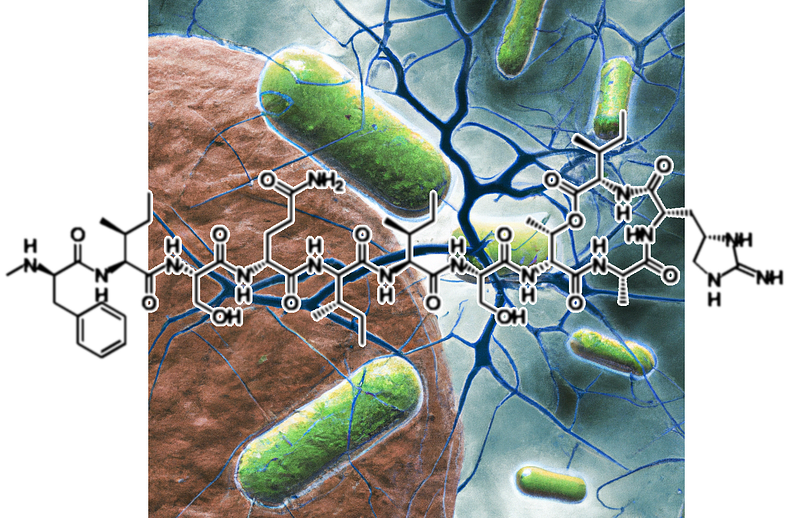
An effort led by the Weingarth group at Utrecht University in the Netherlands disclosed the mechanism of action of Teixobactin, a molecule produced by a soil bacterium to outcompete other bacteria of their environment by killing them. Teixobactin presents a unique chemical scaffold and lacks detectable bacterial resistance, and as this new work finds out it attacks two components exclusive to bacterial cell envelops thus being in principle safe to humans. These are all ingredients for a promising starting point to develop a whole new class of antibiotics.
Previous studies had shown that Teixobactin is very active even against otherwise resistant pathogens including Staphylococcus aureus, Streptococcus pneumoniae and harmful varieties of Enterococci. Moreover, some works had shown that animal models infected with serious pathogenic bacteria could heal by administrating Teixobactin as a drug. Although this doesn’t necessarily mean that we already have a new drug, it is very promising and definitely worth studying further. In particular, knowing how Teixobactin works should help scientists to better define if we can use it as an antibiotic in the clinic, and how to modify it to make it even more potent.
Mechanism
The new work found out that Teixobactin permeates the outer bacterial wall and “hijacks” a key component of it, the so-called “Lipid II”. Lipid II connects the harder outer wall of the bacterium, called peptidoglycan, to the inner membrane itself, made up of lipids. Teixobactin attacks the whole complex, disrupting the membrane and wall. It blocks growth of the peptidoglycan and lipids, at the same time as it directly thins the membrane out leading the cell to lyse.
Teixobactin is an elongated molecule, and it achieves its dual attack by polymerizing in an antiparallel fashion and binding its ends to a special phosphate-sugar moiety of Lipid II. This configuration triggers the formation of a supramolecular fibrillar structure that compromises membrane integrity as it rips off the phospholipids that make up the inner membrane, leading the bacterial to leak its contents and break up, at the same time as it hampers proper synthesis of the peptidoglycan and membrane lipids. The long hydrophobic tails of lipid II concentrated within the supramolecular structure apparently contribute to membrane disruption, too.
The fact that the main mediator of the mechanism (Lipid II) is only present in bacteria makes this molecule a very promising lead for the future creation of a whole new generation of antibiotics. Moreover, natural resistance to Teixobactin is very limited at the moment, which could in the future help to prevent the negative effects of its misuse. Although in an ideal world, it should not happen at all.
More details from the original paper and the author’s own Twitter thread
Here I’ve distilled some key points and “trivia” that you might find interesting, especially if you are into chemistry and biology:
- Eleftheria terrae is the soil bacterium from which Teixobactin was isolated. Indeed the authors had to grow liters of culture of this bacterium to isolate enough Teixobactin for their studies.
- Fortunately, thinking about the possible future use as an antibiotic, other groups have shown that Teixobactin can also be synthesized chemically. It wasn’t trivial to setup the protocol, but it’s out there now. Moreover, groups have already been able to synthesize variations of it, which might be useful someday when/if we really start making clinical antibiotics out of this molecule.
- Chemically, Teixobactin is a peptide, that is a kind of very small protein. It contains five non-canonical amino acids and some chemical groups that are rare in Nature.
- If you know about protein structure you’ll find interesting that the Teixobactin peptide adopts a beta-like secondary structure of antiparallel nature upon polymerization, effectively resembling a fiber as the authors of the study showed experimentally.
Further reads and a comment on closing
The work was just published in Nature this week. If you are into chemistry and biology, you can go deep into the work here:
The corresponding author behind this work also posted a Twitter thread that explains the work at a level lower than the very technical article, yet of course very accurate as it was written by one of the main authors himself:
Comments on a new antibiotic. Will mankind screw it again?
Attacking bacterial membranes is a good strategy that has worked in the past. For example, antibiotics related to penicillin, so-called “beta-lactam” antibiotics, all attack one specific component of bacterial membranes. Unfortunately, antibiotics of this family have been abused and misused for around 80 years already, so bacteria have become resistant to most of them and are in their way to develop further resistance. For the moment Teixobactin has a bright future; hopefully, we won’t screw it up this time.
www.lucianoabriata.com I write and photoshoot about everything that lies in my broad sphere of interests: nature, science, technology, programming, etc. Become a Medium member to access all its stories (affiliate links of the platform for which I get small revenues without cost to you) and subscribe to get my new stories by email. To consult about small jobs check my services page here. You can contact me here.


