
ADVENTURE ATOP ADVENTURE
We “Intubated” Ketamine-Darted Baboons in Kenya
And met a famous guy
We were enjoying a leisurely breakfast at our glamping site on the Kenyan veldt in the Maasai Mara region when a jeep slid to a stop nearby raising a small dust cloud.
“Which one of you is in charge?” asked the jeep’s driver, hopping briskly out of his vehicle.
As one of the faculty physicians heading our medical mission team, I stepped forward.
“Can I help you?” I said.
The jeep’s driver continued, “There’s an American scientist working nearby. He heard there’s a team of doctors here. He’d like your help intubating baboons.”
As an ER Doc, I immediately pictured “intubating” baboons.
My mind’s eye visualized a long oral opening ringed with razor-sharp baboon chompers. And a still longer passage to the trachea once the base of the baboon’s tongue was visualized and held aside with specialized equipment. Then there would be the difficulty of passing a plastic tube between the baboon’s vocal cords.
That’s what meant by “intubating” — passing a plastic breathing tube in a carefully controlled manner between animal or human vocal cords.
I’d “intubated” hundreds of times, “passing plastic” on humans from neonates to centenarians.
Baboon intubation … not so much.
“Sure,” I said. “The team will help.”
A bit of backstory
Our medical team had just concluded a three-week medical mission in Kenya’s Maasai Mara region.
The area is home to one of the Earth's largest collections of wildlife — elephants, zebras, wildebeasts, lions, hippos, crocs and on and on — huge herds of on and on. Picture every safari scene you’ve ever witnessed and you get the picture.
It is also home to the Maasai people, known for their incredible height, warrior prowess and extraordinary leaping ability, among many other fine qualities.
As a reward for our medical labors in the region, many members of the team had decided to treat themselves to a couple of days in the almost-wild, on safari, hence the glamping.
Several others had decided to trek Mount Kilimanjaro.
I was in the safari group.
Our medical team comprised faculty physicians, nurses, medical students and others from Duke University in Durham, NC and Virginia Commonwealth University in Richmond, VA.
The day the jeep pulled up was our first day of rest in over three weeks. We’d been trucking from village to village in the countryside doing everything we could think of to help the local population. We’d seen hundreds of patients daily: weighing and measuring babies, immunizing, providing HIV/AIDS education, diagnosing and treating malaria and dengue, de-worming the kids, dispensing vitamins and much much more.
We’d even been feted by becoming honorary kings in a local Maasai tribe. I still have the ceremonial foot-long knife I was gifted as part of the induction into royalty.
But, baboon intubation … that we’d not done.
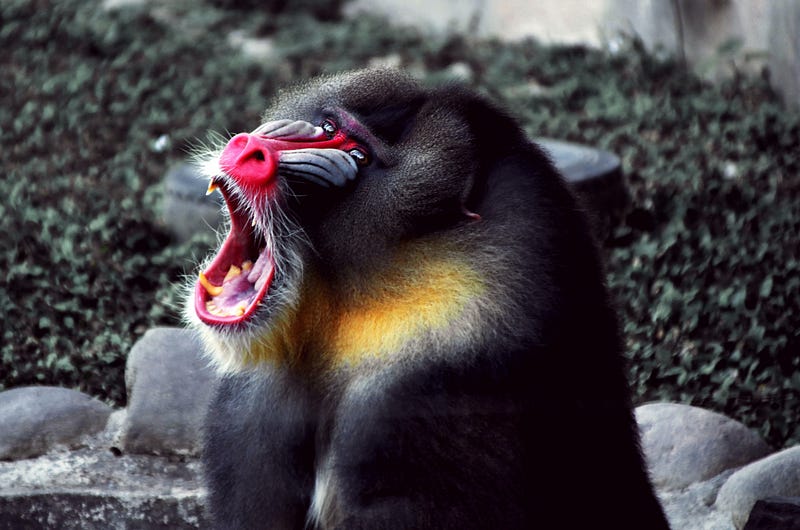
We’d seen substantial troops of baboons though. For some reason they liked to closely accompany our transport vehicles, providing a menacing presence with their muscular strides and incredible yawning displays of death-dealing dentition.
These were the animals we were about to cozy up to.
De-glamping and out to the wild
Our group boarded one of our buses and trailed the jeep out to the scientist’s study site.
An animated, ruggedly handsome, short muscular man with a tangled mane of long curly hair greeted us, eyes ablaze with intelligence.
“Hi, I’m Robert,” he said.
After intros all around, I asked, “Robert, what do you need our help with?”
As I asked, I surveyed the scene.
Men with rifles stood about. About a dozen drooling baboons were splayed out on wooden benches nearby. In the distance, a group of far more lively baboons paced, holding vigil, watching us, and their mates.
Robert replied, “I need to place tubes into these baboons’ stomachs. I’m doing an experiment that requires gastric acid samples and that’s the only way I can get the gastric acid.”
I instantly understood
“Intubation” was not required. Besides Robert didn’t have the equipment. This was NOT an airway issue.
What Robert required of us was to pass NG tubes through the baboons’ nasal passages and down the esophagus (swallowing tube) into the animals’ stomachs. Then, via the naso (N) gastric (G) tube going through the nose and into the stomach, Robert and his helpers could extract the needed gastric juice.
The men with rifles had just “darted” some baboons with an anesthetic agent.
The splayed and drooling baboons were anesthetized — with ketamine— ready for our expert ministrations.
Now I’ve passed some nasogastric (NG) tubes, and seen many more passed by others, mostly nurses.
Inserting an NG tube is widely regarded as one of the most noxious procedures done on awake patients. As the tube goes in the nose — especially when it hits the back of the throat and causes gagging — patients thrash and retch and spit and tear up and pull away and curse and sweat. It’s misery, as you might imagine. Often, even gentle expert tube passage causes nasal bleeding. Even when the tube is properly seated and no longer sliding past sensitive structures, patients hate it. It sucks, all the way around.
“So, Robert,” I asked, “just what have you used to anesthetize these beasts? How long does it last? And, what’s the chance one of these guys will awaken mid-NG-tube-entry and go all Hannibal Lecter on one of my colleagues?”
“All I can say is,” said Robert “that’s never happened before.”
Then he gave me and the med team members LOTS, and LOTS, more medical info on the anesthetic medication used, its duration of action and its side effects. All good stuff for the mouth-agape med studs.
I knew ketamine and its side effects. Without going into all the details, it’s a weird drug, in a class by itself. It provides deep anesthesia of an odd type wherein independent breathing is still possible (none of those squeeze bags you see on TV are needed) even though the patient is stone-cold OUT!
But, roving eye movements, drooling, gulping, occasional vomiting, and random non-purposeful body movements all occur. So it may suddenly seem as though the patient/baboon is awake, even though they are absolutely not.
I, and two of my physician colleagues, stepped up to insert the first three NG tubes. Standing inches from an impossibly strong lethal creature’s fang-filled mouth is quite an experience. It’s hard to keep a steady hand. But we succeeded.
Gently inserting an NG tube while slack-jawed medical students watch and learn without causing gagging, tears, retching or any other untoward event, is an experience as well.
But all went well and none of the three of us required either a change of underwear or a blood transfusion or worse after the brief procedure.
Then it was the med studs’ turn.
I instantly felt sorry for the baboons.
Gagging, retching, thrashing and some nasal blood trickling all ensued. And, several baboons were revisited by their baboon breakfasts.
But, in the end, all baboons were sporting tubes, just where Robert needed them.
I went around, grimly congratulating the med students and wiping away blood, drool and vomit, mostly from the baboons.
Post gastric juice harvesting, we hung around for a little Q&A with Robert.
“I’m Doctor Robert Sapolsky from Stanford University. I’m a neuroendocrinologist. I come to Kenya once a year to study stress and hierarchy in baboon troops. You may have heard of my work or seen my books.”
“Robert” then pulled several of his books from a nearby bag.
I still have inscribed copies of his books, “Why Zebras Don’t Get Ulcers” and “A Primate’s Memoir”.
Somewhat later, and after we’d removed the NG tubes, we watched from a safe distance as our slightly-the-worse-for-wear primate charges awakened and scampered off to safety from scientists.
Our medical troop meandered back to camp as well.


