
We Have No Clocks In Our Home and It Changed Our Attitude to Time
You’ll be much happier appreciating the little moments in life instead.
About 5 years ago, my wife and I embarked on a new stage of our life by purchasing a home.
As part of the renovation discussions, we wanted the design of our apartment to be as minimal as possible. This would mean a lot of hidden compartments and drawers as part of the overall furniture design. This was based on our belief that a home should be clutter-free.
There was also something else that we were determined to have:
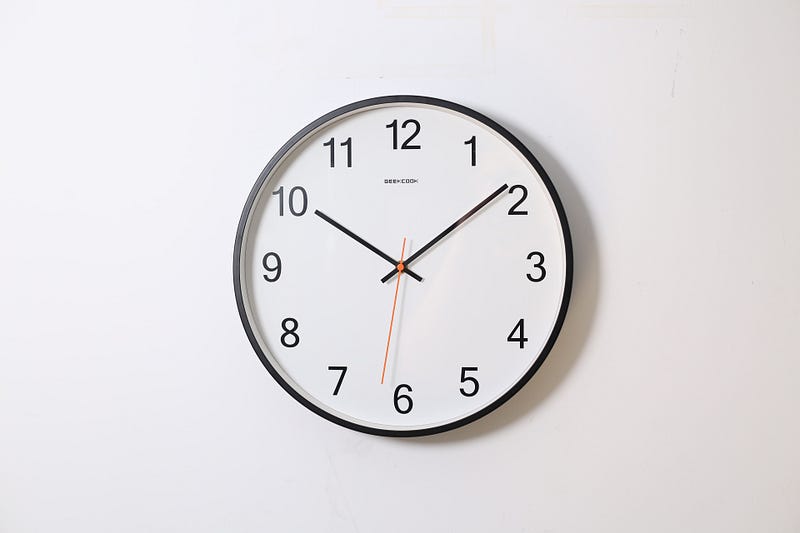
We would have no clocks in our home.
What Time Means To Us
I know it may be a notion that is counterintuitive to most people, but we’ve not regretted the decision even once. The concept of time is something we live with on a daily basis. As language speakers, it is also ingrained in us to experience time as the “past”, “present” and “future”. Indeed, our thoughts and decisions are very much a function of time. It is what determines your idea of being “early” or “late” for your meeting, and also factors into your idea of what you consider a life well-lived and how much of it you have left to earn that first million dollars writing Medium articles. We are deeply entrenched in a particular worldview about Time.
To understand how we arrived at our decision, I would like to ask you a question:
What does Time mean to you?
I don’t mean the number of hours you have available in your life, but rather the more fundamental question of its value to you. If I were to reframe the original question, would there be something that you would want to do, assuming that you are only going to have an hour left in your life? Death has a way of laying your priorities out clearly.
It became quite apparent to both of us that we had constantly experienced many situations in which we were constantly living our lives focused very much on what was going to happen next. Wake up at 630am so that we can exercise by 7 am. Breakfast at 830 am because we need to do some shopping at 11 am. A highly organised life for sure, but one that was focused on the schedule and time limits that we had set for ourselves.
We felt that we wanted to enjoy the present as much as we wanted and that perhaps we could also afford to have a more fluid view of the role that time plays in our lives.
This little bit of soul-searching resulted in an important question that we asked ourselves:
Could we live a life free from the pressures of time?
Relatedly, was there a way to help us better focus on the present?
This was where we decided to experiment with removing clocks from our home.
To be fair, we did not ban every time-keeping device in our home. That would not have been realistic. Our phones still tell the time, and we set our alarms to wake up every morning for work. We were trying to do a social experiment centred around removing our dependence on constantly checking the clock for the time. Hopefully, that would change our attitudes to how we view time as well.
Did It Work?
So what was the result of this little experiment you ask? Well, we experienced two related benefits actually:
1. We took one step towards Flow
First, it allowed us to achieve what I would consider some element of Flow, an optimal state where activities we engage in are highly pleasurable and rewarding.
As teachers, it is common for us to bring our work home, and being able to work on what we need to without the distraction of time has allowed us to be a lot more productive, and to enjoy the process of engaging with our students’ work and lesson preparations a lot better.
I also paint miniature wargame figures as a hobby, and I find that being able to sit down and paint without thinking about time allows me to focus on the process of painting itself — more joy than having the knowledge that I have scheduled only an hour to paint because I had something else to do next.
What followed from this change was also that our days became a lot more fluid in structure. We work when we need to, nap when we are tired and we do things we feel like doing for as long as we feel like doing so. Sounds like an indulgent lifestyle, but isn’t that the point of having a home? I’ve always maintained that time spent in your Special Place should not feel too much like Life. It should provide you with a means of physical and psychological escape from things that often demand attention (and time) from you.
I am therefore happy to say that living without clocks was a positive step in helping us live in the present. We got a chance to enjoy the time we have together more, rather than to think about what we had to do next
2. We became more aware of Time
This sounds paradoxical, but removing physical clocks from our home resulted in us being more aware of Time, or at least its nature.
Just because we do not know what exact time it is on the clock does not mean that time does not exist. Living in a way that focuses on the present came with a certain realisation that what is present is true at the precise moment that it occurs, and then it is gone. This was the same realisation that I had when I wrote about my experience in Vietnam. This experience just served to reinforce that very notion.
It is only with being distinctly and psychologically connected to the present do we realise how fleeting a moment is.
That joke you shared with a loved one, that little accident you had in the kitchen. All these things happen at a moment, and then they are gone. If this does not result in some level of appreciation of each moment of your present life, I don’t know what will.
Final Thoughts
I have to say that the little social experiment that my wife and I embarked on paid off in ways that we never would have imagined. It brought us happiness and also made us a lot more appreciative of what we have in the present.
So for those of you thinking about buying a new clock for your home, consider doing something else with that space on the wall instead. Or just leave it blank. After all, what you need for a meaningful life has always been around you all this while.