
We Fucked the Earth — Now We’re Fucking Up Space
And Elon could be the biggest fucker of them all
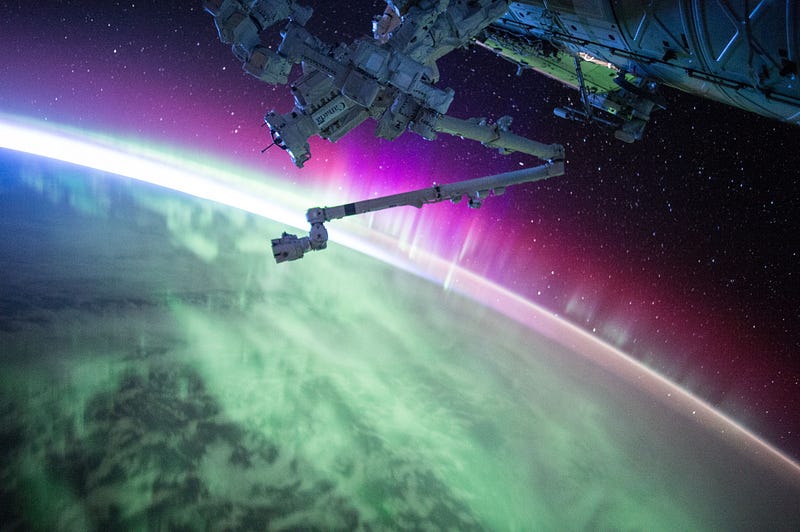
Did you know there are currently 7,800 active satellites orbiting the Earth? Or that 4,074 of them are owned by SpaceX?
Not only do SpaceX’s Starlink satellites account for more than half of all the active satellites, but Elon has plans for a ‘mega-constellation’ of 42,000
That’s clearly a lot of hardware, but space is big, right?
Well, yes and no. The actual usable space for satellites in low Earth orbit is very much finite, and it’s rapidly filling up with junk.
Way back in the very early days of space exploration the world was full of optimism and idealism regarding the potential benefits to all humanity of what was seen as vast, untapped new resources.
The Outer Space Treaty (OST) was established by the UN General Assembly in 1967 to govern activities in outer space. It was created to ensure that the exploration and use of space would be open to all humanity.
At the time the OST was created, no-one could have foreseen the exponential rate at which the number of anthropogenic objects in space would increase. Active satellites are just the tip of the iceberg.
Like everything in the universe, satellites have a finite life, so there’s also a whole lot of defunct ones whizzing around up there, too. Then there’s all the accidents…
Satellites malfunction more often than their owners would probably like to admit. Sometimes they explode. Sometimes they collide. When that happens, the resulting debris field can be vast.
Take, for example, the 2009 collision between the Iridium 33 and Kosmos-2251 satellites, which created more than 2,000 pieces of debris larger than 10cm and untold smaller particles.
There are currently around 30,000 trackable fragments in orbit around the Earth, and an estimated 130 million more fragments too small to be tracked (less than 30cm across). Every one of those fragments represents a potential hazard to other satellites, the International Space Station and other spacecraft.
As the number of satellites in orbit increases, the number of collisions can also be expected to increase. As fragmentation from such collisions raises the chance of further collisions, there is a very real danger of creating an exponential feedback loop known as the Kessler Syndrome, an unstoppable and catastrophic cascade of collisions which would render the orbit around Earth essentially unusable.
And it’s not just the accidents… Anti-satellite weapons (ASAT) testing involves the deliberate destruction of spent satellites. This high-tech target practice — the space-age equivalent of shooting tin cans — creates even more debris and has directly threatened the International Space Station at least once.
Whilst the USA and Canada have announced unilateral bans on ASAT tests, at least temporarily, China continues this weapons testing/sabre rattling.
Perhaps because of the emphasis which the OST places on the accessibility of space for all humanity, there is little, or no restriction placed on the number of launches, and any state or private party with the necessary means can launch any number of spacecraft and/or satellites into orbit, subject mainly to only safety and liability issues.
Although the OST very much emphasises cooperation and collaboration between parties, it is clearly not enough to rely on parties self-limiting their space activities. There is a pressing need for further developments in space law to tackle this issue.
The alternative is that the richest, most powerful nations and organisations will have saturated low Earth orbit long before the rest of humanity has the chance to explore and enjoy the use of outer space which the OST envisaged.