
We Don’t Need Stoicism; We Need Suffering.
Nietzsche explains why suffering means to live.
If you’ve lived under a rock or you haven’t heard of Stoicism, its self-appointed chief Stoic, Ryan Holiday, outlines the four aims of the philosophy.
[Stoicism] sets out to remind us of how unpredictable the world can be. How brief our moment of life is. How to be steadfast, and strong, and in control of yourself. And finally, that the source of our dissatisfaction lies in our impulsive dependency on our reflexive senses rather than logic.
Our world is crumbling. It has been for the past century. Whilst Stoicism offers us mediation, it lacks depth.
It falls flat and doesn’t offer any substantial change beyond the individual’s inner self.
We don’t need collectivism per se, but we need an outbreak of life.
Stoicism dulls life.
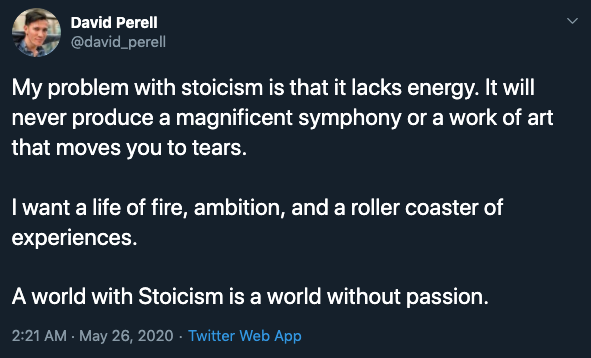
David Perell tweets of how Stoicism lacks energy. I couldn’t agree more.
In the words of Ryan Holiday, Stoicism is a “meditative technique that transforms negative emotions into a sense of calm and perspective.”
He likens it to a yoga session.
A yoga session will only give me clarity. The world was not built to be understood. It is complex, murky and slippery.
I don’t want to understand it.
I want something that will give me life. Something that will make me jump out of bed every morning because it’s too good to be true.
Not something that seeks to help manage my emotions. That’s what I pay my therapist for.
Like David Perell, I want a life ‘of fire, ambition, and a roller coaster of experiences.’
Stoicism doesn’t do this. It promotes peace of mind Zen practices that rob you of life’s fullness. It aims to dull your life rather than spark it with passion.
The ideas behind Stoicism are present in other, more colourful philosophies. They are rooted in carpe diem — seize the day, and memento mori — remember you’ll die.
Both philosophies are breathtaking. They’re inspiring.
But Stoicism makes them dull.
If you have everything in life; if life has given you wealth, health and amplitudes of goodness, then Stoicism is for you.
Go for it. Practise your misfortunes. Look for opportunities of good in evil. Practise humility. Knock yourselves out.
But for the average Sally like myself, Stoicism robs me of life.
I don’t want to think about restraint, compassion and humility like Marcus Aurelius. He was an emperor. He needed to be grounded. I want to fly.
Stoicism becomes a strait-jacket for my wings.
Enter Nietzsche.
My German professor once said, “when there’s a problem, seek Nietzsche.”
So I did.
I soon discovered that Nietzsche hated Stoicism too. In his 1886 Beyond Good and Evil, he writes: “Stoicism is self-tyranny.” Stoicism aims to control life.
I also read Nietzsche’s 1872 Birth of Tragedy. I wasn’t disappointed.
When Nietzsche wrote this seminal text, he ‘blighted his entire academic career’, as Marianne Cowan writes.
That only means one thing in my book. He found the solution.
Nietzsche doesn’t write about Stoicism in this book. But he offers an alternative to how we should live our life.
He offers us suffering.
When David Perell tweets, “a world with Stoicism is a world without passion.” He nails the problem on the head.
Passion in the greek sense means suffering. Nietzsche believed that the Stoics spent life hiding under a “hard hedgehog skin”, avoiding suffering.
Nietzsche narrates the story of King Midas and Silenus. Silenus was the companion of Dionysus — Greek god of hedonism and suffering.
King Midas asks Silenus, “what is the most excellent thing for human beings?”. Silenus responds, “the best of all things is something entirely outside your grasp: not to be born, not to be, to be nothing. But the second-best thing for you — is to die soon.”
The Wisdom of Silenus states that to live is to suffer, so it is best to not exist at all or to die quickly.
Stoicism avoids suffering. It talks of reason and the rational at the face of memento mori.
Stoics seek to reason with death. To avoid death. But Nietzsche brings back the need for death.
It is only through suffering do we live. Suffering liberates the mind.
The world crumbles around us and it is too complex to reason with.
We don’t need Stoicism to mediate life. We must embrace suffering as life is too short to avoid suffering when everyone will die, anyway.
It is through suffering that art is born. It is through suffering that philosophy is born. It is through suffering that science is born.
Nothing ever comes from mediating life. Life demands action. Life demands a fight. Stoicism dulls life.
We don’t need a peace treaty. We need a fight.
To live wholeheartedly, life must have a meaning — suffering.
He offers us eternal recurrence.
The eternal recurrence of the same is the idea that everything you go through will happen again many times over without a single change ever.
The idea is supposed to be a thought experiment. Life will happen again and again. Your suffering will not change. Your joy will not change. Your life will not change.
It is best to embrace life because acceptance of the bleak reality of life is better than to avoid life’s suffering.
Stoicism aims to control life with the individual. It aims to create an order.
But life is best explained by the thermodynamics.
In thermodynamics, we often associate entropy with the amount of order or disorder in a thermodynamic system. But the system favours disorder.
What does this tell us about life? Life is full of chaos and disorder.
Do not rationalise life. It does no good. Life cannot be understood.
Like Greek tragedies, by embracing the eternal recurrence, one can directly confront suffering.
It is when we embrace suffering; we confront it. And when we confront suffering, we accept finitude. We have lived life to the fullest.
We have lived life according to carpe diem and memento mori.
Key Takeaway.
Nietzsche, David Perell and I have all figured it out. Stoicism is devoid of passion and suffering.
It is like yoga. It does great to calm you down, but no good to the rest of the world. The world needs art, not calm. It needs chaos — in a creative sense.
It needs passion.
Fatima Sultan is a writer, tutor and self-proclaimed nerd. She writes about life and its many excitements and disappointments. She also apparently likes referring to herself in the third person. You can read more of her writing by subscribing to her free newsletter.