
We Don’t Need More Michaelangelos but Can Use a Few More Davids
Capture timeless treasures in creative ways
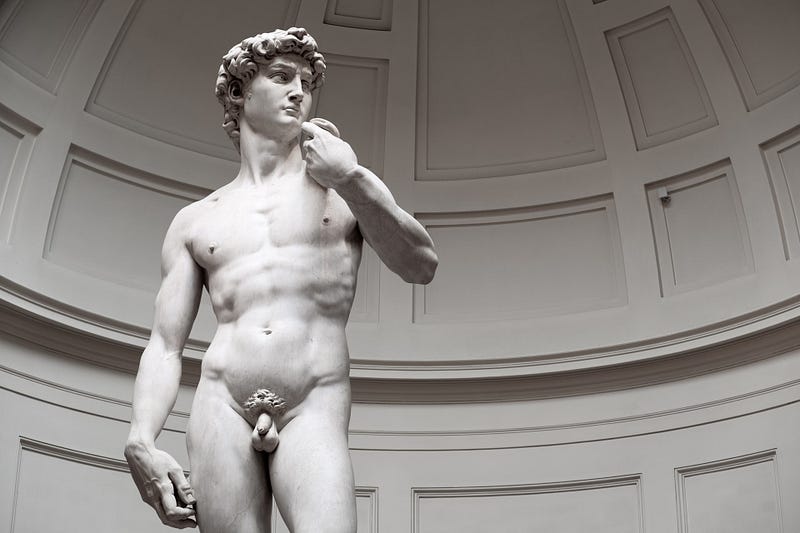
Move over Michaelangelo, the slab of marble in the center of town is no longer yours. It belongs to the robots. Sweating in the sun of summer and freezing in the cold of winter while contorting your body into torturous positions to sculpt doesn’t have to be the love of your art or the painful wear on your body.
Who needs the actual statue of David when robots can make a replica to the same proportions? Technology pits the teamwork of robots and lasers to create a replica of the original against timeless treasures that are crumbling under their own weight and by virtue of time. Renaissance art does not age well.
Rather than lose the sculptures of the masters, technology is re-creating art for viewing and for study. Artists are putting down the archaic tools of their trade — the hammer and chisel — and commissioning robots as modern ghostwriters over slabs of marble, tapestries, and paint to create priceless art.
The Verge says:
Experts have long said that David is at risk of collapsing due to the poor-quality marble that Michelangelo used, as well as its precarious pose. Because of these structural problems, an earthquake or even vibrations from nearby construction could cause it to fall. To test its stability, researchers from CNR and the University of Florence created small plaster replicas of the sculpture and exposed them to forces stronger than gravity inside a centrifuge. Based on their results, they believe the ankle micro-fractures developed after years of outdoor exposure in a public square, where it leaned forward at an angle of about five degrees. David was put on public display outside a Florentine government building in 1504, when it was first unveiled, before being moved inside the Accademia Gallery in 1873.
Michaelangelo isn’t around to fix his masterpiece. But, the poor quality of the marble shows in the way the statue of David is cracking. Quite literally, at his ankles, David’s poor composite is crumbling under 5.5 tons of its own weight.
Enter lasers and robots as the stars of what would otherwise be a magic show with the illusions of smoke and mirrors. The star-crossed lovers of modern tools to replace human hands and shift to technology as saviors of the art and of the Renaissance day.
Artists are sensitive about who claims the credit for their work and are turning to modern advancements as the ghostwriters of their masterpiece:
“Artists want to perpetuate this idea that they are still chiseling with a hammer,” said Giacomo Massari, one of the founders of Robotor, the company that owns the sculpting robots. “It makes me laugh.”
Modern Tools to Preserve Ancient Art
The result is a masterpiece recreated in hours instead of years. One example is the “Psyche Revived by Cupid’s Kiss.”
“Canova took five years to make this,” he said, “we took 270 hours,” Massari said.
From years to hours, albeit hundreds of hours. Minus the contortions and deformity.
The robots are receiving crazy commissions from artists like Jeff Koons, Zaha Hadid, and Vanessa Beecroft.
We can only guess what Michaelangelo would think of the robot gods who create masterpieces, as though by human hands.
“If Michelangelo saw the robots, he would tear out his hair,” said Michele Monfroni, “Robots are business, sculpture is passion.”
As much work as robots can do, they cannot complete the masterpiece alone. Human hands still add the final touches. Time can lay waste to masterpieces, but art can be replicated and live through the hands of robots.
Preserve the Davids in Your Life
True enough that the masters made great art. Likely, there’s art in your life that’s worth preservation too. What is it?
- A handprint or footprint of the kids as they were babies
- The size you were as a newlywed or on your wedding day
- The aroma of cookies baking on a nostalgic holiday
- The song that played during a special moment
As carefully as the masters make and preserve their art, identify your precious “David” artwork and underwrite its preservation. A shelf or curio cabinet can be your Italian pavilion to show off the priceless David-like masterpieces of your life.
Let the robots do the hard work so that you can study the memories.
We need fewer Michaelangelos and more Davids in our lives.
What are your favorite treasures?
Grab, Make Money on Medium: Build Your Audience & Grow Your Income, because you owe it to yourself, and let’s stay in touch.