
We do Scrum, but…
We don’t need a Scrum Master
A Kick in the ScrumBut — Episode 6
It is easy to make the statement: “We don’t need Scrum Masters. Our team is so awesome that we don’t need anyone to hold our hand”. Or “We aim to make the Scrum Master irrelevant”.
OK, fair enough!
No one says you should follow Scrum by the book. You’re not doing Scrum, but ok! It’s a free world and all that. Still…. There are reasons why the Scrum Guide says what it says. There are reasons for the Scrum Master to exist.
What does this mean when someone says they don’t need a Scrum Master? Is it ignorance? Is it a statement from someone who indeed understands all nuances of Scrum? To get to an answer to the question I am discussing this subject here.
So… What does the Scrum Guide mention as responsibilities for the Scrum Master? Are they applicable for you? To answer this we need to check the Scrum Guide.
General remark
The first thing we read is this:
“The Scrum Master is responsible for promoting and supporting Scrum as defined in the Scrum Guide. Scrum Masters do this by helping everyone understand Scrum theory, practices, rules, and values.“ — SG
I will tackle self-organizing teams, cross-functionality, focus on value, facilitating the Scrum Events, coaching the organization, adopting Scrum in more detail below.
But there are other topics related to this issue: Empiricism (Transparency, Inspection, Adaptation), the Scrum Values, the meaning of the Scrum Events. Scrum is a very broad topic. Many Scrum Masters have a hard time grasping everything. Scrum is easy to learn, but difficult to master. Being in a situation where the complete team is on that level, not to mention the organization, is truly awesome. And -IMHO- unbelievable.
“The Scrum Master is a servant-leader for the Scrum Team. The Scrum Master helps those outside the Scrum Team understand which of their interactions with the Scrum Team are helpful and which aren’t. The Scrum Master helps everyone change these interactions to maximize the value created by the Scrum Team.” — SG
The Scrum Master as a servant-leader is only valid when you HAVE a Scrum Master in the team. As such, there is not much to debate here.
This is different from the next part: who is going to help those outside the team understand which interactions are helpful and which aren’t? Is this something that anyone from the development team can do? Is it a desirable situation that all the individuals of the team have to take this upon their shoulders? The reason why the Scrum Master mediates interactions to make them effective is to keep the team clear from distractions and unwanted distractions. Don’t you have any issues with this? That is truly great, but are you sure?

Scrum Master Service to the Product Owner
Here we find a list of 7 topics.
“Ensuring that goals, scope, and product domain are understood by everyone on the Scrum Team as well as possible” — SG
I can imagine situations where the Product Owner and the Development Team work perfectly together so that this is addressed. Still, it seems to me that it is always good that there is one specific person to ask the questions and look beyond the practices that are used now.
5 points that I summarize as “Finding effective techniques and increase Scrum understanding”
I can see that an experienced team can do without guidance from a Scrum Master. It assumes that a Development Team and a Product Owner work together like a machine and fully comprehend Scrum. However, I have worked within many teams and I have never been in this situation.
“Facilitating Scrum events as requested or needed” — SG
Anyone could facilitate events. If this is the sole reason to have a Scrum Master, then you don’t need one. But, why would the team need to be distracted with mundane tasks like facilitating and organizing events? Would even a seasoned team prefer this is facilitated for them?
Scrum Master Service to the Development Team
Here we have a list of 6 topics:
“Coaching the Development Team in self-organization and cross-functionality” — SG
This one sentence includes a lot and as a result, deserves a deep-dive into the matter.
Self-organization
A team goes to several stages of development. I love Bruce Tuckman’s model on this topic:
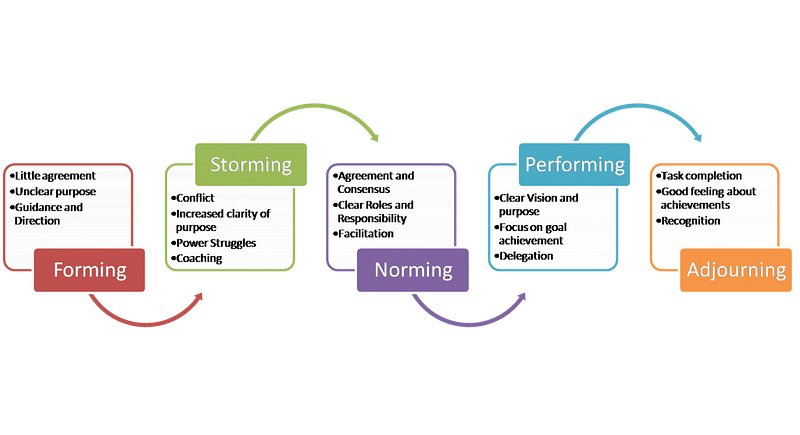
According to Tuckman, these stages are all “inevitable for the team to grow, face up to challenges, tackle problems, find solutions, plan work, and deliver results.”
You wish to reach the “Performing” stage, but you inevitably have times when you are in “Forming”, “Storming” or “Norming”. When you reached “Performing”, sometimes you fall back to “Storming” or “Norming”. This is normal in an ever-changing environment. There may be all kinds of changes that can have an impact on the team. Also, at a certain point, the team disbands (“Adjourning”), which brings another set of challenges.
Someone needs to coach the team through all of this. Within Scrum, this is the Scrum Master’s job. Only in a very stable situation, where nothing impacts the team from being in the “Performing” phase, there might be no need to coach the team. I wonder how often this would be the case.
This formula 1 team is performing as a team at the highest level. But, just as a Scrum Team, many factors influence them. How do they stay within the “Performing” stage?
Cross-functionality
This is another broad topic. A Scrum Master coaches the team to have all competencies to accomplish the work without depending on people outside of the team. This is very much related to the Definition of Done (DoD) and to extending the DoD to allow the team to create a potentially releasable increment. This is not specifically mentioned as a task, but for a good Scrum Master, it is a major piece of the work to guide the team through their DoD journey, as a result of aiming for cross-functional teams and having a working increment.
A team could reach the point where every competency required is within the team. How long does it stay like this? Will the team composition never change? Will the product never change in such a matter that it impacts the required competencies? Who will be driving changes when you don’t have a Scrum Master?
“Helping the Development Team to create high-value products” — SG
Also for this one, I can imagine that the Product Owner and the Development Team work perfectly together without a Scrum Master. But also here: why not having one specific person focusing on this?
“Removing impediments to the Development Team’s progress” — SG
Anyone could do this, but is this always helpful for the team? What if the development team is unable to remove its dependencies? And even if they could, wouldn’t it be better if a Scrum Master could follow up on certain impediments so the team can stay focused?
“Facilitating Scrum events as requested or needed” — SG
We already discussed this one as a service to the Development Team.
“Coaching the Development Team in organizational environments in which Scrum is not yet fully adopted and understood” — SG
How many organizational environments do fully understand Scrum? If I look at the number of wrong interpretations I hear about or find myself, there can’t be many. But OK, if your environment fully understands Scrum then this part is not on the Scrum Master’s plate.
Scrum Master Service to the Organization
3 topics that can be summarized as “Coaching the organization to understand Scrum and help the organization to implement Scrum.”
All are suggesting that the organization still needs to understand, adopt and implement Scrum. If everyone knows enough about it and Scrum is fully functional, then this isn’t required. That is a big IF.
“Causing change that increases the productivity of the Scrum Team” — SG
A team that believes it has reached its best level of productivity is one that most needs a Scrum Master to prove them otherwise.
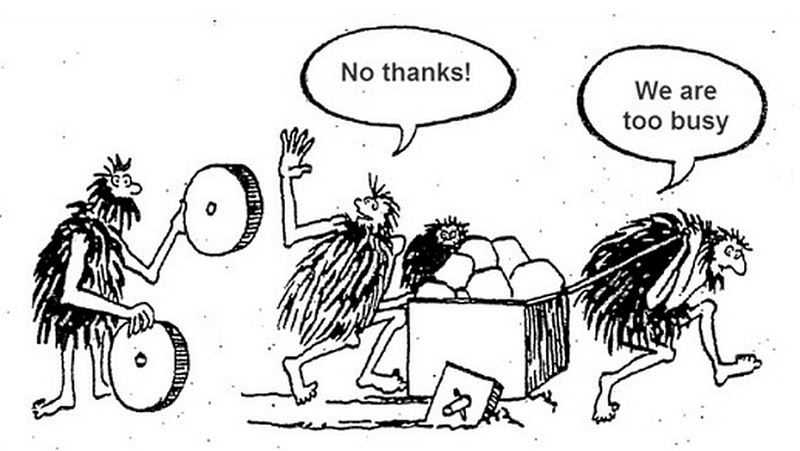
In an ever-changing world, you should always be keen to improve. As a result, I can’t see this as ever being obsoleted. So in my humble opinion, this should always remain a focus. It is something for which the whole team should feel responsible, but it makes sense to have one person leading this.
Bottom Line
I don’t believe that a Scrum Master would become obsolete at a certain point in time. Maybe they are not needed ‘full time’. However, in complex environments situations rapidly emerge and need quick and decisive resolutions. A Scrum Master that flies in after receiving a bat-signal, will not timely assess and respond to situations.
It reminds me of my closing statement in the post about the working increments:
Are your products simple? Are your team and your environment stable? Will your product hardly change in time? Are the requested increments straightforward and clearly understood by the team and all the stakeholders? Maybe you don’t need a Scrum Master. But maybe Scrum is not suited for you at all. Or any Agile way of working for that matter. However, I highly doubt there are that many software environments with this characteristic.
