
We Don’t Know What to Want Anymore
The global desire crisis.

In one of the best books of the century, Peter Thiel observed that the modern West is characterized by its indefiniteness — a pervasive absence of specific desire or vision for the future.
This absence is striking, especially when looking at other countries.
- India wants to reach a level of development equal to the West.
- Russia wants to reestablish its empire.
- Javier Milei is trying to fix Argentina’s economy.
- Erdogan is bringing back the Ottoman Empire.
- MBS is building Vision 2030 in Saudi Arabia.
- Kim Jung-Un wants to conquer South Korea (or at least, build rockets).
We hear about these people because they have definite desires for their countries.
My assumption, therefore, was that their citizens wouldn’t be victims of the current nihilism inherent to Western societies since they were moving toward a clear goal.
But I was wrong.
When I asked these people what they wanted out of life, they looked at me, puzzled; besides trying to move to the West because it’s “more stable” and people “earn more money”, they didn’t know.
That’s how I figured no one knew what to want anymore.
Why We Want What We Want
The origin of desires was uncovered by René Girard.
Born in France, Girard moved to the US where a job as a literature professor led him to find out a common pattern in the books he read: heroes never had desires of their own; their desires were either copied, or suggested.
In Greek mythology, the protagonists had the habits to meet with Pythia, the Oracle of Delphi, who, upon consulting Apollo, could tell the hero what to do next.
He [Herakles] (…) asked Pithya where he should establish himself. Pithya (…) told him to go to Tiryns to serve its king, Euristeo, for 12 years, and accomplish the 10 labors he would give him. Aure’s Notes
If a demi-god didn’t know what to do and had to consult an Oracle, imagine us, mere humans?
Desire is copied, said Girard.
He called it the theory of mimetic desire.
How Desires Propagate
Desires propagate when they become public.
We’re not only social animals; we’re also deeply mimetic.
When a public figure commits suicide, the number of suicides subsequently increases.
When a lot of people suddenly buy stuff (fidget spinners, anyone?) everyone follows suit.
And when a few hundred people gathered to protest in the Tunisian town of Sidi Bou Said, millions of people did the same across the whole Middle East.
Mimetism is the principle at work behind the expression “the spark that lits up the fire”.
It also explains why many holiday spots forbid tourists from uploading pictures on Instagram.
We want what others want. And the more people want something, the more we want it too.
This cycle is called the mimetic cycle.
In the beginning, everyone has individual desires. Paul wants to go to Ireland, Lisa wants to go to Spain, and Mark wants to go to Bosnia.
But people are insecure.
Is what they want good wanting? They look at their neighbors and friends. What do they want? Oh, Bosnia. Where is that? That sounds nice. Much nicer than Spain or Ireland.
So they change their minds to adopt each others’ desires. On a long enough timescale, everyone ends up with the same wants: let’s all go to Bosnia!
That’s when things turn sour.
Why do you have to copy me?, Mark protests.
The universal adoption of one desire necessarily leads to competition.
This creates tensions which rise and rise until they explode, threatening the social order.
The ancients knew about this issue and came up with the sacrifice to diffuse those tensions.
A scapegoat is blamed for the social disorder and killed during a cathartic ceremony.
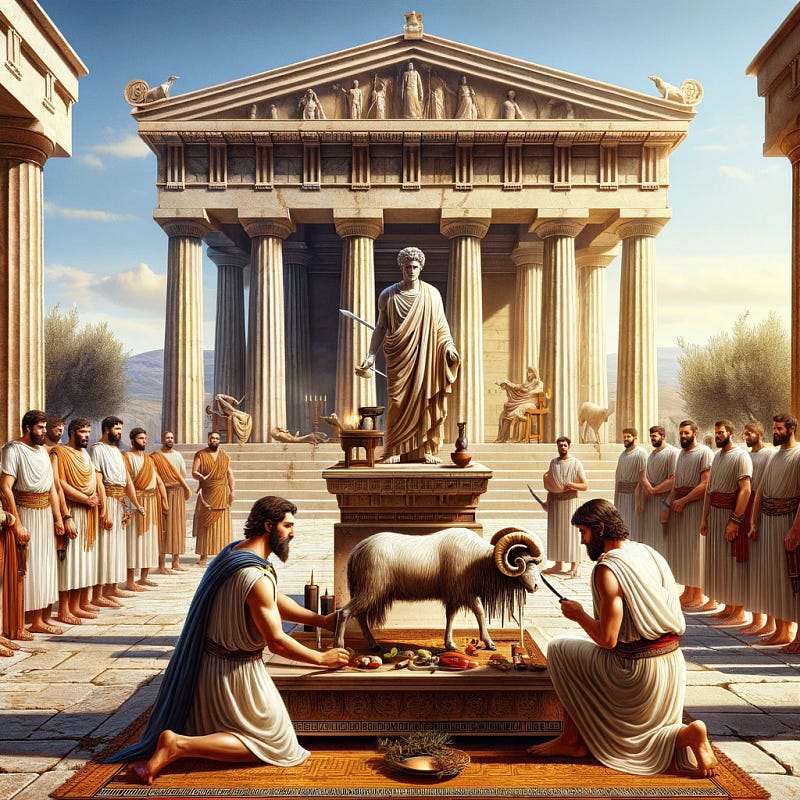
The sacrificial killing releases the mimetic tension and everyone goes back to having their own desires rather than the desires of somebody else, and the cycle starts again.
Who among us, has never blamed then sacrificed someone for their own woes?
The Transcendent Desire
One of the ways to prevent the mimetic crisis and its subsequent sacrifice is for a great leader to come in with a transcendent desire.
Notice how great people throughout history have not been remembered for their deeds, but for their desires.
Alexander wanted to conquer the world; Caesar wanted to conquer Europe; JFK wanted to go to the moon; Mother Theresa wanted to help the poor; Marx wanted to end class struggle; and Romeo and Juliet wanted to love each other.
Desires are what make people stand out. Trump wants to make America great again.
Elon wants to go to Mars.
No matter what you think about them, their desires stick, and they stick much more than Jeff Bezos’ or Larry Ellison’s whom no one knows what they want exactly.
Great leaders have transcendent desires. They inspire people to assemble around them and work toward one direction.
The absence of desires necessarily leads to nihilism. Why would you wake up if you have nothing to achieve?
Nihilism and the Absence of Desires
Many theories have been proposed to explain the current nihilism and lack of motivation in the West, but none have pinpointed the absence of desires as a culprit.
And yet.
My parents wanted to have children. It’s been the desire that carried them through the difficulties of life since the very beginning.
It’s why they woke up in the morning and were pretty happy to do so.
Young people no longer want to have kids today. They no longer want to get married either.
They want to travel. And they want not to work too much to have some time for themselves.
The problem with such desires is that they’re indefinite and undefined. They never end and don’t lead to a series of transformative actions in one’s life.
They’re fun, but not meaningful enough to fix the meaning crisis.
Conclusions
The ancient Greeks had a hierarchy of desires with, at its top, the vita contemplativa, allowing one to contemplate and meditate on life once they had done all of the necessary work for the day.
The reversal of the hierarchy in the 18th century led people to seek materialism and political action rather than contemplation.
Now that those desires failed as well, we’ve reached the stage where we ran out of things to want.
The new, emergent desire among the elite seems to be e/acc (effective accelerationism), a Silicon Valley philosophical movement aiming to improve technology as fast as possible to improve the world.
While its aim is honorable, its realization, like economic success, is only accessible to a tiny few. As a result, e/acc is unlikely to move things around.
Until Western civilization gets a new transcendent desire to go after (and a leader to enact it), apathy, nihilism, and decay will only increase.
For more articles, head to auresnotes.com.


