
We Didn’t Choose to Live Like This
Why we are wired to our phones and what to do about it

The average adult spends almost six hours per day in front of a screen.
Six hours!
We can imagine some children spend even more than six hours per day on screens during weekends. Many play video games, watch TV or scroll social media with no end in sight.
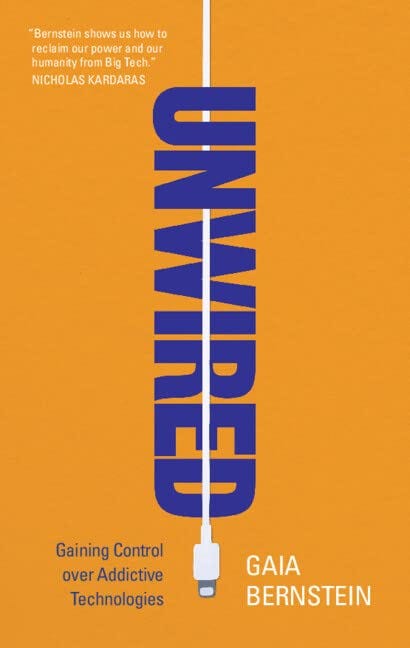
In a recent episode of Passion Struck, I sat down with Gaia Bernstein — a professor at Seton Hall University and the author of a new book, Unwired: Gaining Control Over Addictive Technologies. We discussed the trend of rising digital technology use in both children & adults.
To put it bluntly — people cannot disconnect from their screens.
In 2015, Gaia realized she was no different. She used to spend her mornings with a stretch of uninterrupted writing. One day, she found herself going from blog to blog, reading, texting, and consuming various content on different mediums.
When grabbing coffee with friends, she realized just how often she’d reach for her phone. At a child’s birthday party, she noticed the kids weren’t running around or tackling each other — they were each playing on their phones.
Today’s teens and twenty-somethings have been in front of their screens for over half their lives. Sidewalks and parks are empty, and Roblox lobbies are full. Researchers have found increasing evidence that high screen time may have a direct correlation with rising rates of teen anxiety, depression, and suicide.
Social interactions have been reduced to likes and three-word comments.
How did we get here?
New social media platforms had broken onto the scene since the early 2000s when MySpace, Facebook, and YouTube were each founded with the goal of bringing the world together. Each platform came with different features and a different kind of intrigue.
Users found themselves spending 10 minutes a day on each platform, and then 20, and then 30 — and when new platforms arose (like Twitter, Instagram, Snapchat, Twitch, and eventually TikTok), screen time grew exponentially.
The attempts to “bring the world together” by the big social media corporations have done the opposite. Despite having the world at our fingertips, both children and adults feel more alone than ever before. Attention has become the main form of currency, and the social platforms are cashing in.
What can we do?
Don’t blame yourself.
According to Gaia, the first step is to understand that this is not our fault. When we signed up for Facebook in 2008 and YouTube in 2010, we didn’t know that these platforms would continuously be tweaked and updated to steal our attention. We didn’t know the adverse effects of constant social media consumption or how spending hours on PlayStation could harm our mental state.
The original, good intentions of social media — connect us with people around the world, give us access to information we may have never received otherwise — have been exploited to the extreme.
Do not blame yourself for living in today’s society where screen time is unavoidable. It’s not your fault these platforms have cashed in on addictive behavior.
Public reform
The next step would be to call for wide-scale public awareness and reform around social media and screen time.
When the research started to show that cigarettes weren’t good for us, tobacco companies added small disclaimers to their packaging. People didn’t stop smoking. It took these companies being required by law to slap words like “death” and “cancer” in big, bold lettering across their labels for tobacco purchases to slow down.
The research shows what high screen time is doing to adults and children. But until the words “HIGHLY ADDICTIVE” show up next to apps in the App Store (or games on PlayStation and Xbox), people will still spend their lives in front of screens.
Reform is needed. Instead of corporations building social products to help more people, their models have shifted to products that keep their users on their phones the longest. Subscription services are easy to sign up for and impossible to cancel.
Think of small changes you can make daily.
Instead of getting your social fix from Twitter, talk to the person behind you in line at Starbucks. Instead of hopping on Call of Duty with your buddies on a summer’s night, play beach volleyball at a local park. Even the smallest things, like putting your phone in another room while working or leaving it home while going for a walk, make a difference.
We didn’t ask to spend our days on screens. American adults weren’t clamoring for isolation or begging for a life spent in front of a TV. We didn’t choose to live like this. If we had known the repercussions of unregulated social media use 10 years ago, we would’ve shut it down.
It’s time to reevaluate the way we think about social media and screen time — for ourselves, our kids, and future generations.
For more on the fight against addictive technologies, listen to the full episode with Gaia Berstein or check out her book, Unwired: Gaining Control Over Addictive Technologies.


