
Twilight of the Skeptics: Part V
We Deserve Better UFO Skeptics
Skeptics demand high standards from the UAP crowd, but don’t seem to think they should level up themselves. As evidence piles up, they’re increasingly irrelevant, unimpressive and desperate.

There’s been an awakening. Have you felt it? Professional UFO ‘debunker’ Mick West has seen the light and turned to the dark side. On Twitter this week he kicked the door open just a crack to maybe allow for the extremely unlikely (but not impossibly remote) possibility that aliens may, in some, or at least a few, very rare circumstances — wait for it — be behind UFOs.
Well, sort of.
Twitter, I’ve learned, is a great place to engage all sorts of people (including skeptics) about UFOs, extraterrestrials, etc. Over the course of 2021, I have found myself going to the mattresses with Mick West, Stephen Greenstreet, Jason Colavito, and (on his blog) Robert Sheaffer, all of whom bring varying degrees, styles (and skill) of skepticism to the UFO conversation.
New York Post journalist Greenstreet, to his credit, actually got me to thinking about the language one uses in talking about the phenomenon. I can honestly say I learned something valuable from the exchange.
Another voice deserving mention here is Seattle’s Zac Zichy, who brings a unique perspective and personal history to the topic on his Project Human podcast, where he’s interviewed Ross Coulthart, Stephen Bassett, Luis Elizondo and even West. “Interviewed” is perhaps the wrong word; Zichy is simply a terrific conversationalist. Even labeling him a “skeptic” is a disservice. He’s just a very smart, thoughtful man who brings a healthy skepticism to the discussion, which is not a bad thing.
Others, not so much. Let’s take them one at a time …
Mick West
West is a rising star in popular skepticism. A retired video game designer, he’s all over #UFOTwitter and tends to be less confrontational than Greenstreet. He occasionally makes legitimate points; on other occasions, he gutter balls. This week, however, we had a “stop the presses” moment when, on Oct. 24, West tweeted, in an exchange with someone else, the following statement:
UAPs could be aliens.
The next day, he clarified:
Give credit where credit is due. That’s always been my own non-negotiable on the topic of UFOs. If there is general agreement among scientists that uniform conditions across the universe must mean that it is within the realm of possibility (and probably likely) that life exists elsewhere, you cannot then take that off the table when considering a bizarre phenomenon that on the face of it suggests you’re witnessing advanced non-human intelligence.
But then West weighs in on that (and, predictably, steps in it) when a Twitter follower asked him how he came to see the light. West replied:
I’m basing it on the lack of evidence. The unremitting avalanche of “UFO” sightings that turn out not to be evidence of visiting aliens. And the absence of indicators of civilizations in the nearby universe. Of course it only takes one. But there are no indications that’s here.

Of course it takes only one UFO case where aliens are found guilty as charged to settle the issue, but by what rationale do more than 700 unsolved cases add up to a “lack of evidence” that at least renders the question legitimate? As West must know, that’s the number of UFO cases that remained unsolved in just one study — Project Blue Book in the 1960s. Surely he must know there are hundreds of other well-documented cases in the public domain that defy any “rational” explanation, many of which he probably wouldn’t consider tackling because of that. That said, with truly inexplicable and even bizarre cases, the fallback for skeptics is traditionally that the witnesses involved are wholly unreliable — they’re lying, insane, stupid, they were hallucinating, they were arrested once, etc. So you can ignore them — all of them.
It’s an easy gig if you can get it — and he has: Skeptical Inquirer now has West writing a monthly column, The Practical Skeptic, the debut edition of which he used to unpack the various conspiracy theories that one finds in ufology. His work in this area will be the subject of a more detailed analysis in our ongoing Twilight of the Skeptics series.
Robert Sheaffer
This long-time skeptic and UFO “debunker” from California appears to have joined Medium for the sole purpose of directing readers of our Twilight of the Skeptics series to the rebuttals he posts on his Bad UFOs blog. It’s fun to make him work for it. Seriously, how often are these guys called out to defend their work?
Still, it’s one of those things where you basically end up agreeing to disagree and move on, although Schaeffer’s latest, self-defeating response to our take on his “analysis” of a famous UFO is unintentionally hilarious.

Previously, Sheaffer had casually agreed with the Federal Aviation Administration’s baseless and arguably idiotic assertion that the Chicago O’Hare UFO was probably what meteorologists call a “hole-punch” cloud, which can only form at 32 degrees or colder. Since it was much too warm for one to have existed at the 1,900-foot elevation of that day’s overcast, Sheaffer speculated (which is to say, he guessed, based on zero evidence) that witnesses had probably seen a hole-punch cloud at a much higher elevation where it was (presumably — another guess) freezing — through the lower cloud deck.
Upon reading a lengthy report on the case that he clearly hadn’t read, we illustrated why that was impossible: There was another cloud deck between 8,000–9,000 feet, but the freezing level was above that at 10,000 feet. There were no hole-punch clouds anywhere near O’Hare that day, period.
It is worth pausing here to quote Sheaffer from his rebuttal where he blows off the O’Hare case once again. The following comment was directed at journalist Leslie Kean, who also investigated the case for her book:
“Way to go, Leslie — when you encounter difficulties with your speculative hypothesis, invent something even more speculative and improbable to fix it.”
In his lengthy rebuttal to our article, Sheaffer literally does exactly that.
Yes, he concludes, there could have been a hole-punch cloud where it wasn’t freezing (his first, incorrect hypothesis) because an airplane (could have) made it!
Which is actually possible; airplanes can “punch” holes in clouds. However, given their speed and the gradual angle of their descent or ascent, it seems reasonable to expect that any artificially-made hole-punch would be more of a ragged streak (like in the photo above) covering a large area — not something resembling a perfectly round, grey, spinning disc. One witness offered another level of precision: It was spinning counter-clockwise.
Yes, there were surely a lot of airplanes over O’Hare that day. I doubt that there were any rockets or space shuttles shooting straight up and achieving that perfect “O” signature — which is what the grey disc left behind after it shot upward, revealing blue above.
To explain the absurd suggestion that a hole-punch cloud at 8,000 feet was plainly visible through the lower cloud deck, Sheaffer ignores references to the “solid overcast” and “solid cloud layer” and gropes for wiggle room on “overcast,” which the World Meteorological Organization defines as cloud cover obscuring at least 95 percent of the sky.
Sheaffer has now set the stage for a remarkable, surely once-in-a-lifetime scenario: A perfectly round, metallic-looking hole-punch cloud made by an airplane that just happens to be visible (and appears to be spinning) through one of the wispy sight-lines available in just five percent of the sky otherwise obscured by a cloud deck estimated to be nearly 2,000 feet thick.
That’s not skepticism, that’s magical thinking.
Keith Kloor
My next close Twitter encounter with a professional skeptic was Keith Kloor, a New York-based freelance writer and journalism professor. He writes on the Substack platform and was praised in Skeptical Inquirer by none other than Sheaffer for an article that ludicrously suggested that the UFO phenomenon is the media’s fault. So much for digging deep.
Kloor this week swooped in on one of my own tweets. I had just shared the latest piece by my Trail of the Saucers colleague Bryce Zabel on the intriguing E.T.-related remarks made by NASA Director Bill Nelson, and I posted this observation:
Kloor looked at my comment (shown above), probably chuckled to himself, and said that it reminded him “of that time when Charlie Brown knew he was about to kick the football, at long last.”
The implication is obvious to anyone familiar with the Peanuts comic strip. But for the one person who is unfamiliar with Charlie Brown’s misadventures with football, the running joke in creator Charles M. Schultz’s strip was that Lucy would hold the ball so Charlie Brown could practice kickoff and then would always swipe the ball away at the last second, humiliating Charlie Brown once again.
Kloor thinks that anyone who hopes or expects the U.S. government will reveal what it knows about UFOs is like the indefatigable but obviously naive Charlie Brown, who always expects that this time, despite an unbroken record of evidence to the contrary, Lucy will finally let him kick the damn ball.
Why the analogy fails
Kloor either isn’t paying attention or has a very short memory span, so let’s revisit some highlights from the UFO beat in the last four years, with special attention to 2021 developments:
September 2017 — Although the focus was consistently on co-founder Tom DeLonge, a rock musician, and much of the company’s work was oriented to entertainment, To the Stars Academy formed with a division devoted to the “outer edges of science,” including UFOs. One of the co-founders was James Semivan, a former senior Central Intelligence Agency officer. A reporter might ask: Why is a former CIA officer involved in such a project? What does he bring to it? Could it be that the government is actually, secretly, interested in the UFO problem?
December 2017 — The New York Times breaks the story about the Pentagon having secretly investigated UFOs for the past ten years and alludes to “materials” recovered from UAPs
May 2021 — The New Yorker publishes a long article on the Pentagon’s UFO program, part of a larger trend that sees mainstream media paying more serious attention to UAPs.
May — Luis Elizondo and Christopher Mellon, both former high-level ranking intelligence officers who were involved with the Pentagon’s UAP program, appear on 60 Minutes with U.S. Navy pilots who had encounters with UAPs.
June — The Office of the Director of National Intelligence releases a preliminary report on UAPs (Congress received the classified version, the public got 9 pages) revealing that 144 UAP reports remained unsolved.
Summer —Elizondo and Mellon begin popping up on one podcast after another to talk about UAPs; although both are legally constrained by national security protocols, the message by both — particularly Elizondo — is clear: We are not alone, and humanity better take a deep breath and figure this shit out.
August — Asked about UAPs on CNN by Jake Tapper, Sen. Mitt Romney replied: “I don’t believe they’re coming from foreign adversaries, if they were …that would suggest that they have a technology which is in a whole different sphere than anything we understand. And, frankly, China and Russia just aren’t there. And neither are we, by the way ….” A good reporter might have asked Romney to elaborate; Tapper did not.
September — Congress moves to establish a permanent UAP office.
October 10 — A Pentagon-reviewed and approved book, Skinwalkers at the Pentagon, written by journalist George Knapp with a former U.S. intelligence officer, James Lacatski (as one of two co-authors) offers additional details about the Pentagon’s UAP studies.
October 19 — NASA Director Bill Nelson, a former astronaut, says that the agency will help investigate UAPs after decades of claiming disinterest in the subject.
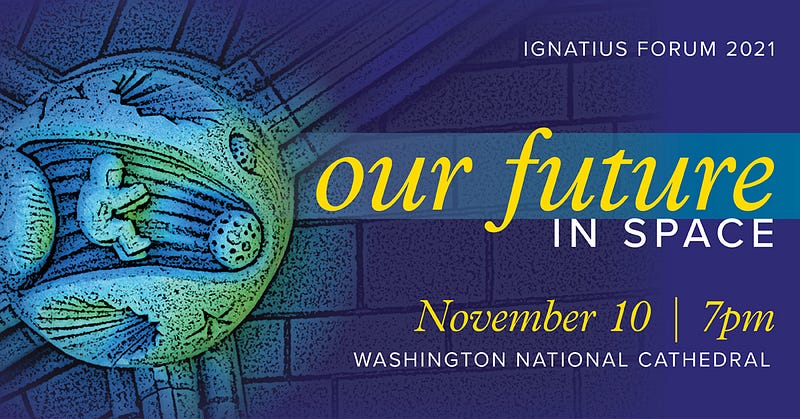
Looking ahead to November 10 — Avril Haines, Director of National Intelligence and NASA’s Nelson are scheduled to speak about space and the possibility of extraterrestrial life at the National Cathedral’s annual public affairs program.
To clarify my analogy, the dam has already sprung multiple leaks. To follow through on Kloor’s analogy, basically we’re watching Charlie Brown’s football sail through the air every month at this point. The pattern offers no clear indication or assurances when or even if it might fly through the uprights, but the fact that it is in the air at all suggests that there’s a there there.
I don’t know about Kloor, but in my line of work, that’s called news.
Jason Colavito
Jason and I have Twitter-talked before, and the occasion for this exchange was seeing his dour reaction to an upcoming event on the future of space at the National Cathedral in Washington D.C. next month, mentioned above. In addition to Haines and Nelson, speakers will include David Wilkinson, a theologian and astrophysicist from Durham University in Britain, and Harvard University Department of Astronomy’s Avi Loeb, who is a contributor to Trail of the Saucers.
Some quick context on the event: This is the Ignatius Forum, held annually to give prestigious experts an opportunity to discuss important issues. It’s named after the late Nancy Ignatius, a longtime lay leader, and her husband Paul. Among their children is Washington Post columnist David Ignatius, who is scheduled to lead the discussion on “our common future in space, and whether we’re alone in this vast universe.”
Colavito weighed in and we had the following exchange on Twitter, with my comments bold-face:
Colavito: Shouldn’t this bother us a little bit that the DNI and NASA administrator are gathering at the national cathedral for a panel discussion that is framed around the religious implications of UFOs?
It doesn’t bother me. It makes me wonder what they know that would compel them to hold such an event in such at this particular time.
Absolutely nothing. The forum is held every year and covers a different topic in the news. Last year was COVID-19.
How did you acquire this ability, reading minds and discerning motivation with absolute certainty? Or did you interview them?
Let me be more specific: There is no reason to presume a hidden agenda given the history of the forum unless you are a conspiracy theorist.
It’s not presuming an agenda to inquire about motivation. The Bulletin of Atomic Scientists’ ‘Doomsday Clock’ is 100 seconds to midnight, for multiple, earthbound reasons. Why, in the face of those reasons, does NASA and DNI want to discuss ET in the context of religion … now?
Because somebody at the National Cathedral decided “space” would be a fun topic for their annual forum and tried to tie it to something newsworthy. The forum attracts high-power officials every year. Dr. Fauci did it last year.
Well, assuming we agree that Covid and the pandemic was an appropriate topic for this year, what would you like to have seen them tackle this year?
There’s nothing wrong with discussing space. It’s weird to have government officials on a panel speculating on the religious implications of ET-piloted UFOs unless you like entangling government with religion — particularly since in this context “religion” means Judeo-Christian.
It’s not clear that any government officials will “speculate” anything about religion. They have two agency heads who will presumably address space issues from their perspective and an astronomer. There’s one theologian, also an astrophysicist, and he’s not from the U.S.
That’s where the conversation ended and Colavito moved on.
The real takeaway here, which illustrates the intellectual bankruptcy of pseudo-skepticism, is Colavito’s “absolutely nothing” remark. Consider the unambiguous, non-negotiable, absolute certainty here, and then remember that Colavito is referring to the Office of the Director of National Intelligence, whose charge is to oversee the collective efforts of the entire U.S. intelligence community as they collect and analyze endless terabytes of data that is classified.
Imagine thinking that this agency — which handed Congress a classified report on UAPs that appears to have compelled Sen. Romney to go on CNN and rule out any prosaic explanation for UFOs — knows “absolutely nothing” about UAPs that might conceivably guide their public relations strategy when discussing the issue.
No. Actually, thinking has nothing to do with it.
Imagine being naive and bull-headed enough to imagine that, and you have some idea of what it’s like to be a professional skeptic.
Trail of the Saucers is edited by writer/producer Bryce Zabel and published by Stellar Productions. Zabel co-hosts the popular new podcast Need to Know with Coulthart and Zabel that can be found on all major platforms.


