
We Create Suffering for Ourselves by Resisting What Is
Spoiler: We Rarely Like What Is. So, we’re in trouble.
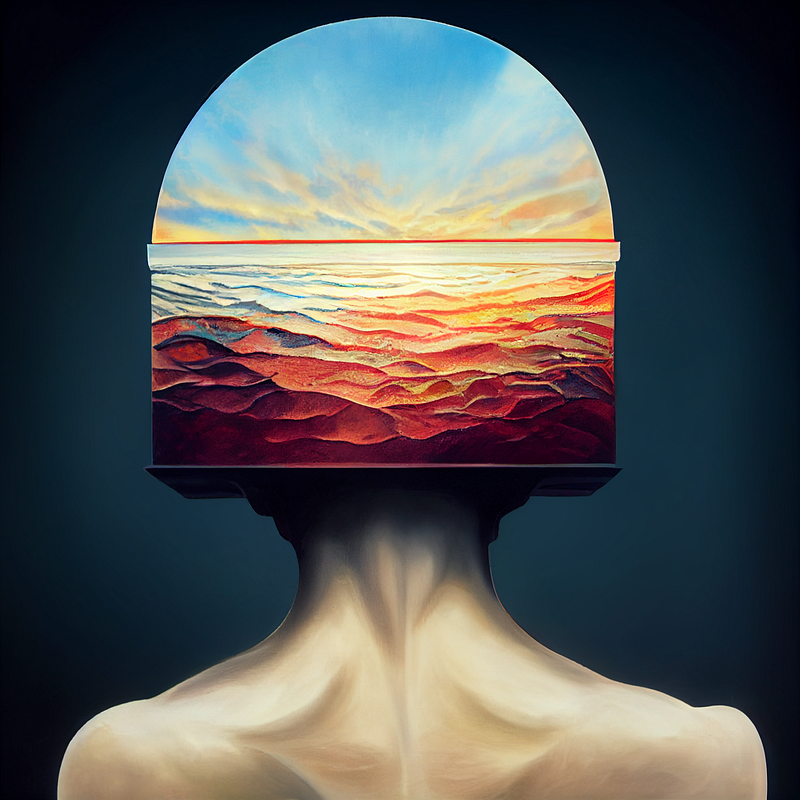
We fear the unknown.
To balance out this fear, we tell ourselves stories.
The Story aims at making a narrative sense of reality, giving us the feeling of control.
If reality brings pain, we start resisting it.
Resistance creates Suffering.
Suffering is a prolonged and thought-fueled pain.
Without the Story, there’s just pure pain.
Pain is just vibrations in the body.
Vibrations are impermanent.
A still mind is able to observe vibrations without reacting to them.
Lack of Reaction = lack of Story.
Lack of Story = lack of Resistance.
Lack of Resistance = lack of Suffering.
That’s it.
L*fe Happens
Life’s biggest flex is making us miserable when we least expect it.
Through that, I learned it takes a lot of acceptance to keep your sanity.
And acceptance requires a lot of humility.
It’s merely a pep talk when all goes easy peasy lemon squeezy, and you’re walking a rainbow, but when l*fe turns into a total mess, then knowing how to accept things thrown at you, suddenly becomes an existential matter.
One important rule that I will lay down for you right away is that life’s current doesn’t necessarily care much about our little long-term plans, calendars with meetings, or cute vision boards, and it, well, just happens.
Stress and anxiety come from our expectations of how life should be. What makes us oppose the gifts we are being “kindly offered” by life is that we think we know better what is best for us and try to bend reality to match it.
The problem is, we don’t.
We often don’t know what’s best for us until we get it. We didn't know we needed to grow until we did. We didn’t know we needed a breakup until years after we met a million times better match.
The endearing part about being human is that once we land in a better place, we act as if it was all solely thanks to our actions and not a resultant of random events that we had little influence on.
We then play smart, offering advice on how everybody should, too, be the helm, sailor and the ship sailing the vast waters of their lives (as we say in Polish), while in fact, we barely know how to swim in a kids pool that’s up to 1m deep.
That’s not to say there’s no free will, that we live in a matrix, or that the world is controlled by a pasta monster with strawberries and cream topping — yes, Polish quirks again, or else [insert a philosophical dilemma of choice here].
It’s rather to say that life doesn’t care (in a good way), and it will just push you where you need to be pushed, for your own good.
My friend once phrased it nicely in a conversation with me: “Life doesn’t tell bad from the good, or easy from hard. It just finds the quickest and most efficient ways to put you on the right path. And sometimes it might just mean a total blow-up”.
When we are able to accept that life is how it is, not as we think it should be, we can smooth up our experience of it (and acquire inflatable armbands to prevent drowning in a kids pool).
Instead of falling into self-pity, frustration, anger, or despair, we can accept that things happen — and will continue to happen in circularity, so resisting this obvious occurrence doesn’t make much sense.
Just like the seasons pass, death follows birth, and cakes are eaten so new ones can be baked, similarly — events in your life are impermanent, and they circle too.
Example: Something nice happens, so you are happy — so much that you even complete a gratitude journal entry in the evening. But soon enough, another thing emerges that you don’t like at all, and you are miserable. Then, a friend brings you a cheesecake, and the living’s lovely again (well, that surely works for me, at least).
Life’s a spinning cycle.
It can spiral you out either in an upward or downward direction.
You can’t control the outcome, but out of the very few things you get to control is the direction of spinning: up or down.
Acceptance is lighter than Resistance in the universal law of cheesecakes and strawberry toppings, so the sooner you acknowledge (/accept) that l*fe happens, the better for you and your sanity.
“Acceptance (…) allows us to engage with life on its own terms rather than rail against the fact that life is not as we would wish. It allows us not to struggle against the day-to-day current.”
— Douglas Abrams, “The Book of Joy”
The Self-Made Sense of Control
Our brains love to think we have our lives under control. They freak out as soon as the sense of it disappears.
Throughout life, we trained our minds always to try to bend reality to our liking, create narrative sense out of the nonsense, and fight the unpleasantness sneaking up at us from the least expected corners.
It’s an impossible task when you think of it. And it also pokes out our innate shared madness.
If you look closely at how we all act purely out of our humaneness, you will be left with no doubt that we are all terribly neurotic and not as sane as we’d like to believe after all.
The truth, independent of our bent perceptions, is that we don’t have as much influence on the current of our lives as we feel comfortable believing in.
We can, of course, choose our actions and our words. We can even work on the thoughts preceding them (good on us if we do!), but we can never fully control the outcome they create.
When was the last time you said something and got utterly misunderstood? Or you bent over backwards to throw your loved one a surprise bday party, and it turned out to be the last thing they ever wanted, so you both hated it all the way through and ended up fighting about getting a chocolate cake instead of mango-flavour three years back?
There you go.
The input doesn’t dictate the outcome.
And since our life is a summed-up outcome of words, actions, and thoughts, it’s clear we can only try influencing it by being smart about the former, but we can’t control it either.
L*fe happens, indeed.
Equipped with this revolutionary knowledge, we can proceed to learn how then can we advance from the kids' pool to the adult one (or skip the swimming lessons altogether!) and deal with the happening.
We are full of Fears, so we come up with Tales
Life’s like a gigantic river, and we still didn’t graduate from the kids' pool.
But life is life, so deep waters it is.
The logic says: You gotta keep swimming not to drown (or cry), right?
Yeah, you got the armbands already, I know, but nobody told you how to inflate them.
You don’t know how to swim, and surrendering to the current without frantically swimming against it feels counterintuitive.
You fight the river because you don’t know where it might take you. Even worse — you can’t predict what the experience of getting there will be like.
Since the current is uprooting you from where you stand, the additional fear is that it will carry you away from the joy you share today. I mean, usually, you don’t resist being moved from the Nice to the Nicer, so it’s an easy assumption.
Being moved from the familiar to the potentially worse and getting stuck there is what freaks us out.
We fear the unknown.
To balance out this fear, we tell ourselves stories.
Floating in the Now
Our minds create a narrative for the wordless reality, trying to make sense of it. We forget the impermanence of things, and we trust in our human judgment a lil bit too much. That keeps us in the kids' pool.
We hold on for dear life to the self-made sense of control, as if giving up on swimming against the current would inevitably mean we go down.
One thing we forget is that we can float.
Floating means staying in the present moment.
And the best thing is you can learn to float without progressing to the adult pool.
Floating is scary, I know.
It requires you to let go of the sense of control and surrender to the current.
A helpful thing to know is that you don’t resist floating itself, but the unknown sensation of it.
Hence, you don’t resist the actual situation, but you worry about how it could make you feel.
Anticipation of the experience is woven into the Story our minds constantly tell us, and it comes from fear (see above).
The Story creates Resistance.
Resistance creates Suffering.
Without the Story, if something hurtful happens, it’s just pure pain. The nervous system perceives it as vibrations. Whether it’s physical or mental, it’s just pain. On that level, it’s possible to observe this pain as energy flowing in the body and thus realise the impermanence of it.
If you were able to stay on this level of perception, learning to swim wouldn’t be necessary.
But they don’t teach that in the kids' pool.
Instead, they power the crank that your mind works on, and as soon as its receptors recognise pain, the Story is launched, narrated based on the experience of it — wanting the pain to go away and exacerbating what caused it.
That’s how Suffering is born — prolonged and thought-fuelled pain.
The intensity of Suffering depends on the degree of Resistance to the reality of the present moment:
More Resistance = More thoughts = Longer Story = More Suffering.
If we were accepting reality for what it is, keeping the circularity in mind, the Story would be needless:
Present moment + Remembering the impermanence = No fuel for Suffering.
Let me explain.
The Story that our minds tell is powered by thoughts. You can never have a thought about the present moment because thoughts only exist in reference to the past or future. Thus, the Now can only be experienced while it lasts — as soon as you think of it, it’s already in the past.
And similarly, pain can only be perceived in the now. Our nervous system perceives it as vibrations of various intensities. As soon as you think of it, it becomes Suffering. Suffering, built of thoughts and narrated as a story, is always a projection into the past or future.
If you don’t like the present moment in reference to the past or future, you resist it through the Story in your mind.
Getting rid of the mind’s narrative results in an instant acceptance of the present moment.
Acceptance erases Suffering: if you were able to focus entirely on the present moment without resisting it, the pain would be experienced but not suffering.
As soon as you recognise you started resisting reality, it’s a sign of the Story (= Suffering) being generated.
Let go of the Story, and you’ll land in the Now.
Remember the impermanence of things, and you will stay there.
As Eckhart Tolle said, “suffering needs time; it cannot survive in the now”.
Remember that you’re suffering not because something happened but because you didn’t like it. Read that again.
I said we would learn how to deal with the happening, so here it is:
Experiment:
What if next time something happens that I don’t like, instead of resisting it with my whole being, I will curiously tilt my head to the side and observe?
Just once, to see what happens.
You don’t necessarily need to look for lessons or some other deep meaning.
Simply observing without creating the Story, saying, “Let me see how long it lasts” (as S.N. Goenka, the populariser of the Vipassana meditation method, used to say), will change how you approach life situations.
It doesn’t mean you suddenly start liking the pain or you become indifferent to it.
It means that you acknowledged the impermanence of things, learned to observe them without automatically getting involved, and allowed life to flow as it should. At least in this one moment.
If you keep exercising that, you will slowly establish your peaceful resilience.
You won’t create cravings for the good things to happen, wishing for them to stay forever, nor will you create an aversion for the unpleasant ones, wanting them to go away.
You will observe both, enjoying the gentle ones while they last and not losing your sanity over the stormy ones.
Step by step, this will replace your old chaotic mindset with more stable inner peace.
To practice it, try to remain aware of your internal sensations to external events.
As soon as a sensation arises, stay with it, and observe without reacting. Let it last as long as it needs to last. Don’t do anything, just remain present with it. It will pass away soon enough, without stirring up in your 1m deep pool too much.
Remember you have the inflatable armbands of acceptance, so you’re good, my friend; you won’t go down.
Just try once and see what happens.
And then try again.
Of course, it won’t work every single time, at least not until you exercise it for long enough, but hopefully, you will see how transforming and life-bettering it can be.
You can always create some extra suffering for yourself next time a negative thing happens. No worries; as we said in the beginning, we don’t like most things that occur in our lives, so you will have plenty of opportunities.
Why not sacrifice one situation on exercising this, then?
Summary
“We are meant to live in joy, this does not mean that life will be easy or painless. It means that we can turn our faces to the wind and accept that this is the storm we must pass through. We cannot succeed by denying what exists. The acceptance of reality is the only place from which change can being.”
— Archbishop Desmond Tutu in “The Book of Joy”.
No feeling is final — good or bad.
Observe and let go.
Allow the free flow of thoughts and emotions.
Remain unbothered, untouched.
Learn to choose your reactions.
Practice being the space, not the curator.
Thoughts and emotions are just clouds in the sky of your being.
Don’t let them overcloud it. Always look at the sun.
Oh, and remember that L*fe happens, so get yourself a cheesecake and try to enjoy the ride.
Before you go
I’m Justyna Cyrankiewicz, and I write about simple things that make overcomplicated minds.
If you enjoyed this piece, consider subscribing to my free weekly letters. It’s a community of people who, like you, care about what’s up in their heads.
P.S. Please note that this story is based on my personal experience, the books I’ve read, and the teachings I have received. Don’t follow online advice if your mental health is severely at risk; reach out to friends, professionals, and other groups to gain relevant support for your particular situation.
Thank you for being here.