
We Can’t Solve Societal Issues Through The Lens Of Personal Identity
An individual-oriented culture stands in the way of a better society
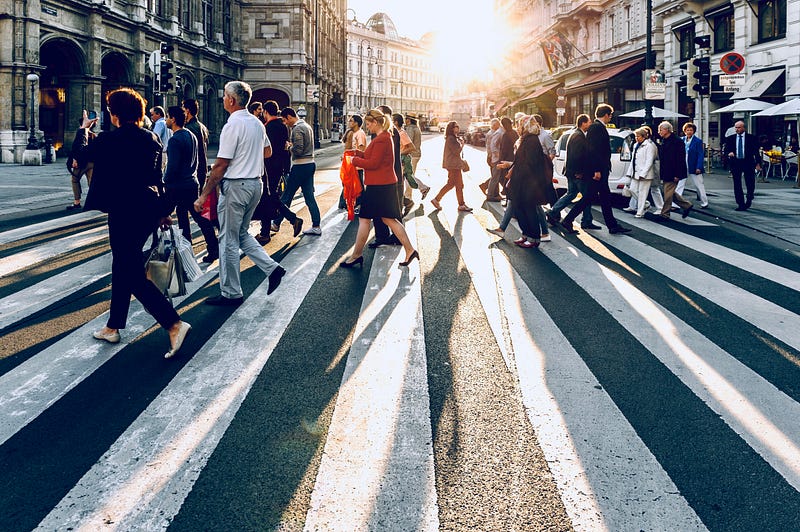
“But Mom, I want to do what my friends are doing. Why can’t I go?”
Something like this coming from a teenager is so ubiquitous as to almost be cliche. We are highly aware that children and teens exert peer pressure on each other and we also understand that this doesn’t entirely disappear once you become an adult. None-the-less, most people still tend to think of themselves as individuals who make their own way and act independently because that’s what our culture tells us is desirable.
As my husband James and I lead an ever-increasingly non-conformist life, we have become even more aware of just how boxed-in most people actually are. Many people have never questioned why they do what they do, or if it truly suits their needs. They are just, consciously or subconsciously, going through the motions of what they believe is expected of them.
James was at a dinner last night where none of his peers could understand why he had retired at 52. My perspective is, why would you keep working a 9–5 if you could figure out a way to not have to do that? They also couldn’t wrap their heads around driving an electric car or not living in the posh, expensive neighborhoods close to where their offices were. Needless to say, he didn’t even bring up that we are pansexual and polyamorous. Their heads would have probably exploded at the thought of it!
People should live the lives that they want to, including very traditional and mainstream ones, but only if that is what they have actually chosen for themselves, and not because, like sheep, they are simply following the group. As I said in a previous story about our beliefs around our own individuality:
A couple of weeks ago I was talking to a man about how the social system of patriarchy (a dominance hierarchy that gives men some measure of power over women) negatively influences the institution of marriage. He felt that it was unfair to blame something as broad as a type of relationship for particular issues that might crop up for a specific couple. He told me that he, himself, did not pay much attention to what was expected of him by society. In other words, a broad sociological dynamic had no real influence on him because he was his own man — an individual.
So I asked him how many hours a week he spent actively co-creating his relationship with his wife. How much time had they spent at the beginning of their relationship and how much time did they still spend talking about the type of relationship that they wanted to have, the boundaries and parameters, what was open for discussion and what was a hard no. He admitted that they had done almost none of that. In other words, their relationship was built primarily on unexpressed expectations that stem from cultural narratives. He was not much of an individual at all. He was the product of his society and the norms that it dictates. He had simply fallen into them, in the same way that nearly everyone else around him had. He only imagined himself to be different from the crowd.
It doesn’t really affect me too much if other people want to have relationships steeped in their societal programming — at least not so long as they refrain from hassling me about the choices I’ve made. But this belief in your own individuality does become an issue when it’s used to avoid addressing societal problems because you don’t recognize that a larger dynamic is in play.
We understand how peer pressure affects children; we understand that different cultures around the world construct their societies in different ways; and yet, we are often reluctant to admit that our own society profoundly influences how we think and act because that goes against the American mythos of individuality. You wouldn’t believe the strong reactions I’ve had when I’ve referenced this quote in the past:
It is not that we have created the patriarchy around us. Or the working conditions, or even the dominant culture. What we have done is colluded with it. We cannot mature inside a culture without having internalized aspects of it. Our ability to change our political environment begins with the understanding of how we have helped create it. Our consciousness is where the revolution begins. Fifty percent of the work we need to do is on ourselves. The other 50 percent is to focus outward and use ideas like stewardship to redesign the practices, policies, and structures that institutionalize what we wish to become.
Block, Peter. Stewardship: Choosing Service Over Self-Interest (p. 50). Berrett-Koehler Publishers. Kindle Edition.
Just asking people to consider the ways that they have co-created the society we live in, which includes consciously or unconsciously supporting some of its inequities, makes some people quite irate. “I haven’t done anything like that,” is the standard response. “I shouldn’t be held responsible for the things that other people do.” But this presupposes that every act of discrimination or unacceptable behavior is consciously chosen by the individual who perpetrates it rather than something that often takes place as part of a societal dynamic.
I’m a firm believer in the power of personal responsibility, but there are just some things that can’t be addressed in that way. Most people aren’t even self-aware enough to even be making conscious choices around much of what they do. They are just going along with what the people around them are doing. In fact, the bulk of racism and sexism is not based on out-and-out hatred and acts that are plotted and consciously done. It’s overwhelmingly the result of unconscious bias due to upbringing and environment.
“Neuroscientists have uncovered brain regions involved in racial and gender stereotyping and shown that such stereotypes begin to form early in childhood. Recent work found that the brain responds more strongly to information about ethnic groups who are portrayed unfavourably, suggesting that the negative depiction of minorities in the media can fuel bias.
Scientists believe that stereotypes in general serve a purpose because clustering people into groups with expected traits help us navigate the world without being overwhelmed by information. The downside is that the potential for prejudice is hard-wired into human cognition.”
The fact that unconscious bias exists does not give perpetrators of harmful or discriminatory behavior a pass, however. Spending time getting to know people you have stereotypes around can help uncouple them, and ultimately, people are responsible for their own actions. Black blues musician, Daryl Davis, has gotten hundreds of people to leave the KKK just by spending time with them and getting to know them. He keeps the robes of those who have changed their opinions, simply because he sat down with them to have a meal or a conversation.
It’s important to keep recognizing that bias is often in play, particularly in situations where large swaths of the populace are having the same negative experiences. There are bad apples out there, but most of the time, they aren’t the ones responsible for most of the problems. And you may not be doing anything wrong, but if your culture is, you still bear some responsibility for that, because you are a part of this society. If one of your brothers continually beat up your little sister and you didn’t do anything about it, because it wasn’t about you, it would be the same kind of complicity.
Marital rape wasn’t a crime in all 50 US states until 1993. Prior to that time, there was a wide-spread belief that wives owed husbands sex and that women’s bodies were not under their own control — that it was not even possible to rape your wife. It takes time for cultural narratives to change, even in the face of changing laws. Old ideas tend to hang around in our collective unconscious for a lot longer time then we would care to admit.
Loving vs. Virginia, the US Supreme Court case that struck down laws against interracial marriage, was decided in 1967 — a mere 53 years ago. Interracial marriage was considered aberrant because of the perceived inferiority of Black people. Black people were widely considered to be intellectually and morally lacking, to be predisposed to crime and sexual depravity, and to introduce the lowest common denominator into any situation in which they took part. Just because the Supreme Court struck down laws that enshrined those beliefs does not mean that the beliefs themselves have fully evaporated.
Perpetrators may even have certain consciously held positive beliefs, but in the moment, act entirely differently from their stated values, particularly if they are tired or otherwise under stress. They are reflecting the implicit associations that they picked up on or were taught as young children or that are otherwise reinforced in their surroundings.
This does not absolve them of responsibility for their impact on others, but it does speak to how simply punishing individual perpetrators is not an effective way to change societal dynamics. Neither can we hope to address other kinds of problems with our culture one person at a time.
According to the National Eating Disorders Association, 42 percent of first- to third-grade girls want to lose weight, and 81 percent of 10-year-olds are afraid of being fat. These girls are reacting to cultural messages and the media compounded by pressure from peers. Individual counseling or parental intervention may indeed make a difference, but unless you shift the pervasive societal messaging, a large-scale change in beliefs and outcomes seems unlikely.
We’ve been trained to focus on ourselves, and our individual fortunes, rather than on how we participate in our culture and how that impacts other people. Not only has this led to a real crisis of loneliness and social isolation, but it has made some people believe that they can distance themselves from the things that are wrong.
It doesn’t matter whether or not you personally have intentionally hurt someone or acted from a stereotype. We cannot address societal ills through the lens of personal identity. The laws around marital rape were changed because the culture altered enough to demand it. Laws around interracial marriage that had seemed only fitting for hundreds of years were struck down because the climate of the country had altered. This did not happen accidentally or organically. People made it happen.
If we want little girls in elementary school to stop obsessing about their bodies, or sexual harassment to no longer be a part of the culture of most industries, then we have to all work together to take responsibility for that. Individuals should face the consequences of their actions, but we also need to evaluate the climate that led them to believe that they could behave in that way with impunity and see if there is a way we can contribute to it changing.
And because so much of this bias is unconscious, we need to keep bringing it into the light and dismantling it. As a society, we also need to keep challenging the places where unconscious bias is being consciously reinforced, such as the pervasive media depiction of black men as thuggish and dangerous.
One of my husband’s former bosses, who was at that time an Assistant Attorney General of the United States, was told to get out of his own neighborhood by the police because they didn’t think that a black man belonged there. His personal efforts to get a good education and be an upstanding member of society had no impact in the face of their stereotypes and bias.
There was absolutely nothing that he could have done to have taken more responsibility for himself and his life in that situation. Likewise, simply reprimanding the officers who were involved would not make any substantial impact on the cultural belief that an athletic-looking black man could not possibly live in that expensive neighborhood and must, therefore, be a drug dealer.
The ills of a society must be addressed by the society, and that means all of us. Just as you would hopefully care enough about your little sister to try to impact her plight, so too should we care enough about our brothers and sisters in this country to try to help co-create a better society for everyone.
© Copyright Elle Beau 2020