
We Cannot Escape Our “Programming”
Our memories and experiences make us who we are.

I stress when the house isn’t clean. A fundamental fact that I know about myself. I can also be incredibly efficient at household tasks. I also get a panicky/stressed look on my face when I am intent on completing a task quickly; even if I don’t feel stressed. It's become a common joke around the office: “I’m not stressed. I’m focused.” Is the new catchphrase when we push to make deadlines. I can’t help the look, however, it's rooted in my muscle memory.
My father used to sit with his watch, timing me every night after dinner while I completed my chores. 3 minutes to sweep the floor. 5 minutes for the dishwasher to be packed. Another 5 for the washing up. 2 minutes to wipe benches and tables. If it wasn’t done, there was a flogging and the timer would start again. If it wasn’t done ‘properly’ another flogging, and the timer would start again. It didn’t take long until he no longer needed the timer.
It took me a long time to fully comprehend the impact of his methods. I can still feel the same conditioned responses today whenever my life gets chaotic. I take a minute and then notice that the house has dissolved. The programming sets in and I have to struggle against that need to clean the house myself according to a set routine and efficiency. I feel the panic rise up if my husband doesn’t move at the ‘right’ pace or sweep the ‘right’ way. The temptation to take the broom out of my husband’s hand and do it for him becomes an overwhelming urge. If I am really triggered, I cannot watch him and I need to leave the room.
It reminds me of those rats that scientists put in cages. The ones where there was a positive incentive for the correct action and a negative incentive for the wrong ones. The ‘praise is better than punishment’ philosophy certainly didn’t frame my childhood. I wouldn’t think that my father was even capable of it. I can tell you from experience, though, that punishment is still effective.
Memories and Experiences. Our Data Input.
We are a product of our society, experiences, and upbringing. It is something we cannot get away from. Our memories and experiences make us who we are. One might argue the complexity of the human brain, its body and our capacity for emotional thought and decision making make it more complicated, but we cannot do away with our experiences. They form us.
There are things that I do every day that I don’t need to think about. Some might call them habits. I call it programming. Some are conscious habits and routines that I made a choice to implement. Most are the result of data input that I couldn’t control. I am constantly wondering ‘why do I do this?’ To question if I am pre-programmed poorly by family, my upbringing, or society. To question if that programming is working against me.
We all boast elements of conditioning. Whether they are positive or negative in nature and effect. It was Ivan Pavlov who first gave breath to the idea that our bodies, minds, and memory connected. Our bodies remember. Our minds remember.
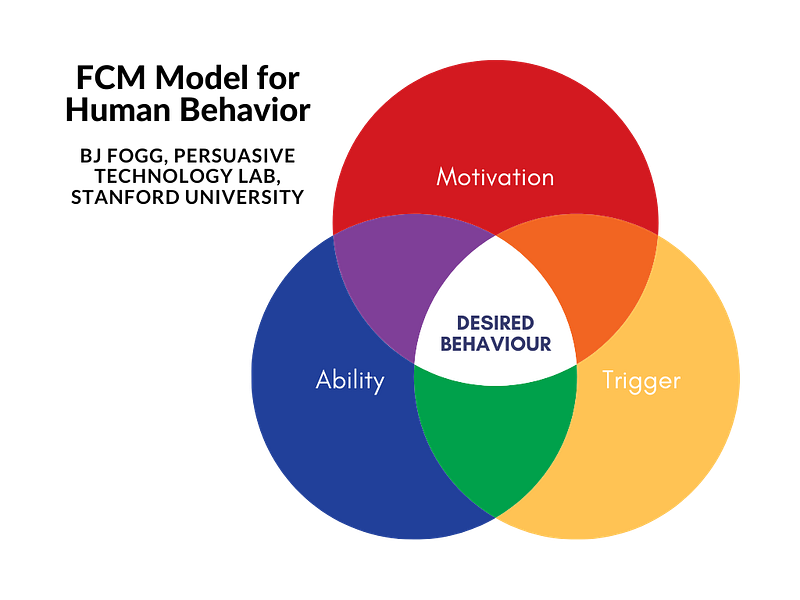
A Model for Human Behavior
BJ Fogg, of Stanford University, presented a model of human behavior called the FCM Model. He argued that in order for someone to achieve a desired behavior, three things needed to be present at the same time: motivation, ability, and a trigger.
Let’s break these down.
The first essential component is motivation. His assertions were that the three major categories of motivators for individuals are:
- Pleasure or pain
- Hope and fear
- Social acceptance or rejection
While Fogg asserts these as three separate motivators, one could argue that these categories are actually interlinked. We know from Eisenberger, Lieberman, and Williams and their FMRI studies that both physical pain and rejection activate the same part of the brain. There is also a common association between pleasure and pain and hope and fear.
The second essential component is ability. Fogg proposes multiple factors that influence our ability, including time, money, and so forth. These all hinge on the proposed idea that we are wired to take the simplest route.
The third essential component is a trigger. This trigger serves to give us the green light or the go-ahead. We know these by multiple names such as cues, nods, notifications (if we are on a media platform), and so on. Fogg’s ideas and studies on triggers are arguably not necessarily new, but have been evidenced by multiple avenues. [You can check some out here if you are interested] They have been presented again and again in seminars such as ‘How to Re-wire Your Brain’ or ‘How to create healthy habits’ and are employed as effective marketing techniques.
My father didn’t have the benefit of this paper and observations, but he still managed to achieve the desired behavior. He invoked fear of pain, waited for the ability, and initiated a trigger. The trigger I possess now is purely associative. What I think though is that this idea draws upon a frightening reality. If we are able to be conditioned or programmed in the performance of simple tasks at what point does this programming end and our own choice begin?
Embracing our “Programming”
Pretending that we aren’t a product of our society, experiences, and upbringing isn’t going to help us build a better future. It's going to keep us locked in an outdated and damaged past. Ignoring our programming and pretending that it doesn’t exist can be damaging. Changing standards and habits takes time and practice. Mix that with a lot of self-forgiveness and self-acceptance and you get the picture.
I sat for years in the self-help section. Spent years on my therapist's couch. The progress was slow. It was constant. I eventually realized that I didn’t want to spend the next 18 years un-learning every damaging aspect of my childhood. I don’t want to be immobile anymore because of my past.
I also recognized that there is a positive and negative side to every skill or lesson I have had programmed into me. We can learn to do better. We can channel it. Pain and abuse can grow empathy and understanding. Fear can breed efficiency and focus. Ignorance can give growth to curiosity breeding knowledge and understanding. It comes down to perspective. One of the most powerful tools that we have in our arsenal as a human being.
Instead of fighting against my programming, I make a choice to challenge and correct the negative assumption. My motivator. The associative fear that if I do not clean the house that pain will occur. I also find what is positive about my programming: efficiency.
When it comes to my housecleaning efficiency, I have embraced the Pareto principle, 80/20 rule. It's become my ally. It is the ultimate in streamlining our ability by lowering our standards and expectations just a little. In a nutshell, the principle teaches us that 80% of an effect comes from 20% of the causes. I realized that I could maximize my efficiency by focusing on just that 20%. I essentially worked to lower my standards to that 80%. Working to accept that the job didn’t have to be perfect to be completed.
Cleaning my home in less than 20 minutes is a useful skill. With three children 6 years and under, on some days it really is. What isn’t useful is the psychological pain associated with the method and efficiency. In how his expectations shaped my identity. This is where I get to choose.
Don’t fight it. Embrace it. Make it work for you. After all. No one else is you and has your voice and experiences. Isn’t this why we are here? To share them.
Drawing on some of the oldest wisdom, Confucius writes:
“He who conquers himself is the mightiest warrior.”
References (in order of use)
Wheatley, R.K., West, R.P., Charlton, C.T., Sanders, R.B., Smith, T.G., & Taylor, M.J. (2009). Improving Behavior through Differential Reinforcement: A Praise Note System for Elementary School Students. Education and Treatment of Children 32 (4), 551–571.
Fogg, B.J. (2009) Article 40: A behaviour model for persuasive design. Persuasive ’09: Proceedings of the 4th International Conference on Persuasive Technology, 1–7.
Eisenberger, N.I, Lieberman, M. D, and Williams, K.D. (2003) Does rejection hurt? A FMRI study of social exclusion. Science, 302 (5643), 290–292.