
We Can Lift Millions out of Poverty with Universal Basic Income
The ranks of the homeless and working poor are increasing as wages don’t match up to inflation
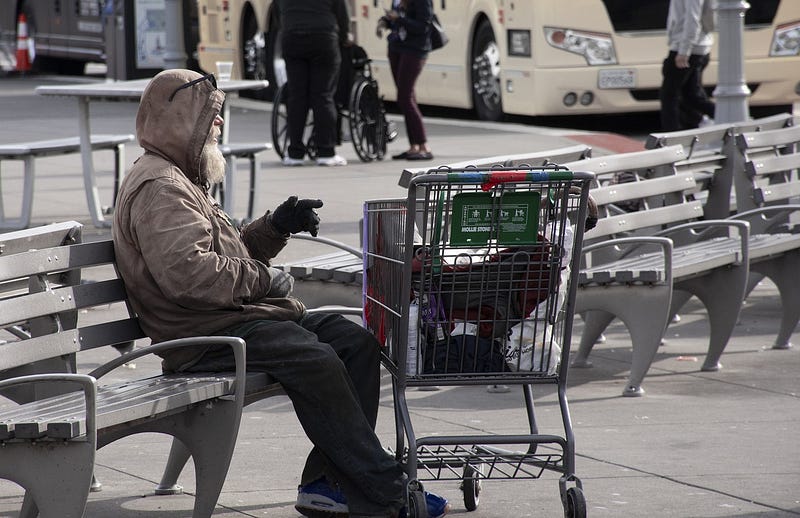
Poverty is reaching a crisis level, and wages aren’t increasing to match with inflation, leaving many people struggling with more than one job, losing their homes, and facing a host of other problems that are associated with poverty.
According to the United Nations,
Poverty entails more than the lack of income and productive resources to ensure sustainable livelihoods. Its manifestations include hunger and malnutrition, limited access to education and other basic services, social discrimination and exclusion as well as the lack of participation in decision-making. Various social groups bear disproportionate burden of poverty.
The impacts of poverty are far-reaching, and stretch across the globe. Some countries have a higher poverty rate than others, but even wealthy countries like the Untied States have a rising poverty rate.
According to CNBC,
As of January 2021, 37.9 million Americans lived in poverty, accounting for 11.6% of the total population, according to the latest report from the United States Census Bureau. That’s despite the fact that America ranks first as the richest nation in the world in terms of GDP.
The disparities in income between the very rich and the very poor are increasing. There are more people living in poverty, a shrinking middle class, and billionaires with more money than ever before in history.
The rise of the working poor
In recent years, the minimum wage has stagnated, while costs of living continue to rise. This leads to things happening in the US like people having to work as much as 120 hours per week just to be able to afford a 1-bedroom apartment.
The minimum wage isn’t a living wage, and it hasn’t been in years. When FDR first instituted the minimum wage in the 1930’s, it was intended to be a living wage. However, this doesn’t prove to be the case in the US today.
According to an analysis done by MIT,
An analysis of the living wage (as calculated in December 2022 and reflecting a compensation being offered to an individual in 2023), compiling geographically specific expenditure data for food, childcare, health care, housing, transportation, and other necessities, finds that: The living wage in the United States is $25.02 per hour, or $104,077.70 per year in 2022, before taxes for a family of four (two working adults, two children), compared to $24.16, or $100,498.60 in 2021.
The minimum wage does not provide a living wage for most American families. A typical family of four (two working adults, two children) needs to work more than two full-time minimum-wage jobs (a 96-hour work week per working adult) to earn a living wage. Single-parent families need to work almost twice as hard as families with two working adults to make a living wage. A single mother with two children earning the federal minimum wage of $7.25 per hour needs to work 252 hours per week, the equivalent of almost six full-time minimum-wage jobs, to make a living wage.
Since there are only 168 hours in a 7-day week, it is literally impossible for a single minimum-wage earner to work enough hours to be able to make a living wage. Not only that, no one should be expected to work 100% of the time without even having time to sleep.
So, those who say the poor just need to work more are completely out of touch with the realities of the financial situations of the working poor.
When you look at poverty worldwide, the figures are even more troubling than in the United States alone. According to the World Bank,
the global poverty rate increases by 0.2 percentage points to 46.9 percent, representing 44 million people living in poverty.
That means, almost half of the world’s population is living in poverty.
However, I focus on the United States in writing this not just because it is what I know, but because of the stark contrast you can see there between the very rich and the very poor.

There are more billionaires living in the United States — and in New York City — than anywhere else in the world. New York City is also home to 70,000 homeless men, women and children.
New York Billionaires can literally walk out their door and trip over a homeless person dying in the street.
The stark contrast is mind-boggling and unnecessary. The inequalities in wealth in the United States are greater than any other industrialized country, and they are only rising. When you can see these vast differences in income and wealth distribution, it is a clear signal that something is badly wrong.
Something needs to be done in order to help the very poor to be able to make a living wage, and lift them out of poverty. This can be done both through raising the minimum wage, and by instituting a Universal Basic Income.
There are places that currently pay their citizens to live there
Universal Basic Income programs have been tested in some countries in the past such as Finland, Iran and the UK. Some of these trials are still in progress, so results have not yet been released.
Since there are already programs in place where citizens are paid a stipend to meet their basic needs, this is something that could be replicated and expanded upon in the future by other countries around the world.
Alaska
One US State already pays each citizen on a yearly basis. That is Alaska. These funds are derived from the Oil Royalty Fund. These are distributed to each citizen of Alaska on a yearly basis.
Since one of the complaints by detractors of Universal Basic Income is that people won’t work if they receive UBI, Alaska’s findings are promising.
According to Knowledge at Wharton,
a study of Alaska’s oil royalty program shows a very different picture. “One of the concerns is … if you give people money for nothing, why should they work?” says Ioana Marinescu, a professor at the Penn School of Social Policy & Practice. “What we found was astonishing — which is that on average Alaskans work at the same rate as comparable states” such as Utah and Wyoming.
Using this information, it is a good argument that if Universal Basic Income was expanded to other states besides Alaska, then people would keep working despite receiving the payments.
Norway
For residents of Norway, being able to meet their basic subsistence needs is ensured by the government.
According to World Population Review,
The country whose system most closely resembles universal basic income is Norway. Norway is a welfare state, ensuring that all Norwegian citizens residing in the country have access to education, universal health care, and income in the form of social security or benefits. However, recipients of the monetary benefit must still meet specific conditions. For instance, they must seek work, abide by the law, participate in elections, and pay taxes.
When this program was instituted there were the same questions about whether it would disincentivize people to seek work. However, this appears not to be the case, and people typically reenter the workforce when they are unemployed.
Even during the COVID-19 pandemic, Norway had a social response that allowed them to provide for their citizens using a social safety net.
European welfare state
Although the rest of the EU doesn’t have the same type of social system as Norway, the EU as a whole does provide much better for their citizens in general. European countries typically provide social healthcare, housing, and additional benefits to their citizens.
According to Open Mind BBVA,
In the broader European Union context, the catchphrase “European Social Model” has come to refer to something that is uniquely European to the extent that this model is capable of promoting positive-sum solutions to what elsewhere (e.g., in the allegedly not-so-social American model) are considered to be unavoidable trade-offs between sustainable economic growth, on the one hand, and social justice and social cohesion, on the other. Because of its effectiveness, the European Commission champions the developed welfare state as an example to mimic for other countries and at the supranational European level.
Though the EU doesn’t provide Universal Basic Income to all citizens, it allows people to be able to work to live, instead of living to work. There is more paid vacation time, better healthcare, and many other benefits to living in an EU country.
This can provide a model for the rest of the world to follow in the future, in terms of providing a high standard of social care to their citizens. Countries such as Germany provide a universal child allowance that is paid to each German child.
Universal Basic Income in the United States
The idea of having a Universal Basic Income in the United States has been proposed by 2016 presidential candidate Andrew Yang, and a system that closely resembled UBI was first proposed by Thomas Paine in 1796.
It isn’t a new idea in America to fund a basic cost of living for all citizens. We do this already with Social Security for the elderly and disabled. However, expanding the program exponentially to include everyone, or even just those living in poverty, would require additional taxes that many people are unwilling to pay.
According to The Borgen Project,
Studies have shown that UBI can reduce poverty rates, particularly among vulnerable groups such as children and the elderly. Research shows that a UBI pilot project introduced in the 1970s in the Canadian town of Dauphin led to a reduction in poverty rates and improved health outcomes as hospitalization rates declined by 8.5% in four years, mental health improved and more students completed secondary school.
UBI can also stand as a solution to end poverty by stimulating the economy. When people have more money to spend, they are more likely to invest in local businesses and contribute to economic growth. A study conducted by the Roosevelt Institute found that implementing UBI in the United States could boost the country’s GDP by as much as $2.5 trillion by 2025 by introducing an annual $12,000 per person basic income and this would increase the labor force by 4.5 to 4.7 million people.
Lifting people out of poverty is a civil rights issue. When people live in poverty, they can experience many additional negative life events as a result. Many are homeless, food insecure, and lack access to medical care. Living in poverty can also cause trauma.
By instituting Universal Basic Income, we could lift millions of people out of poverty, and help them live much better lives. This is important because of the systemic and generational effects of poverty: if you are born in poverty, it is harder and harder to rise to a higher socio-economic level.
We can help to enrich the lives of those that are suffering, and provide a safety net for people who are just one paycheck away from losing their homes. This could help in the case of a sudden job loss, such as those that took place during the COVID-19 pandemic.
UBI could also help those that are disabled, mentally ill, or otherwise unable to work. By providing income regardless of the ability to work, we can provide equality to those who are most in need in our society.
Children and the elderly would also benefit from Universal Basic Income, since they most often rely on a caregiver to provide their income. This would allow them to be more self-reliant and able to care for themselves. UBI for children and elderly would also help to defray the costs of child and elder care which can hurt low-income families.
With all of these benefits to those in need, instituting Universal Basic Income would go a long way toward alleviating poverty, and providing a degree of equality to the poor in America today. It would help to lessen the gaps between the very rich and the very poor that currently exist, and create a more equitable society for all Americans.
For more exclusive content, sign up for my newsletter on Substack.