
We Can Fix Global Warming, Says the Voice of ‘Planet Earth.’ But Humans Must Hurry.
David Attenborough issues climate-change warning at Davos: ‘The Garden of Eden is no more’
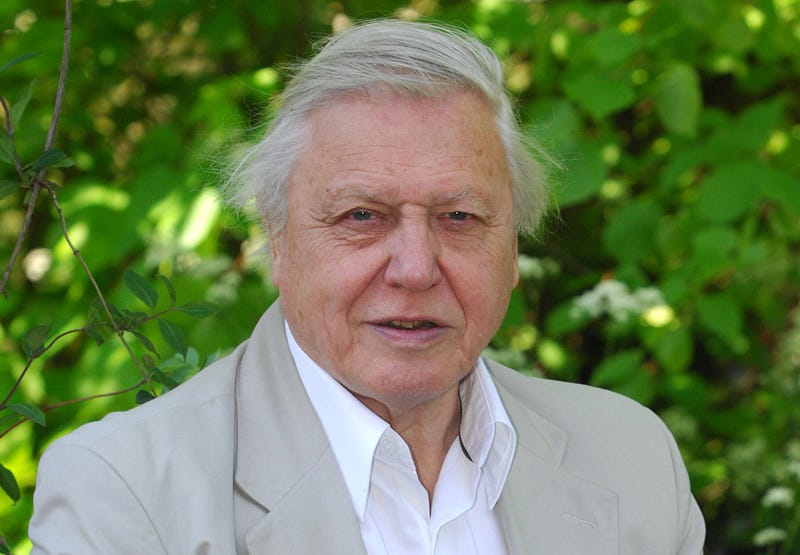
By Kayla Epstein
Sir David Attenborough has seen more of the planet and its wonders than most humans ever will. And on Monday, the famous naturalist and British television broadcaster warned that it had changed so rapidly and profoundly because of human-driven climate change that we risk destroying our earthly home.
“The only conditions modern humans have ever known are changing and changing fast,” he said while accepting the Crystal Award at the World Economic Forum in Davos, Switzerland, an annual gathering of the world’s most powerful political, cultural and business leaders. “It is tempting and understandable to ignore the evidence and carry on as usual or to be filled with doom and gloom. … We need to move beyond guilt or blame and get on with the practical tasks at hand.”
To drive home the point, Attenborough pointed to the changes that had taken place during his lifetime.
“I am quite literally from another age,” the 92-year-old said. “I was born during the Holocene, the name given to the 12,000-year period of climatic stability that allowed humans to settle, farm and create civilizations.
“Now in the space of one human lifetime, indeed in the space of my lifetime, all that has changed,” he continued. “The Holocene has ended. The Garden of Eden is no more.
“We have changed the world so much that scientists say we are now in a new geological age — the Anthropocene — the Age of Humans,” he said.
The Anthropocene is a scientific theory that posits Earth has entered a new geologic era brought on by human activity and pollution. Though the scientific community continues to debate whether we have actually left the Holocene epoch, in 2016 a group of scientists offered the theory that human impact on the planet was so profound that in the future it would appear in the geological record. They estimated the Anthropocene, if real, would have begun between 1945 and 1964, when Attenborough would have been entering adulthood.
Attenborough was not being hyperbolic. In October, the U.N. Intergovernmental Panel on Climate Change released a report that sent shock waves around the globe. It concluded that humans had only about a decade to get global warming under control or would suffer “unprecedented” consequences.
In 2018, global carbon emissions, a key driver of global warming, reached an all-time high.
Attenborough — something of a national treasure in Britain thanks to his classic documentary series such as “Life on Earth,” “The Living Planet” and “Planet Earth” — has spoken intensively about humanity’s role in causing climate change.
Speaking at a U.N. climate summit in December, he demanded of world leaders, “If we don’t take action, the collapse of our civilizations and the extinction of much of the natural world is on the horizon.”
An episode of his series “Frozen Planet” that focused on changes experienced in Earth’s polar regions caused controversy in 2012 after addressing climate change.
“You can argue about the interpretation of the evidence, sure. But the evidence now and has been for a decade or so incontrovertible that the climate is changing,” he told the Washington Post in 2015. “There was an argument 10 years ago as to what degree humanity contributed to that change or drove that change. Even that has now been pretty well solved.”
A recent poll from the Yale Program for Climate Change Communication found that Americans increasingly believe that global warming is happening and that it is caused by humans. About 73 percent of Americans think that global warming is real, and about 62 percent believe it is caused by humans, researchers found.
On Tuesday, Attenborough was interviewed at Davos by Britain’s Prince William, and he was equally frank about the crisis facing humanity.
“We are one coherent ecosystem. It’s not just a question of beauty, or interest, or wonder — the essential ingredient of human life is a healthy planet,” he said. “We are destroying the natural world, and with it ourselves.”
Kayla Epstein is the social media editor for National at the Washington Post. She specializes in blending traditional reporting and social media to tell stories and engage readers. She previously worked for the Guardian US, where she worked in support of the Pulitzer Prize-winning team that broke the National Security Agency stories. Follow her on Twitter @KaylaEpstein. © 2019, The Washington Post