
We Are the People
A tale of voting rights throughout history
We the People, are the first three words of the Preamble to the U.S. Constitution. In all, a fifty-two-word sentence with some mighty power.
We are the people; black, brown, white, native-born, or immigrant. We are the people, not based on our sex, gender, or who you love. And as such, we form our government. We are the stewards of these words, therefore, we are responsible for their continued existence.
In our current social climate, with our country experiencing deep divides surrounding racial and ethnic equality, voting rights, and economic disparities, one could argue we are 180 degrees from the original vision and intent of our founding fathers.
But have we been here before?
Is it a crime for a citizen of the U.S. to vote?
This year is the 100th anniversary of the 19th Amendment to the U.S. Constitution, giving women the right to vote.
Throughout the late 1800s up until after WWI, women fought for their voices to be heard and to be recognized as a ‘person’ mentioned in the Preamble. Susan B. Anthony, a suffragette for women's rights, was arrested and charged in 1872 for voting in a federal election, well before the ratification to the 19th Amendment.
If women had not gained the right to vote, were they considered ‘people’ under the words of the Preamble?
On August 18, 1920, the 19th Amendment did indeed grant women the right to vote, but not all women. Black women would not see their full rights for several more decades.
Where one hurdle had been overcome, that of being a woman, one was still playing out as an obstacle, the color of their skin.
Up until 1965 when president Lyndon B. Johnson signed the Voting Rights Act, black people were being denied the right to vote.
Even though the words of the 15th Amendment guaranteed the right to vote regardless of race, color, or previous condition of servitude.
These words fell flat in the face of subversive tactics such as poll taxes and literacy tests, keeping black citizens from casting a ballot. Combine this with fears of lynchings and persecution and the numbers of registered black voters dropped. Did they fit as ‘people’ under the words of the Preamble?
My grandmother worked as a nurse in WWI yet it would be a few more years before she could cast a vote and let her intentions be known. Both of her parents emigrated from Germany in 1880. She was born later in the U.S. as a U.S. citizen. Under the 14th Amendment, she held birthright citizenship meaning anyone born within a country’s borders is automatically a citizen, regardless of their parent's nationality.
Yet, she could not vote until she was 28 years old. If she had been black this would only compound her rights. If she had been black she would be waiting for the majority of her life to partake in the right of a citizen.
Even native Americans did not see full, legal U.S. citizenship until 1924. Can you imagine? The insult to not be recognized as a person of merit and of rights, in your own land?
This new law did not grant Natives automatic voting rights. It was not until the Voting Rights Act of 1965 put an end to the blanket discrimination that truly all people were allowed to vote under the law.
Now, are we the ‘people’ in the Preamble?
Unfortunately, the centuries-long struggle for all our voices to be heard continues.
This being an election year as well as the centennial of the 19th Amendment we are only seeing a ramping up of problems. We are facing dilemma’s in our democratic process from racial gerrymandering and redistricting to voter roll purges, to cybersecurity and tampering to the most current obstacle, the obstruction of mail-in-ballots through the U.S. Postal Service.
And while we are at it, let's throw in a public health emergency too, which for safety reasons requires us to keep our distance from each other.
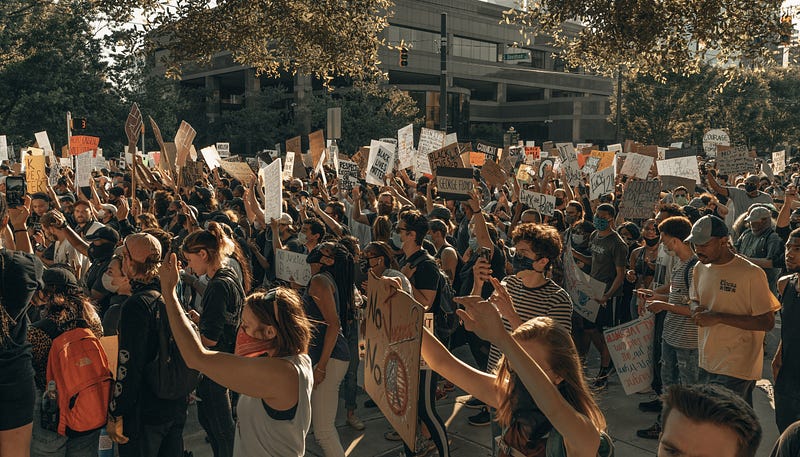
The very 1st Amendment of the Constitution guarantees the right to assemble peacefully and to petition the government. In essence, it is our within our constitutional right to speak out and stand up when we witness an injustice. But this too is under fire. There are citizens threatened with arrest and bullied with felony charges for peacefully protesting. A two-fold tactic. It instills fear and if convicted of a felony, you cannot vote.
Right now, at this very moment in history, it certainly feels like the world as we know it has turned upside down. That 180 degrees from the world which our forefathers and foremothers envisioned.
When those men wrote the now famous words ‘We the People’ they wrote them inclusively to the few states forming the new union. New York. Massachusettes. Delaware. Connecticut. Pennsylvania. New Jersey and New Hampshire.
The numbers of people grew with each assembling vote, eventually including all 50 states of the union, and presumptively the citizens of those states.
William H. Hastie, the first black federal judge wrote, Democracy is a process, not a static condition. It is becoming rather than being. It can be easily lost, but is never finally won.
But is never finally won, implies the fight for equality, for a continued seat at the table carries on. The three words, ‘We the People’ are inclusive to all color, race, creed, sex, and gender. We must keep sight of this and speak up for any moral injustice.
Individuals like our own ancestors and today’s groups like Black Lives Matter, have and are attempting to make this country reflect the democratic beliefs written throughout its founding document.
Let freedom and our voices ring. One way to do this is to vote. It is the right for each of us. We are the people.


