THE MASTERPIECE INTERVIEW
“We Are Our Souls, and From That Perspective, We Are Unlimited Possibilities” ~ Keri Mangis
We are here to grow and evolve.
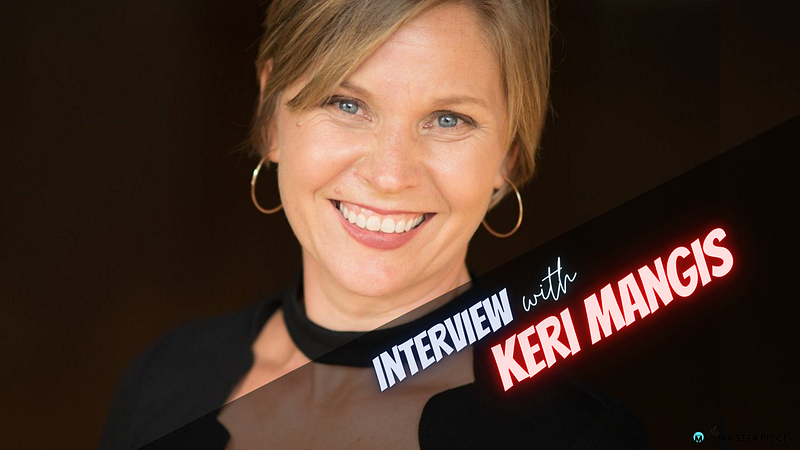
Hello and welcome everyone to The Masterpiece Interview.
Today we have Keri Mangis with us. Keri is a free soul wandering in this vast universe, experiencing everything in her way. Like snakes, she sheds skins in order to grow and evolve.
Her first book, Embodying Soul: A Return to Wholeness: A Memoir of New Beginnings, won several awards in 2020, including the IPA Award (Mind, Body & Spirit Category), New York City Big Book Award Winner, and The Independent Author Network Book of the Year Awards.
So, let’s talk to our lovely guest right away.
Hi, Keri. How are you doing? We are very happy to have you with us.
Keri Mangis: I’m doing well. Thank you so much for inviting me!
Where are you living right now, and how is the pandemic situation there? Is everyone okay in your family?
Keri Mangis: I live in Minneapolis, MN, so the pandemic has kind of taken a back seat to the issues related to police violence against Black people. It’s a fascinating time in history, and I am hoping to see Minneapolis, the city that raised me, be a beacon of light, truth, and justice going forward. But yes, my family has remained healthy and pursuing what they love.
That’s great to know. We hope justice and truth prevail. Now, let’s start with the very basic question that we ask all of our guests. It’s about how you see yourself. How do you define Keri Mangis? What does she do?
Keri Mangis: I do my best not to define myself! I did, though, for a lot of years, try to label myself and make it stick. I taught yoga for over a decade and then moved into the world of Ayurvedic healing. But I would always find myself itching to move on to something new. This bothered me, for a while, until I realized that it’s part of who I am.
I like to move through life like a snake shedding skins…trying new things, and letting them go when I’ve learned what I needed to from them.
So, as part of my work right now as a writer, I try to free others from the tangled web of their many “skins” — a shortcut word I use for labels, titles, or even personality traits. I do this because I believe that we are so much more than these things. We are our souls, and from that perspective, we are unlimited possibilities. And for me, I want to explore as many facets of that possibility as I can!
That’s a wonderful answer. It’s great that you don’t want to fit in a particular box or label. Well, we will talk about it more later. Now, tell us about the very early years of your life — where did you live in your childhood days, something about your parents, your siblings, and your experience of schooling.
Keri Mangis: I was raised in Fargo, ND (but I moved around a lot in my early years and don’t have much of the “you betcha” accent remaining!!). Fargo is a small town where everyone knows everyone.
I am the oldest of three — I have two younger brothers. And my parents are still happily married! But I always felt that I was the odd one out. Politically, for sure, but also just in terms of my desire to get out of a town where everyone knows everyone. To my family, that was a comfort. To me, that was confining. So, the moment I could move away and go to college in Minneapolis, I did!
I was always very curious as a child — always had my hand up in class. At least, when I was younger. At one point, I stopped doing that — out of fear of being wrong or annoying my classmates. If I could go back in time, I would tell my younger self to keep raising her hand and asking those questions!! But instead, I do it now, as an adult. Curiosity is the trait that most defines me (if I had to pick one!)
That’s really great. Asking is how we learn things we don’t know. But we are always in two minds fearing how people would think of us. Anyway, when you left your home for college, how did the world unravel in front of you? Can you remember?
Keri Mangis: What I mostly remember when I left home is this: people are people, wherever you go, whatever their background, their skin color, or anything else that sometimes separates us. I learned this first at the University of Minnesota, where I was introduced to so much more diversity than my upbringing in Fargo, which was a predominately white, Christian, “family values” kind of place. This was an important time in my life of seeing how much more diverse the world was, and that it was exciting me.
From there, I moved to a few different states, and each time, discovered the same mantra — “people are people.” They have worries, fears, dreams, phobias, desires, hopes…everyone. So, whereas I felt the “odd one out” growing up, I suddenly felt part of something so much bigger. I started to feel like I “fit in” in a way I never did grow up around people who looked like me.
So that time you have an epiphany or something (any event/experience) that made you realize something different in you? How did that feeling of something bigger come to you?
Keri Mangis: I can’t think of a particular moment of realization. In fact, I would say that this just hit me in a way I hadn’t even seen before. So, perhaps it was a more gradual unfolding.
But I do remember in the beginning, never telling anyone I was from Fargo. I would always say I was from Minneapolis. This was all about the time that the movie “Fargo” was very popular, and also a source of jokes. I didn’t like to bring it up. But I stopped doing that at some point, when I realized people liked me for who I was, not for where I’m from, or anything else.
More and more pretenses like that one continued to drop as I realized how freeing it was to simply be authentic and truthful, and how that encouraged others to be authentic and truthful. We have so much power to free each other from these false beliefs that separate us by deciding that we will no longer believe in them.
A crucial realization indeed. Revealing one’s true self seems hard until that person has a solid realization of who he/she is. Now, we want to know more about your realization ‘people are people.’ Do you believe that we all people are connected through some common things like fear, ambition, hope, dreams, emotions, etc? Can you please give us a solid idea about what you mean by people are people and how this shaped your thinking?
Keri Mangis: So, let me back up a bit with this one. I published my first book, Embodying Soul: A Return to Wholeness, a little over a year ago. After it was done, I had to come up with a press kit for it, which included questions like, “Why did I write this book?” You’d think I’d have known that, but sometimes you have to step back and really think about it.
When I did this, I realized that I wrote the book from a singular question: Did my Soul say YES to this human life? This, versus life being some kind of punishment, or merely a karmic result, or a test…
When I started my book, I wasn’t 100% sure that my soul would’ve chosen this life if it had known how painful it could be. How much suffering there is on this planet. Did she, my soul, say yes…even knowing that I would suffer too? By the end of the book, I got to the answer and it was a resounding YES, she did say YES to this human life. My soul chose THIS LIFE, not any other, for particular reasons to help me grow. She even chose Fargo on purpose as my birthplace!! And I realized that my soul chose this life so that it could continue to grow and evolve.
So now to your question: this is what I think we’re all here for, and what connects us all — we are here to grow and evolve. We’re here to learn lessons and expand our knowledge. And we’re all helping each other do that. So, the “people are people” comment could also be, “souls are souls” — and while we all have our varying talents, gifts, challenges, etc., we all said YES to this human life. We all bravely decided to take on this journey — even knowing we’d never get all the answers, that we’d fall short, that we’d hurt each other.
I always think about a person’s soul journey, and how it guides their life choices. It’s a curiosity of mine.
So, now we want to know — what is soul, and why souls have chosen this human life (when we see that thousands of us are suffering in different parts of the world). Do you believe that all the souls are connected to a whole (The One or something greater)?
Keri Mangis: Here is what I believe about the soul. The soul is the part of us that continues on life after life. It is the part of us that remains tethered to our Oneness, but it is also separate. The soul is the part of us that needs to get in this body and down on this earth to experience itself — as opposed to Spirit, which is always seeking up and out. We need both Soul and Spirit to be a whole human being.
What I meditated on while writing my book is why my soul thought a human life would be such a great idea — when it had access to realms and energies so much greater. What I learned is that being “embodied” — in human skin, allows us to see so many more faces and facets of the One, or the Divine, or whatever word someone chooses, than we could see from a soul perspective. It’s like pulling away from the mirror so we can see more clearly.
I always like the answer to the question of “Why did God create humanity?” “So that he could see himself.” I believe this is the answer to why a soul said yes to this human life, too.
Humanity shows us difference and uniqueness. Soul reminds us of our sameness and oneness. We need to understand both — they both feed each other and complete each other. We need to see ourselves as containing both the earth and mud of being human and the ether and light of being soul. So I don’t use “soul” as a metaphor, or a descriptor. I really see our souls as our essence, as our fundamental nature. The part of us that is wise, that is our instinct, that is our inner knowing. The voice that guides us back to our true self — that’s our soul.
The suffering is always difficult to understand — even when I tried to see it from a soul perspective. I can only trust that there is some greater purpose for it. In my book, I learned the purpose of my suffering was to bring me back to wholeness. But hands down…there is really no comfortable answer that makes it make sense. But we humans do push against our differences, rather than embrace them. And until we do the latter, we will continue to see suffering.
Now, what do you think — when this human body will die, will our soul be back again in a different form, at different times? Do you believe that our soul comes back on earth again and again?
Keri Mangis: This is my personal belief, yes. It is the only way I can reconcile the suffering if even I can. Why would we only get one chance, one experience? To me, that would seem like the greatest injustice of all, especially for the lives cut short.
We’ve all met the young person who feels so wise as if they’ve lived 1000 times before. We call them an “Old soul.” We’ve all had moments of deja vu, where we’ve felt we know someone we just met. We all have fears or phobias that have no known connection to this life, yet they’re real, and they’re there. We all feel connected to certain places and times — notice what movies you’re drawn to, and that might give you some hint of where/when you may have lived before. Notice what music draws you, as if your soul knows it, even if you’ve never heard it before. These can all be pointers to previous lives…if we pay attention and trust that pull of our soul.
In my book, I visit with my soul guide and explore my previous lives. I can see how I’ve grown through them, and why they mattered. And, it makes more sense, then, to see the magic in the life I’ll be living next.
There are so many possible vantage points in this human life, and some of us, as souls, want to try on as many as possible — and maybe even simultaneously! I don’t know anything about parallel lives, to be clear, but I think it’s a fascinating concept!
Interesting! Parallel lives sound a really fascinating concept. And what you are saying about souls is very thought-provoking. Now, can you tell us — how will one know or perceive that he/she had one or a few previous lives? In your case, have you ever realized anything about your previous life? We are curious to know your experiences with souls and different lives or life forms.
Keri Mangis: One of the most important previous lives for me to have learned and understood was one in which I was orphaned, and left on the streets to fend for myself. As a young child in this life, I regularly had a fear that my parents would leave me. If I lost sight of them in a public place for even a second, I would panic and cry. When they left for the evening to go to dinner and left me to babysit, I feared they would never come back.
So, learning about my previous life helped me to heal in this one. Sometimes, that’s what healing requires, to go back into previous lives and heal those. Not all of the wounds we carry are from this lifetime. And, not all of our wounds can be healed in this lifetime, either. Meaning: there are some wounds that have been instigated in this life for which we will need another lifetime to fully understand, reconcile, and heal.
The more we see this connectively, the less pressure (I hope) we’ll place on ourselves to try and heal everything, right now. We’re in such a rush, in our society. And that extends, sadly, to the healing communities. I saw it in yoga, too…everyone wants the handstand!! But no one really wants to sit with themselves.
A belief in reincarnation is more than just a “wow, I was a princess in a previous life” kind of thing. That’s a boring and elementary understanding of the purpose of reincarnation. Reincarnation is a way of understanding that growth takes time, evolution takes time, healing takes time. None of this work is meant for a single life. It takes many lives. If we slow down and realize this connection, we can forgive ourselves and others for not “getting there” in some superficial timeline. We can be patient with ourselves. And have compassion for those parts of ourselves that we can’t quite understand.
We couldn’t agree more that in this tech-driven world almost no one wants to sit with themselves and think about their relationships with this world or universe. Anyway, at what age did you realize all of these, and then afterward, how it impacted your life choices?
Keri Mangis: By my early 30s, I was married and had two young children. A good marriage, a good home, enough food, clothing, etc. And yet, I was diagnosed with depression and anxiety. Why? I couldn’t figure it out.
I disparaged myself for it. I told myself I didn’t deserve to be depressed when I had everything anyone could ever want. It was then that I started yoga. And, I was lucky enough to have teachers who did exactly what we were just talking about: sit with myself. I learned how to do this with compassion and grace. Well, maybe not so much in the beginning, but over time! Anyway, that’s when I found all this “stuff” inside me that was left unexpressed and unexplored.
I’d long ago stopped asking questions about God, or soul, or the purpose of humanity, and thought just living a good life would make me happy. I didn’t want to make anyone uncomfortable, so I just started dialing myself back — toning down my voice, my energy, my power. And that’s why I had depression and anxiety — and also, chronic, burning hives.
Ever since then, I’ve been on a journey to expressing myself, my emotions, my truth. I “raise my hand” again, metaphorically speaking. I’ve regained my curiosity and I know that as long as I remain curious, I keep depression at bay.
My life changes originally did shake up both my family of origin and my immediate family. They were sometimes shocked by my more outspoken behavior. They’re all used to it now, but there was a time where it was confusing, and it would’ve been easy to give it up. But I just couldn’t. Once you rouse that part of ourselves and reconnect with our soul, it is not very easy to shut it down again. It would be like waking up from a dream, but then trying to pretend to everyone you’re still dreaming. Can’t be done. Once you wake up, you can’t undo that.
If I ever give a warning about a spiritual path, that’s the one I give: there’s no going back. But, you won’t want to, either. Once you are living a life with greater awareness and soul expression, any other life would be so stifling, so confining, I can’t imagine it’d be possible.
It’s great to know that you regained your curiosity. And while having a conversation with you, our curiosity is skyrocketing as well. So, we are very interested to know about your idea of God. Can you share that with us?
Keri Mangis: I grew up scared to death of God!! When I learned in my Christian upbringing that God could read our thoughts, I thought I’d rather die! My thoughts were the last part of me I thought were sacred and private, and here He was, poking around in there! No Thank you!! I struggled a lot with the Christian God.
For a long time, I just tried keeping my head down, hoping to not catch attention. I got married in a Christian church, baptized my children there, as well as took them to Sunday School as I had done when I was a girl. But the day my youngest child came home from Sunday School with a picture she’d drawn of Satan, I reconsidered my entire relationship with God, and with the church. I struggled, mostly, with the patriarchal vision of God — a punishing, jealous, angry God. In a very potent session with a healer, I set down my Christian beliefs, once and for all. I’ve never looked back.
God to me now, well, I don’t often use the term, preferring instead Oneness or the Divine. But I don't really relate to Oneness either..human beings aren’t really designed to relate to a concept. I find, instead, the ideas of the gods and goddesses in the Hindu tradition appealing to me (Krishna, Shiva, Kali, etc), as they seem to me faces of God — as well as the Gods and Goddesses we meet in myth and story — Aphrodite, Zeus…etc. I find that I engage more with stories than I do with dogma or religion.
Wonderful! Being a person with an understanding and awareness of soul, spirit, God, and life as a whole — what do you think our purpose in life? Do you even believe that we all have purposes in life? What’s your thought on that?
Keri Mangis: Oh, you just opened up a can of worms with me! lol. I have a lot to say about this “purpose” we’re so keen on in our society. I think it muddles the whole journey of being human.
We are putting society’s beliefs on top of our spiritual movement. It is bad enough to reduce ourselves down to a label or role in society; it is even worse to reduce our souls down to a singular purpose!
Yes, we’re here for a reason: to grow, to evolve, as I’ve said. But as far as a task to accomplish, or a particular mission to find — I think this keeps most of us in a place of discontent and even fear. Fear, because “what if I can’t find my purpose”? That can be so debilitating, can’t it?
I think we should drop that idea of purpose altogether. The many teachers and programs that run on helping people “find their purpose” might not agree, though!! Because that’s all it is — a gimmick. We need to stop putting so much pressure on ourselves. We are learning in every engagement. There is growth in every life journey. There is a chance to grow no matter which of our soul’s strengths we explore and which ones we don’t. Endless possibility. That’s who we are. And possibility doesn’t need a purpose.
In one of your writings, you talked about “Multipotentialite”. What does that mean?
Keri Mangis: I didn’t come up with the term, but I wish I had! The link to the creator of that term is in that article if readers are interested in seeing more. But I certainly related to it!
For those of us who have multiple, seemingly disparate interests, it can be hard to find a job title that can encompass all of that. And therefore, we can start to feel like there’s something wrong with us, rather than embrace this.
I like to be a bit of a head-scratcher for people! I think it’s great fun to try new things that might not seem related! This last summer, I studied alchemy with a passion, for no other reason than I wanted to learn about it. I’m probably not going to find a job as an alchemist, but learning about it was so much fun. I don’t want to live in a world where I can’t learn something just for the sake of it.
So yes, multipotentialite — it means our potential to grow moves in many different directions. And we’re claiming that, rather than trying to “fix” it.
Well-expressed! You are exceptionally wonderful with your words. Anyway, we know that you don’t like to align yourself with some existing paradigm, company, model, or structure on this earth. Instead, you do what your soul expresses to you. You find joy in exploring new things. Now, tell us about your multipotentiality. How many different things you’ve tried so far? And tell us something about each one.
Keri Mangis: Growing up and into my 20s, I was a competitive runner. I always thought I’d be an athlete for the rest of my life…until I didn’t find joy in it anymore.
I was also a dancer for many years, ballet, jazz, tap, ballroom. I spent the most time in the yoga world. Even there, I explored every single style and philosophy I could find.
I then moved into studying crystals, and herbs, and took a full-length course on aromatherapy. For a while, I became a hands-on healer, working with angels and guides. Then, I spent several years learning about Ayurveda.
In Ayurveda, I got introduced to herbs and oils. I created my own herb kitchen and made my own herbal remedies for clients. This was great fun, too, but very time-consuming!
Then, this is when I finally got into writing. And of course, like the passionate learner I am, couldn’t just stop at articles, I had to write a book! So, I took all kinds of courses on writing and book publishing. I even decided to self-publish, which was a whole journey of learning and growing as well.
And then, as I mentioned, I moved in to study Alchemy. I’ve also been studying the archetypes, Hermeticism, and lately, focusing a lot on studying Myth and story!
I said before it’s all disparate things, but really, they do all connect when I look at it with a wider lens. Then, I see how they are all helping me in my journey of self-knowledge. As much as I can, I also try to share my knowledge with others. These are the constants of my life: learning, and teaching.
Incredible! This is amazing and quite astonishing as well. How did you manage your time for all this when you have a family? And how long you stay in one phase? This world seems like a learning playground for you and we must say — you are playing exceptionally well.
Keri Mangis: I have a very, very supportive family!! I’m so lucky.
Some phases lasted a long time, like yoga, but others were like a flash in the pan. I had some friends who would tease me about this, and sometimes I still confuse myself as to why something that seemed so interesting suddenly doesn’t inspire me anymore. But you’re exactly right — when I view this life as a playground, it really doesn’t matter anymore! And I hope to continue with this approach for the rest of my life.
Did you ever have a conflict regarding your thoughts/thinking/lifestyle with your husband? Is your husband influenced by your thinking? Or, he has his own philosophy of life?
Keri Mangis: Yes to all of the above. I mean, my husband, his name is Todd, he’s always been the first one in the line of fire for my new thoughts/walks of life. It’s him that has to walk in the house when I’ve literally smoked us out while making a new herbal recipe, and him who has had to help me move furnishings in and out of offices so many times… He’s not like me. He’s the steady, rock kind. But that’s probably good, right? Two of me…that would be a catastrophe! So, he holds the boat steady while I rock it. And somehow, that works.
He’s not the philosopher I am, but he does take new things in and ruminates on them. Over time, he’s changed a lot, and grown a lot, because he’s willing to continue to question what he believes, yet he still has his own beliefs independent of mine. I really can’t imagine a better life partner.
That’s lovely. Now, let’s ask you a different question — How will you convey your message of wholeness to the people who are on the downside of luck, for example living in war zones and struggling to survive at each moment? Or, people who are suffering extreme financial and emotional downturn? How will they see their souls or become aware of themselves and connect to the Wholeness while they are suffering each moment externally? What would be the procedure or practices?
Keri Mangis: If you are familiar with the chakra system, you’ll see that there are seven chakras, energy centers, in the body — Root, Sacral, Solar Plexus, Heart, Throat, Third Eye, Crown. To develop each one in a healthy way, each needs the others to be balanced and whole. The issues you’re talking about…survival…have to do with the Root chakra. Concepts like personal growth, using our voice, developing our intuition, and moving into wholeness — these all have to do with upper chakras. Upper chakras cannot be explored to great depth if the root chakra is not stable.
So, what I’m saying is, those of us who have the option to explore these concepts are quite lucky indeed. Because when we don’t have enough food, when we don’t feel safe, when our lives are under threat — no amount of “oneness” talk, or “step into your power” mantras are going to help. In fact, they’re going to be abrasive.
That is why those of us who do have this luxury need to also be politically and socially active. It is we who must work for a more just society so that others can eventually have this opportunity as well. There is nothing that bothers me more than a spiritually aware person who stays away from politics. These are exactly the people we need in politics and community leadership! Awake, aware, engaging, compassionate people using their privilege and opportunity to bring this same privilege and opportunity to those who can’t.
So true. You are right that we are indeed in a luxurious position to think. Now, tell us briefly about the philosophies that have an immense impact on you and helped you build your awareness. And how a curious reader can get them to his/her benefit?
Keri Mangis: First, the practice of Maitri, which is a practice of self-love. Learning to embrace all the parts of myself that I once rejected. This is about sovereignty, personal authority, and self-respect.
Second, the practice of compassion, which is a practice of understanding and empathy. This is about the movement to wholeness. My favorite mantras are a set I learned while studying Yin Yoga. They are:
May I be free from fear and harm. May I be at peace with whatever comes. May I be happy as I am.
Then, these mantras can be developed and said for “you” and then for “all beings.”
This is all part of a larger practice of Tonglen, which I definitely suggest readers look into as a style of meditation that goes much further than simply relaxing ourselves but moves to healing our collective.
Thanks a lot, Keri. Now let’s have some quick questions. Who labeled you as a deep-thought translator and what does that mean? Keri Mangis: My daughters did when they were little! I suppose, to them, it meant that I was always asking more questions. To me, it means I wish to understand and unravel my biggest questions.
How do you see yourself as a mother? Keri Mangis: As a guide, mentor, and, now that they’re grown, friend.
What happiness means to you? Keri Mangis: Happiness is transient, based on events. I seek joy, which is more soul-based.
Have you any major regret in this life? Keri Mangis: No, none. Everything, every path, has meaning.
Tell us one big question that you are still searching for an answer to? Keri Mangis: The big question: Who am I?
Name at least three books that changed the way you see yourself/the world. Keri Mangis: The Alchemist, Conversations with God, and Siddhartha.
Do you have any role models or schools of philosophy that you always look up to? Keri Mangis: My teacher lineage is: Caroline Myss, Andrew Harvey, Michael Meade, James Hillman. Philosophy: All is One, or As Above, so Below.
What is pain and suffering to you? Has it any spiritual significance? Keri Mangis: Pain and suffering in my life has always meant separation from soul.
Are you influenced by Buddhist philosophy? Keri Mangis: Yes, I enjoy much of it, but I’m not tethered to it, either.
How long your writing phase has been continuing? Are you still enjoying it? Keri Mangis: Yes! I think this particular “skin” might be with me for a long time. It’s healthy for me.
That’s great to know for us too. Because you have so many lovely thoughts and perspectives that we all need to know. Anyway, that’s all, Keri. We cannot thank you enough for your precious time.
Keri Mangis: Thank you so much! I’m so glad you’ll be sharing this with your readers, and I hope it is valuable!
We know that we missed many things as there is so much to know from you and the time is so limited.
Keri Mangis: I’m always open to a Part 2!
That would be really wonderful.
Dear readers, We hope you enjoyed the conversation with Keri Mangis. You may read her writings by visiting her Medium profile.
If you want to read amazing conversations like this one, you may check out other interviews by clicking the below image.

You can also share your outstanding stories and inspire others. Just click the below image and be a writer for The Masterpiece.