avatarAndra Forbes

Summary

The Milky Way is on a collision course with the Andromeda galaxy, which is approximately 2.5 million light-years away and moving towards us at 110 kilometres per second; however, the merger won't occur for about 5 billion years, by which time Earth will be uninhabitable due to heat.

Abstract

Our galaxy, the Milky Way, is destined to collide with the Andromeda galaxy, the largest galaxy in our local group. Despite being 2.5 million light-years away, Andromeda's immense size, roughly 200,000 light-years in diameter, and its rapid approach at 110 kilometres per second, make it a significant future event in the cosmos. This cosmic event is expected to result in the formation of a single large elliptical galaxy after a merger that will take place in about 5 billion years. Although the concept of a galactic collision may seem catastrophic, actual star collisions will be rare due to the vast distances between stars. Notably, by the time this merger occurs, Earth will no longer support life due to increasing heat from the Sun.

Opinions

  • The author suggests that the collision between the Milky Way and Andromeda galaxies is a significant and fascinating astronomical event, but not one that should cause immediate concern for readers.
  • The author implies that the merger of the two galaxies will be a slow process, with the resulting elliptical galaxy forming over an extended period.
  • It is mentioned that the Earth will be too hot for life by the time the galaxies merge, which could be interpreted as a comment on the long-term habitability of our planet.
  • The author encourages readers to explore more of their writing on the universe and life, indicating a belief in the educational value of their work.
  • By inviting readers to subscribe, the author expresses a desire to engage with an audience interested in astronomy and related philosophical topics.

Our Galaxy Is on a Collision Course

The Milky Way is on a collision course with another large galaxy.
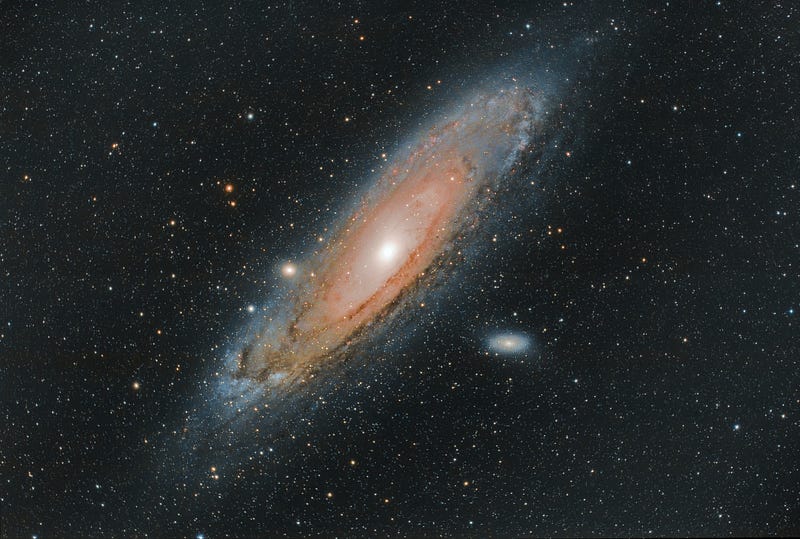
Photo by Gaëtan Othenin-Girard on Unsplash

British spelling.

Andromeda is a spiral galaxy similar to our galaxy, the Milky Way, but much larger. It is approximately 2.5 million light-years from our planet.

2.5 million light-years is a vast distance when you consider that light travels 9.46 trillion kilometres in one year. A trillion is 1 followed by 12 zeros.

Andromeda is the nearest large galaxy to the Milky Way and is estimated to hold a trillion stars. It has a diameter of over 200,000 light-years and can be seen at night as a fuzzy patch by the naked eye.

At this time, the Andromeda galaxy is racing towards the Milky Way at about 110 kilometres per second, which is 396,000 kilometres per hour, but there is no need to panic; the two galaxies will not merge until roughly 5 billion years.

By that time, the Earth will be far too hot for any life to exist.

It will take a very long time, but eventually, the two galaxies will settle down and become one large elliptical galaxy.

You would think that when that merger happens, stars will be colliding all over the place, but star collisions will be very few due to the vast distances between them.

The end

You may find some of my easy-to-understand stories about the universe and life interesting and educational.

If you hit the free subscribe button you will see my latest stories. Regards.

Andromeda Galaxy
The Milky Way
Vast Distance
Astronomical
Speed Of Light
Recommended from ReadMedium