
We are no better than the fish we keep.
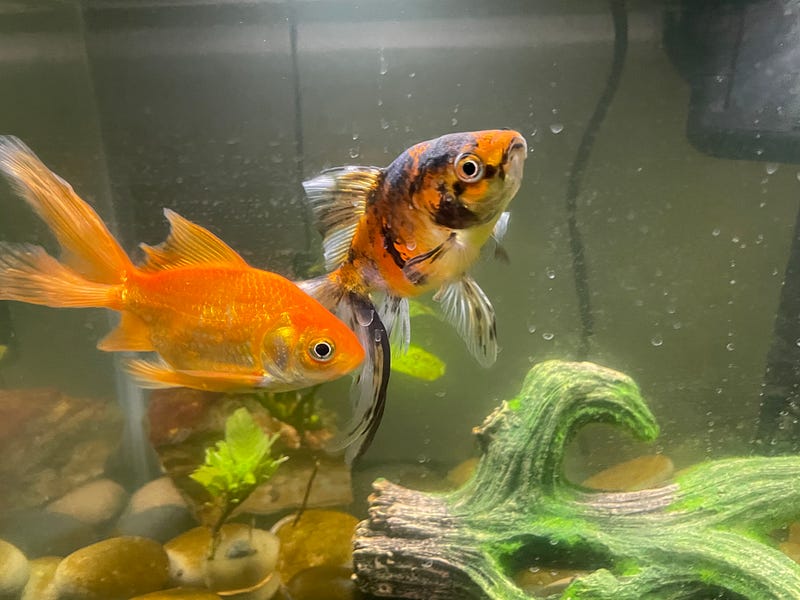
In the confines of a modest home, where every item had its place and purpose, the aquarium stood as an emblem of both wonder and deceit. Within its transparent walls, a false ocean thrived, its inhabitants unknowingly trapped in an artificial semblance of their natural habitat. This miniature sea, with its vibrant fish and counterfeit coral, was more than a decorative piece; it was a subtle metaphor for the larger world outside its glassy confines.
These fish, gliding through their confined waters, were blissfully ignorant of the true vastness of the oceans they were meant to roam. Their reality was limited to the dimensions set by their human guardians, their every need curated to maintain an illusion of naturalness. Yet, in their restless swimming and occasional frenetic bursts, a sense of something lost, something missing, was palpable.
This microcosmic display mirrored the broader human experience. Just as these marine creatures were bound to their glass enclosure, so too are we often confined within the metaphorical walls of our own making. Our cities, though sprawling and seemingly boundless, are akin to larger aquariums, where we navigate through the currents of life in a world meticulously designed by unseen architects.
In these urban landscapes, we follow paths laid out for us, believing in the freedom of our choices, yet often unaware of the invisible boundaries that guide us. We are encapsulated in our routines, our daily circuits through the city mirroring the circular swimming of the fish in their tanks. We are provided with the necessities and luxuries that create a semblance of contentment, a simulation of freedom, but beneath this veneer, there lies a controlled and structured reality.
The architects of our urban aquariums — the policymakers, urban planners, and societal norms — shape our environments just as the owners of the aquarium shape the lives of their aquatic captives. They construct the flow of traffic, the layout of our neighborhoods, and the rhythm of our daily lives, all under the guise of efficiency and progress. In doing so, they create a habitat that sustains an ecosystem, one in which we play our designated roles, often unconsciously.
Just like the aquarium, our cities are filled with artificial flows and rhythms, echoing the false freedoms granted to their inhabitants. We are allowed to swim freely within the confines of these larger tanks, mistaking our well-orchestrated routines for genuine autonomy. Our lives, in many ways, are governed by the needs of the ecosystem we help sustain, an ecosystem that benefits those in control, the unseen hands that feed and maintain the tank.
In this realization, there is a dawning awareness of the parallels between our lives and those of the fish in the aquarium. Both are subject to the whims and designs of higher powers, both live within boundaries that are often invisible yet omnipresent. Yet, in this awareness, there is also the potential for awakening, for recognizing the walls of our tanks and perhaps, in time, finding ways to transcend them, to experience a freedom that is true and unbounded, beyond the glass walls of our contemporary aquariums.


