
SPACE | ASTRONOMY | ASTROPHYSICS | STELLAR EVOLUTION
“We Are Made of Star Stuff”
If we are made of star stuff how are stars made? Read on to find out.
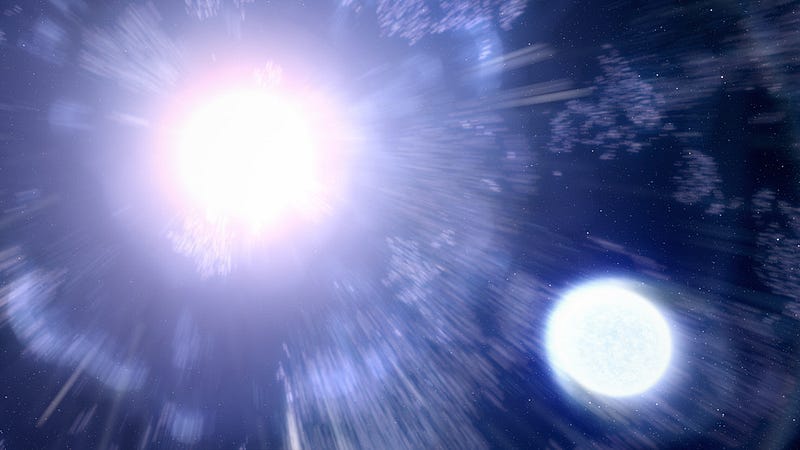
The quote of the title is by the late Carl Sagan, from his TV show Cosmos. I have embedded a 9-second clip at the end. But what exactly does it mean? And do all stars contribute equally in ‘star stuff making’?
This is an article I’ve long wanted to write. It is about one of my favorite subjects, stellar formation and evolution. An ‘astrophysics 101’ article, written as simply and clearly as possible. I am not an astronomer or astrophysicist like Ethan Siegel, who I’ve read for many years in this platform, but I am a high octane astronomy geek. I’ll try to do my best. So, here we go.
How are stars made? Where do they come from? Why are there any stars and galaxies at all rather than dispersed dust and gases all over the universe? Well, we can thank gravity for that. The seemingly simplest but actually most mysterious of the four fundamental forces.
Gravity pulls stuff together. The closer and the more massive they are the stronger gravity is. So the above gases and dust, which originally consisted of hydrogen and some helium, very slowly got together into larger lumps. The more massive those lumps were the more gravity they exerted. So that process accelerated with time, until the first proto-stars were formed ~400 million years after the Big Bang:
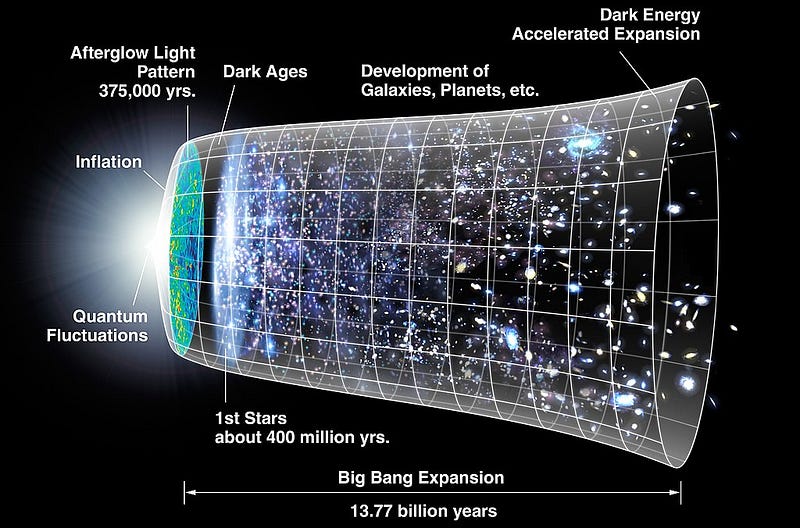
“Quantum Fluctuations” in the above image is code for “We do not really have a clue about the Big Bang itself, only what occurred after.” Let’s ignore for this article most of the info above and focus on stars and planets.
The first proto-stars are believed to have been huge. Far more massive than our Sun. Because they were huge they did not last long, just a few tens of million years. Stars ‘light up’ by fusing hydrogen into helium. For the entirety of their lifespan there is an equilibrium between gravity pushing inward and the energy from their core pushing outward:
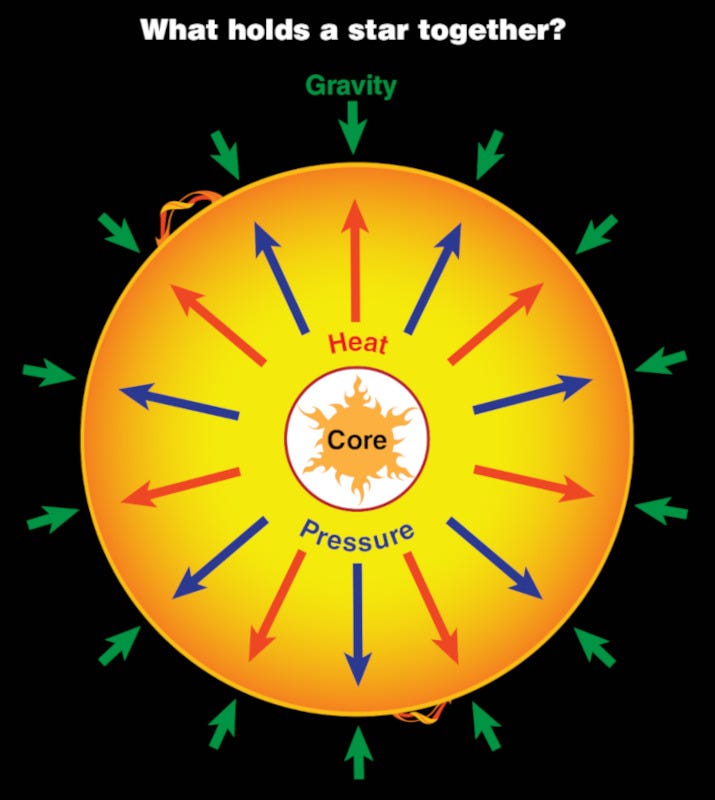
The more massive a star is the faster its fusion rate. The result is higher temperatures that gradually turn them -starting from red- orange, then yellow, white and eventually blue. The more intense the fusion is the faster the hydrogen of their core is converted into helium.
In the cores of Class G stars like our Sun helium eventually is fused into carbon via the triple-alpha process. Carbon is the main element of life. However our Sun will probably never release its carbon for potential new planets or new life.
Stars like our Sun fuse helium into carbon during their red giant stages. Eventually, after blowing up into gigantic dimensions after about 11 billion years -see image below (4.6 is ‘Now’)- they shed their outer layers into a nebula but keep the vast majority of their carbon in the white dwarf that they leave behind, which is actually their former core.
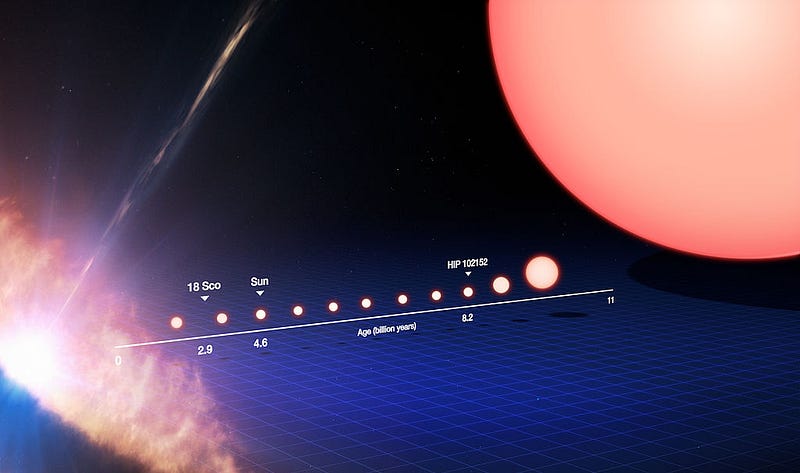
Unless that white dwarf collides with another star or absorbs matter from it to explode into a Type Ia supernova, its carbon -along with some oxygen- will forever remain trapped there. Until it cools over hundreds of billions -perhaps trillions- of years into a black dwarf.
So where does Carl Sagan’s “star stuff” come from for planets and eventually life to form? Surely white dwarf collisions must be rare right? They are not very rare, but more importantly they are not the only kind of supernovas. The first proto-stars I mentioned above were all planet-less. They could not have planets because elements heavier than helium did not yet exist.
Planets, in particular rocky planets like Earth where life can evolve, require heavy elements to form. They absolutely need silicon and oxygen along with some metals for the planet’s crust, and hydrogen — oxygen for water. They also need heavier metals like iron and nickel for the planet’s core; for rocky planets the size of the Earth at least.
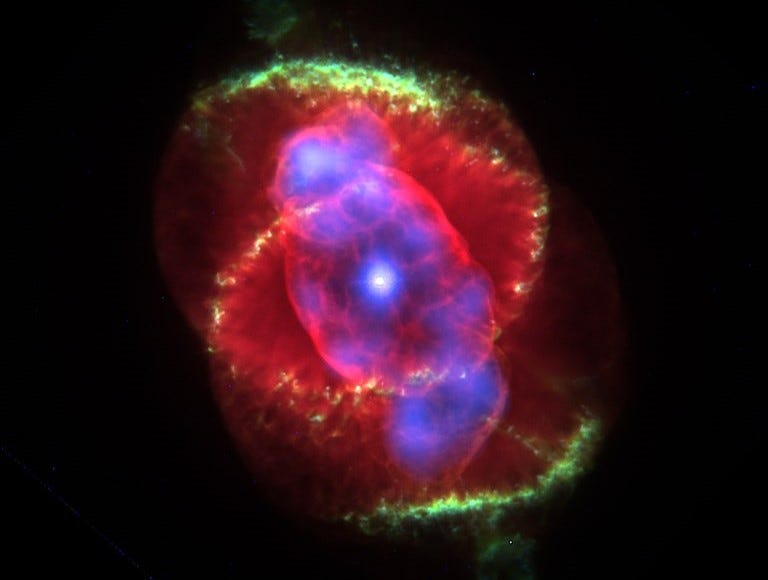
By the way, this nebula -called “Cat’s-eye nebula”- is from a star with a similar mass to the Sun. After ~7 billion years our solar system will look like this, and the surviving planets will all be inside a similar nebula.
Mercury, Venus, Earth and probably Mars will literally become star dust, but the outer planets -Jupiter and farther- will survive. The bright spot in the middle is a young white dwarf, the distant sun’s former core.
Life as we know it also requires nitrogen and phosphorus to form DNA, and traces of copper, magnesium, and many other metals. None of the heavy elements can be formed by stars like our Sun; unless, like I mentioned, it bumps into another star.
But white dwarf collisions are not enough to account for the abundance of planets, some of which might host life, in the universe. The rest of the required ‘star stuff’ for them -and us- is generated by the supernova explosions of very large stars. Just like the ancient huge proto-stars very large stars do not live long.
They explode into Type II (core collapse) supernova when their core, after multiple fusion steps, produces iron. Iron fusion requires more energy than the energy it generates. As a result the core cannot produce any more energy to counteract gravity and it spectacularly collapses.
The star first implodes -for fractions of a second- to a very small size and then explodes, similar to how some nuclear warheads function. That explosion seeds the universe with nearly all the elements of the periodic table you learned about at school. Without neither Type I nor Type II supernovas we would not be here, nor planets would exist.
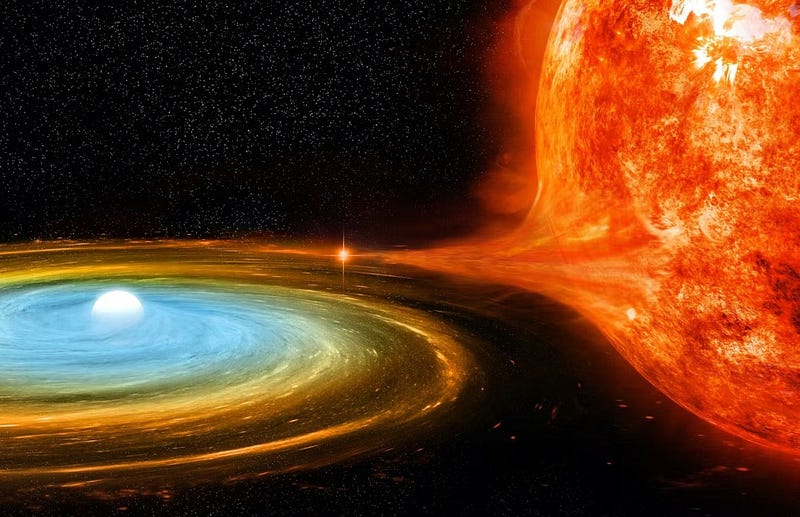
A supernova like that of my header image, which kicks away its companion star, is the most destructive force in the universe. It can outshine an entire galaxy for a few minutes. But it is literally life giving.
If stars did not ‘sacrifice’ themselves planets and life would not exist. The universe would have remained in its original proto-star stage.
Supernovas are the seeders of star stuff. The seeders of life. If you imagine the original planet-free universe as a dry sterile land, supernovas provide the seeds, the water and the fertilizer for planets and life to grow.
I think I covered the basics of the basics of stellar formation and evolution. Carl Sagan also says in the clip “We are a way for the Cosmos to know itself.” That’s very poetic.
sources: What Is a Supernova? | NASA Hubble Reveals Surviving Companion Star in Aftermath of Supernova | NASA The End of The Sun | Northwestern University Astronomers discover two stars in a stellar dance | Inverse


.jpg)
