
Ways to Evolve Your Thinking
Overcoming learning plateaus, deschooling yourself, and using punctuated equilibrium to find success. — Your #1 Newsletter for Accelerated Learning
“It is among the commonplaces of education that we often first cut off the living root and then try to replace its natural functions by artificial means. Thus we suppress the child’s curiosity and then when he lacks a natural interest in learning he is offered special coaching for his scholastic difficulties.” –Alice Duer Miller
Cambrian Leaps: One Way to Apply the Genius of Warren Buffett to Your Life
Charles Darwin’s On the Origin of Species is one of the most remarkable books ever written. It explained, for the first time and in plain English, the theory of evolution.
In doing so, it shined a light on biology and the natural sciences, which laid the groundwork for many of the great discoveries of the twentieth century.
More than that, it provided a metaphor for many other systems in the world around us. We talk about people, marketing, and ideas evolving in the same way species do.
However, Darwin got one thing wrong in On the Origin of Species, which has an important implication on how you think about evolution as a metaphor for how to change your life.
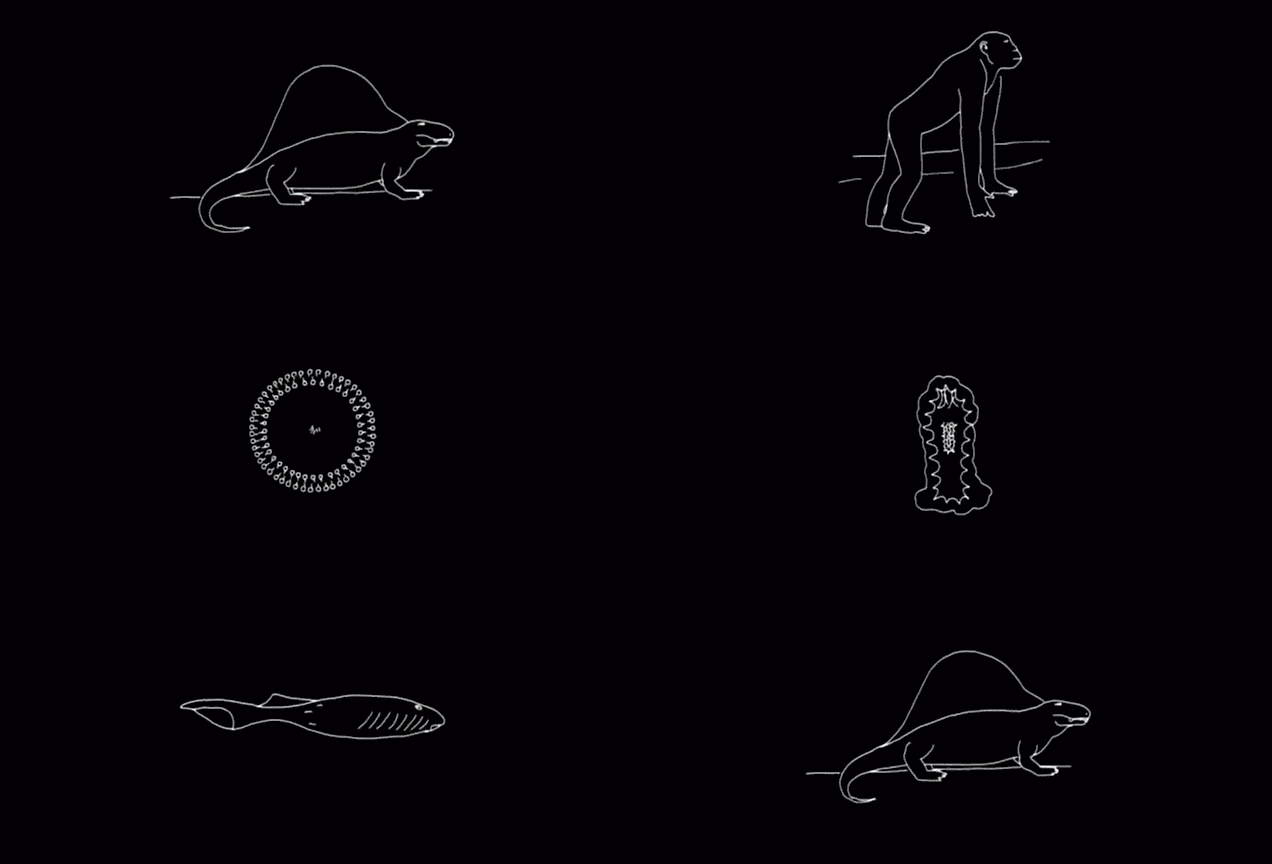
He believed species evolved gradually and linearly. However, research conducted after the book’s publication showed that evolution happens through long periods of stasis where there is very little change going on, punctuated by periods of rapid growth.
What Is Punctuated Equilibrium?
This phenomenon, called punctuated equilibrium, is the way that most natural systems evolve. Understanding punctuated equilibrium is essential to understanding how to change your life.
Trending Today…
The Schooled Mind vs. The DeSchooled Mind — Fifteen thousand hours of schooling leaves quite the impression. Your habits, thoughts, goals, relationships, and worldly views have all been influenced by your education. Most of us have been schooled, but have you deschooled? Here are two ways of seeing the world and how they factor into your success.
Check these out…
How to Break Through Any Learning Plateau and Never Stop Growing — We’ve all hit that wall before. It feels like no matter how much you wish to push onward, you’ve reached a mental limit and lost all motivation. Nat Eliason offers some tricks to help you break a learning plateau and get your groove back.
Want To Make Big Progress? Stay Forever Curious — Curiosity should be at the center of your life. It fuels work ethic which in turn fuels success. Here’s what David Kadavy has to say about curiosity, art creation, and living the life of your dreams.
In the Year 2889 — This is a short story by Jules Verne, author of Journey to the Center of the Earth and 20,000 Leagues Under the Sea. Written in 1889, this is Verne’s captivating prediction of what the future will be like in 2889. We recommend you give it a read! From the story:
Little though they seem to think of it, the people of this twenty- ninth century live continually in fairyland. Surfeited as they are with marvels, they are indifferent in presence of each new mar- vel. To them all seems natural. Could they but duly appreciate the refinements of civilization in our day; could they but com- pare the present with the past, and so better comprehend the advance we have made! How much fairer they would find our modern towns, with populations amounting sometimes to 10,000,000 souls; their streets 300 feet wide, their houses 1000 feet in height; with a temperature the same in all sea- sons; with their lines of aërial locomotion crossing the sky in every direction! If they would but picture to themselves the state of things that once existed, when through muddy streets rumbling boxes on wheels, drawn by horses — yes, by horses! — were the only means of conveyance. Think of the rail- roads of the olden time, and you will be able to appreciate the pneumatic tubes through which to-day one travels at the rate of 1000 miles an hour. Would not our contemporaries prize the telephone and the telephote more highly if they had not forgot- ten the telegraph?
What’s up?
We want to provide you with the most valuable content possible. So hit us up on social media with your comments or suggestions, and we’ll get back to you. You can find us on Facebook, Twitter, and Medium. We’d love to connect!
If you’re enjoying this newsletter, please click here to clap it up on Medium!
Interested in what else we’ve found around the web? Check out our M-F Newsletter to get more awesome content from us and others delivered straight to your inbox! Sign up here.


