
Ways AI May Soon Revolutionize The Healthcare Industry
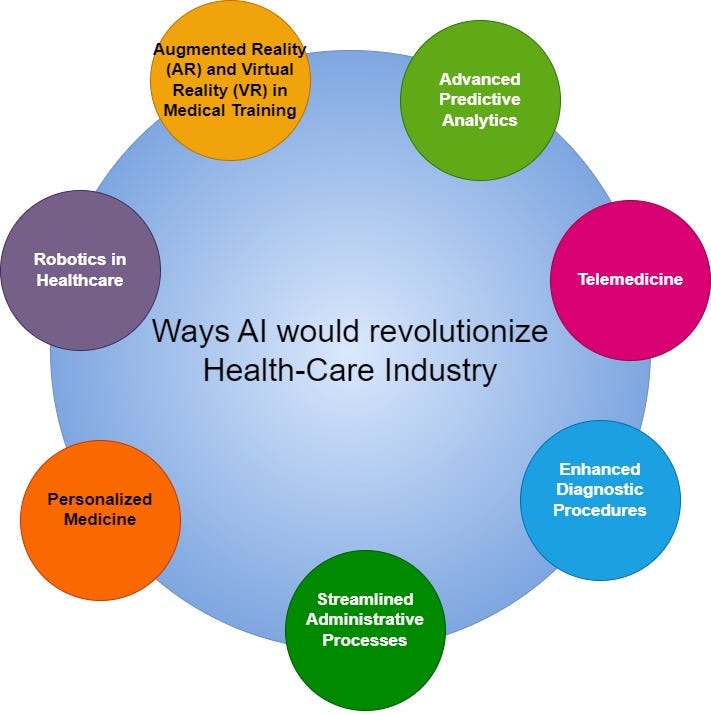
AI Revolution in the healthcare industry would help human life extension, fixing birth defects i.e. CRISPR (DNA updates), reducing administrative costs, and many as discussed below
The healthcare industry has been substantially impacted by the rapid advancements in artificial intelligence (AI). From diagnostic assistance to administrative workflow optimizations, AI has proven to be a potent tool in revamping healthcare dynamics. One significant advantage has been the reduction of costs, a critical aspect given the escalating healthcare expenses globally.
1. Advanced Predictive Analytics
Predictive analytics, fueled by AI, promises to take preventative healthcare to unprecedented heights.
- Risk Prediction: Leveraging large datasets, AI can predict potential health risks, allowing for early interventions and preventing the escalation of health issues.
- Epidemic Outbreak Predictions: AI can help in forecasting epidemic outbreaks by analyzing diverse data points, and facilitating timely preventative measures.
2. Telemedicine
Telemedicine, backed by AI, offers a flexible and efficient alternative to traditional healthcare delivery.
- AI-Assisted Teleconsultations: AI can assist doctors during teleconsultations, providing real-time insights and data analysis to facilitate more informed decisions.
- Virtual Health Assistants: These assistants can help with regular follow-ups, and medication management, and provide personalized health tips, enhancing the quality of remote healthcare.
3. Augmented Reality (AR) and Virtual Reality (VR) in Medical Training
AR and VR stand to reshape the medical training landscape, offering immersive and interactive learning experiences.
- Simulated Surgeries: Medical students can practice surgeries in a risk-free virtual environment, offering a hands-on experience before stepping into the real world.
- 3D Visualization: These technologies allow for 3D visualization of complex biological structures, enhancing understanding and retention.
4. Enhanced Diagnostic Procedures
AI promises to elevate diagnostic procedures, offering more precise and timely diagnoses.
- AI in Radiology: AI can assist in analyzing medical images, and identifying patterns that might be overlooked by the human eye.
- Predictive Diagnostics: AI can analyze a patient’s medical history to help doctors arrive at a more comprehensive diagnosis.
5. Streamlined Administrative Processes
AI is set to revamp administrative processes, bringing in efficiency and reducing human errors.
- Smart Scheduling: AI can optimize appointment scheduling, reducing waiting times and enhancing patient satisfaction.
- Automated Billing: AI can automate billing processes, reducing administrative overhead and the scope of errors.
6. Personalized Medicine
AI is paving the way for personalized medicine, ensuring treatments are tailored to individual genetic makeup.
- Genomic Analysis: AI can analyze genetic data efficiently, helping in the formulation of personalized treatment plans.
- Personalized Drug Development: AI enables the development of drugs tailored to individual genetic profiles, potentially increasing the effectiveness of treatments.
7. Robotics in Healthcare
Robotic assistance, integrated with AI, holds the promise of reshaping various aspects of healthcare.
- Robotic Surgeries: Robotic systems can assist surgeons in performing complex surgeries with precision.
- Robotic Caregivers: In the near future, we might see robotic caregivers assisting elderly individuals and patients with chronic diseases, providing a new level of care.
As we stand at the cusp of a revolution in the healthcare industry, AI emerges as the catalyst driving transformative changes. From predictive analytics to personalized medicine, AI is all set to redefine the paradigms of healthcare. The road ahead is brimming with opportunities for innovation, steering the industry towards a future where healthcare is more accessible, efficient, and personalized, promising a healthier future for all.