
Waxing Rhapsodic About “Rhapsody In Blue”
An ode to one of my favorite pieces of music.
The lone, low clarinet trills near the bottom of its range, then glissandos upward in joyful mourning, settling in on a bluesy riff. And for the next 16½ minutes, I am transfixed.
The first time I heard George Gershwin’s “Rhapsody In Blue” was in my school library. I was a fan of musical theater and collector of cast albums. I was listening with regularity to recordings of scores by Stephen Sondheim, Leonard Bernstein, Jerry Herman, Bock and Harnick, Kander and Ebb, and others who were writing for the theater at the time. I was just discovering the older composers in that medium, like Jerome Kern, Cole Porter, and of course Gershwin.
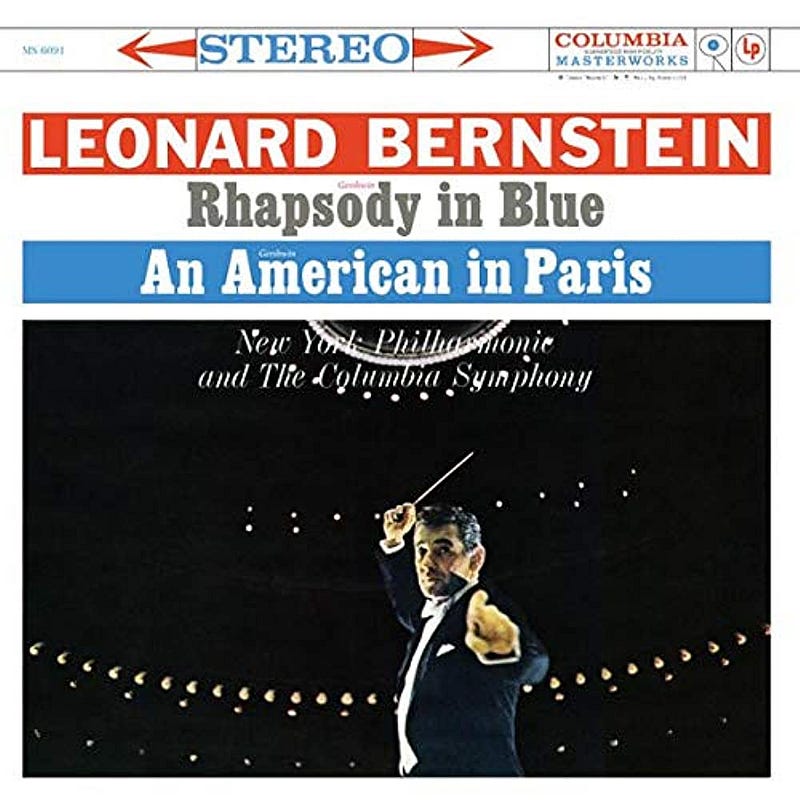
I was also starting to explore classical music. It was while I was thumbing through that section of records that I stumbled upon a recording of “Rhapsody In Blue” and “An American in Paris” by George Gershwin, conducted by Leonard Bernstein. I had to hear that!
So I pulled the record off the shelf and went over to the carrels where there were turntables and headphones set up. I sat down, put the headphones on, and…
I was enthralled from the start. It was part jazz, part blues, part classical, but it was also something more. It was the sound of a young composer of popular songs finding a new voice. And something in it just grabbed me.
It has remained a part of my listening repertoire ever since.
I also enjoyed the work on the other side, “An American in Paris,” but it didn’t affect me in the same way.
In addition to there being many, many different recordings of the Rhapsody by many different orchestras, conductors, and piano soloists, there are also a few different versions of the piece itself.
Gershwin originally wrote the music out for two pianos. The arranger Ferde Grofé then created the original orchestration for jazz band (Paul Whiteman’s band, to be specific) based on that piano version. (Gershwin, at the time, knew little about the art of orchestration.) In 1976, conductor Michael Tilson Thomas was the first to record that 1924 jazz band version. Once again, I found it in the library.
After years of listening to standard symphonic orchestras playing what had become one of my favorite pieces of music, hearing that smaller version was so much fun! There are saxophones and even a banjo in the arrangement that gave the music a whole different pulse than the previous recordings I’d heard. And that record had the added interest of having the piano part played by the long-deceased composer himself, via player piano rolls he made in 1925.
Speaking of piano rolls, there’s also a recording of Gershwin playing the entire piece by himself, taken from those once-common devices. He tends to play it a bit faster than many later performers did, though I find that to often be true when composers play or conduct their own work. He also plays some sections very differently than we’ve come to know them.
All of these variations have different feels to them, but for me the composition itself still shines through.
I listened to all of the recordings listed above in preparing this article, trying to parse out what it is about “Rhapsody In Blue” that speaks to me. I can’t put my finger on it. In terms of classical music, it is amateurish and somewhat disjointed. A little messy musically. Sections can be taken out or moved around (which has been done) and somehow, it’s still the Rhapsody.
Maybe it’s the messiness that’s part of the appeal. It has a personality.
George Gershwin composed several other concert works, becoming more proficient in compositional technique, before passing away far too young at the age of 38 from a brain tumor. For me, his death may be the most tragic of the era. I can’t help but wonder what else he might have written had he lived longer.
But whenever I hear his “Rhapsody In Blue” I feel almost like I know the man. And I’m taken back to that day in my school library.


