
Watching John Lewis’ Homegoing
The Edmund Pettus Bridge, Jonathan Daniels, and My Granddaughters
On July 17, 2020 I watched CNN’s Don Lemon interrupt his evening programming for late breaking news: John Lewis had died. During a short commercial break, Lemon’s team quickly reached Andrew Young, the civil rights activist on the phone.
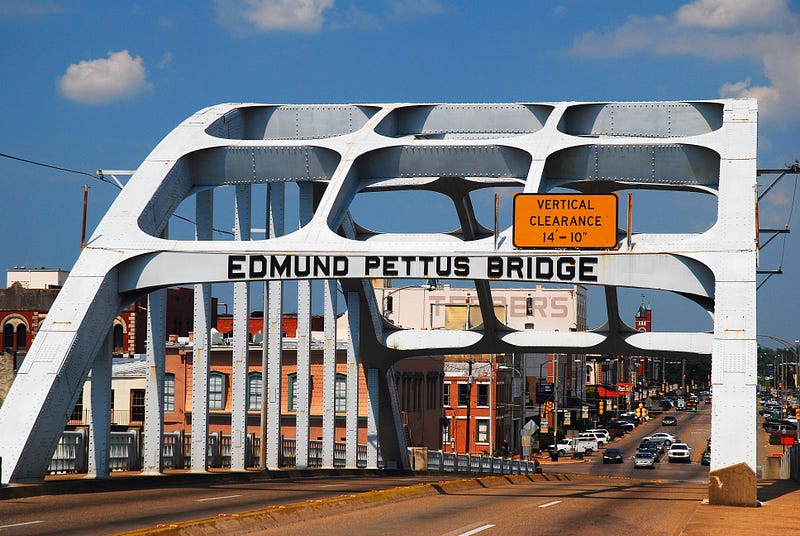
Lemon and Young talked about Lewis, about “good trouble.” About that day in 1965 when the 25-year-old Lewis led 600 people over the Edmund Pettus Bridge from Selma, Alabama and on to the state capital in Montgomery.
Violence ensued, John Lewis had his skull bashed in. That day would be named “Bloody Sunday.”
Lemon showed a clip of Lewis and hundreds of others recreating that walk across the Bridge years later.
I watched a video of Congressman John Lewis, Speaker Nancy Pelosi, Senator Kamala Harris, and others walking across the Bridge on March 8, 2020.
Four months later, I watched a horse-drawn carriage pull John Lewis’ coffin over the Bridge.
I thought about Abby, Caroline, and Alison, my granddaughters. With other young people from St. James Episcopal Church in Keene, NH, they walked across the Edmund Pettus Bridge in 2015, in memory of the 50th anniversary of Bloody Sunday.
And in memory of Jonathan Daniels.
Daniels, a young seminarian and member of their church, had dedicated himself to Civil Rights. Traveling south to Alabama in the spring of 1965, he answered the call of Martin Luther King, Jr. for others to join in marching across the Edmund Pettus Bridge.
Staying on in Alabama, Daniels tutored Black children in reading, registered voters, and helped integrate a local Episcopal church. He returned briefly to complete his studies at the Episcopal Theological School in Cambridge and then back to Alabama.
“On Saturday, August 14, Daniels was picketing local businesses with others in Fort Deposit, AL. They were arrested and held in the county jail in Hayneville before being released on August 20.
As the day was hot, Daniels and three others — the Rev. Richard Morrisroe (a Roman Catholic priest), Joyce Bailey, and Ruby Sales — approached a local store to buy sodas.
The entrance was blocked by a man with a shotgun, Tom Coleman, who threatened to shoot if they tried to enter.
During the confrontation, Coleman aimed the gun at Ruby Sales. Daniels pushed her out of the way and was shot in the chest, dying instantly. Father Morrisroe was shot in the back as he and Joyce Bailey ran for safety.” stjameskeene.com/jonathan-danielsJonathan
Jonathan Daniel’s body was taken back to New Hampshire for the funeral and burial. Daniels is listed in the Memorial Book of the Chapel of Saints and Martyrs at Canterbury Cathedral. His name has been added to the church calendar of saints, and a bust of him is in the National Cathedral in Washington, DC.
I watched John Lewis’ four-hour funeral. His homegoing ceremony.
Listened as Reverend Dr. Raphael Gamaliel Warnock, the Senior Pastor of Ebenezer Baptist Church, reminded those assembled to say “Amen” louder because “that’s what we do in Baptist churches.” Told us about the man he loved who stood for “good and necessary trouble.”
I listened as this good man, known well for “good trouble” was eulogized by Keisha Lance Bottoms, Mayor of Atlanta; Nancy Pelosi, Speaker of the House of Representatives; President Obama; President Bush; President Clinton; Bernice King, Martin Luther King’s daughter; 12-year-old Tybre Faw from Tennessee who told us how Lewis was his friend; James Lawson, the Civil Rights activist and one of Lewis’ teachers of non-violence. And so many others.
I remembered where I was in 1968 when Martin Luther King, Jr. was murdered and was eulogized at his homegoing ceremony also at Ebenezer Baptist Church. And realized how far removed I had been from the Civil Rights Movement and Bloody Sunday in 1965 on the Edmund Pettus Bridge in Selma, Alabama.
Living in Connecticut with a husband finishing a PhD at Yale, I was tucked away in the Yale Divinity School, cataloging books. I’d asked for a transfer from Sterling Library, the main library at Yale, because that job was even more boring than cataloging books.
I was barely proficient enough in German to work with books in that language. (Other than saying “gesundheit” when my husband sneezes, my scant knowledge of German disappeared long ago.) I was certainly living in a bubble.
The closest I got to the Civil Rights Movement was listening to Sandy, a Black friend of mine, tell stories years later. She had left Michigan State University to return home to Alabama and fight for civil rights.
Now I remembered what she’d told me: the fear, the violence, the people killed, the knowing that what she was doing was right. And her Mother’s disapproval for fear her daughter would die.
I thought again about my granddaughters, Abby, Caroline, and Alison. Proud they believe Black Lives Matter. Proud they walked across the Edmund Pettus Bridge.
For another Black Lives Matter story, see https://readmedium.com/kindergarten-in-a-black-school-27f3e2806ddc


