
Watch Out! That Person Next to You in the Church Pew Might Be An Atheist!
Examining the curious phenomenon of churchgoing unbelievers
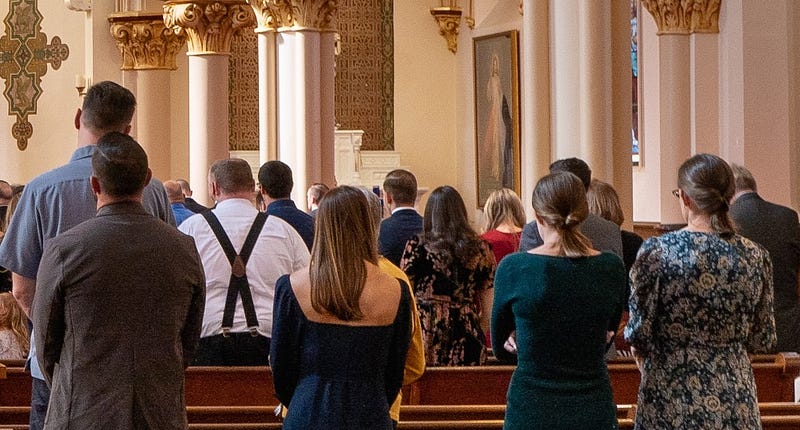
I was the newly inducted vicar in an inner-city parish in Yorkshire, UK.
After my first Sunday service, I chatted with parishioners over a mug of tea. Later, as I was packing up my stuff before going home, the churchwarden casually said to me.
“Oh, I see you met John. He’s our friendly church atheist.”
What???
Over the years I was the vicar in that church, he attended services — not every week, but invariably a couple of times per month.
He looked after the upkeep of the church hall, and if we ever needed someone to come down to the church to help with practical repairs or improvements, his was invariably the first name on the list.
He was one of the most committed people in that church — but didn’t believe in God, Jesus or the Bible…
Many years earlier, when I was still a curate (trainee vicar, in essence), I sat in a meeting where church leaders were discussing some aspect of the worship — and suddenly, the Church Treasurer wailed:
“Yes, that’s all very well — but what about those of us who don’t believe?”
Here was a mature lady, probably in her early sixties at that time, who sang in the church choir and — in response to appeals for someone to step forward — had taken the role of Church Treasurer.
This propelled her into the upper echelons of the church leadership pyramid as — quite rightly — the Treasurer attended every church meeting.
Yet she had zero belief in the core tenets of the Christian faith.
It had never entered my head that someone who admitted to no faith or belief in Christianity would choose to belong to the church.
It turns out that it’s more common than you might imagine.
Research published in the December issue of the Journal for the Scientific Study of Religion discovered that whilst almost two-thirds of their University sample identified as either atheists or agnostics, around one in five of those unbelievers had attended Sunday worship in the previous year.
According to the Public Research Institute, this phenomenon is not unique to the academic community — but is found within the wider population. Although 71% of atheists never attend public worship, 29% attend at least “sometimes.”
Similar patterns are found among self-identified atheists in the general public. Roughly 3-in-10 (29%) atheists say they attend religious services at least sometimes.
And according to Christian Today, something like 1% of atheists attends church regularly — even weekly.
Enough with the statistics. There have been other surveys, but I won’t make people’s head spin by quoting more — take it as read that a minority — but a sizeable — minority of atheists like to attend church.
The question is, “why?”
Why would a rationally thinking unbeliever drag themselves out of bed on a Sunday morning, limp along to a religious building, and sit there — quite possibly in the cold — listening to some spiritual leader spouting from the pulpit?
I think there are a few reasons:
- Some people go to keep their spouse or partner happy. I subtitled this with the word “spouse”, but the overwhelming majority are men dragged along by their female partners. Many men likely go to church on Sunday for no other reason than to keep their wives happy.
- Other atheists go for the sake of the kids. This is a similar thought process to the previous point. The mother and children enjoy the church, so the dad forces himself to go along to show support. One might argue why an unbelieving father would “pretend” to demonstrate faith this way. Still, it seems that for some men, the desire for family bonding and shared activity trumps any personal misgivings they might have.
- Others still go to church to feel part of a community. In this increasingly fragmented world, many people are longing for connection. Whilst few churches would claim to be perfect — and my experience is that they are often far from it — it is still the case that churches tend to be friendly, welcoming and open.
In my last church, a handful of men seldom attended the service but were always at social events or work mornings. Often they would magically appear just as the service finished because “My wife needs a lift home” and stick around for coffee and to enjoy the sense of community in the church family.
We even had one guy who offered to join the coffee rota. He would dutifully show up ten minutes before the end of the service and make coffee for everyone!
But he quite openly stated that he thought the Christian faith was nonsense and didn’t believe a word of it.
Another reason atheists might attend church is to do with the indefinable sense of beauty and peace found within many churches, especially those with hundreds of years of history, such as we typically see here in the UK.
I stumbled upon a blog post by a writer called Sophia Mitrokostas. Entitled “I’m an atheist, and I go to church”, Sophia tells the story of how she was raised within the Orthodox faith but fell away from it as a young person.
Yet she still finds connection and meaning within churches. She speaks about how she is drawn to church buildings.
I frequently retreat into churches and temples on walks through the countryside or around busy cities. I find their serenity to be infectious. A church can be a quiet place to bend your head and reflect on your day, mull over a problem, or let go of all thoughts and simply dwell.
I never ask for divine guidance or intervention. I try not to be self-conscious about closing my eyes or looking out of place. I just sit there and appreciate a few minutes of silence.
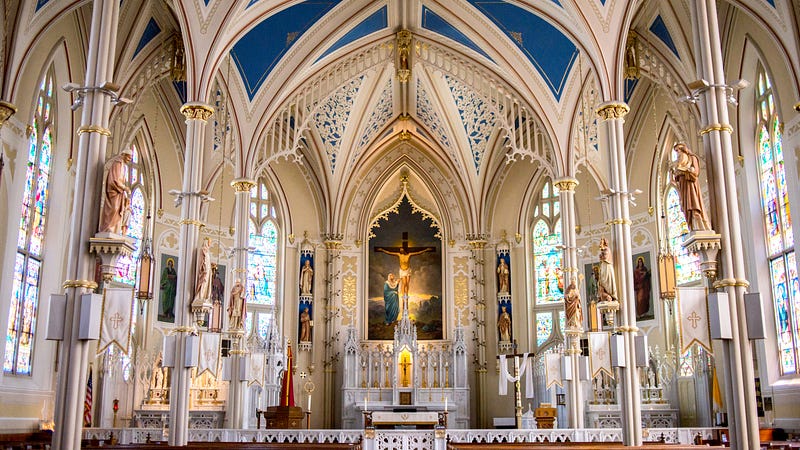
But there is more to this than simply acting as a spiritual tourist, scouring the English countryside for medieval church buildings — she also finds deep meaning in the rituals within those buildings.
Ceremonies like baptism and marriage help us create identities and foster community belonging. They lend us words to describe ourselves, give us milestones to measure our progress through life and create moments of shared emotion.
Even as an atheist, I believe there’s power in ritual to shape the reality of an individual or group. Lining up to receive communion or bathe in a holy pool may not be mystical to me, but it does seem transformative. The hope and comfort imparted to believers by such acts can’t be denied, even if there’s a chance the source is more psychological than celestial.
It doesn’t surprise me that at least some atheists and agnostics find value and meaning in church liturgies, worship and the buildings themselves — but it got me wondering if the reverse is true.
Do Christians find value in atheist or humanist gatherings?
Believe it or not, the secular equivalent of churches exists.
Back in 2013, the Sunday Assembly was founded in London by two comedians. The gatherings offered the experience of belonging without the associated dogma. The concept was to tap into the sense of loss at the core of our culture in the absence of faith, which appeared to be a feasible alternative.
It grew rapidly and spawned branches in several UK cities. But numbers declined in the second half of the decade, and when I looked at their website today, many of the gatherings have closed or put on hiatus.
Why is there a drop in participation? The underlying reason appears to be the absence of any coherent binding force other than an aspiration to find community. In an article for The Atlantic, Faith Hill cites one researcher:
Being uninterested in something [i.e. religion] is about the least effective social glue, the dullest possible mobilising cry, and the weakest affinity principle that one can imagine.
Scratch beneath the surface of experiments like The Sunday Assembly. I’m sure you’ll find the occasional Christian believer hiding under a wide-brimmed hat and fake beard — possibly for the same reasons I mentioned above, i.e. to keep a partner of differing beliefs happy.
“I’ll come to your church worship service today if you come to my humanist meeting next week.”
Is there a lesson for the contemporary church today?
Strip away the accoutrements of Christianity as The Sunday Assembly did a decade ago, and there’s little to commend it for most people. Hence the decline in numbers once the initial period of novelty had fizzled.
Some unbelievers find the desired sense of community by dipping their toes into the church — and can often do so in more beautiful and evocative buildings than the bland meeting rooms typically employed by the Sunday Assembly.
But could the church do much more to provide a space for those around the periphery of belief and some who identify outside the Christian faith entirely?
Many church leaders are custodians of the most amazing and spiritually uplifting buildings and have skills in leading people in meaningful rituals and appreciation of symbols.
Is it time to stop our obsession with preachy sermons and repetitive worship songs and explore how we can move people with diverse symbols and rituals through art, music, poetry and creativity?
I think it's worth a try. What do YOU think?


