
Watch Euphoria, Sex Education, and Normal People to be Better People
We should all talk about emotional validation and affective responsibility

How I wish I had these three wonderful series available in my teens! Art offers us a security window to analyze the lives of some characters, seeing ourselves reflected. Thus, time after time, in our adolescence we walk between the fine line of not taking responsibility for our actions or blaming ourselves for the damage that others afflict us — with the misfortune of not being as wonderful as Zendaya —. TV shows Euphoria, Sex Education, and Normal People give us a different perspective of what it means to be a teenager, and how we can manage in an intense relational and emotional world around us. Each of them has different strengths and can help us even as adults to improve our relationships, both with other people and with ourselves.
EUPHORIA

Masculinity
Euphoria is a series focused on women. Even so, the male characters make us review all the toxic patterns of masculinity, either due to white privilege (Nate), poorly channeled traumas, or pressure that society imposes on us (McKay and Nate’s father). And the only ones we have left, Fezco and Elliot, both seem good guys but are deep in the drug world.
What do we learn from them? That there’re no excuses. Wherever you come from, whatever privileges you have or not, you can be someone who makes bad decisions. It’s up to you to evolve or stay in a spiral of anger and fear.
Toxicity in relationships
If in the first season we suffered from the abusive relationship between Nate and Maddy, now Cassie enters the equation. Watch it and see the worst that could happen to you. These types of abusive relationships show that sometimes we have to give up social skills, assertiveness, and empathy: if you experience abuse, run away. It’s the only option. But what happens when you can't see it? That you sink deeper and deeper into misery. TV shows like these, are so obvious that I think they can help many people who confuse obsession with real love.
Self-love
Jules is a trans girl. Kate deals with weight problems. But both girls coincide in avoiding important conversations because they’re not very clear about their identity or what they want. And both end up having problems in sex because of it. But along the way, both can empower themselves… or fake they’re empowered. Sometimes, we need to allow ourselves to feel miserable again, as happens with Kat in the wonderful scene of ‘Love Yourself’ in chapter 2x02.
And on the other hand, we have Rue, who, in her way, doesn’t know how to love herself either and resorts to the worst of extremes: drugs. Until now, the stories we’d seen gave us a reason why people start taking drugs. That’s what I like about Euphoria. Does Rue have a reason? Not specifically, as she says in chapter 2x03.
Learning: excessive culture of self-love is ridiculous, and leads us to invalidate and disempower ourselves. Likewise, our attempts at self-destruction by not loving or respecting ourselves don’t always have an origin to go to. Perhaps the most frequent reason is not being able to bear our shitty life or context.
Euphoria represents the worst thing that could happen to you or your relationships. It’s exaggerated, but it’s not impossible either. Thanks to that we can analyze the extremes objectively and even put a name to the, I hope, small mistakes you’ve made in life.
SEX EDUCATION
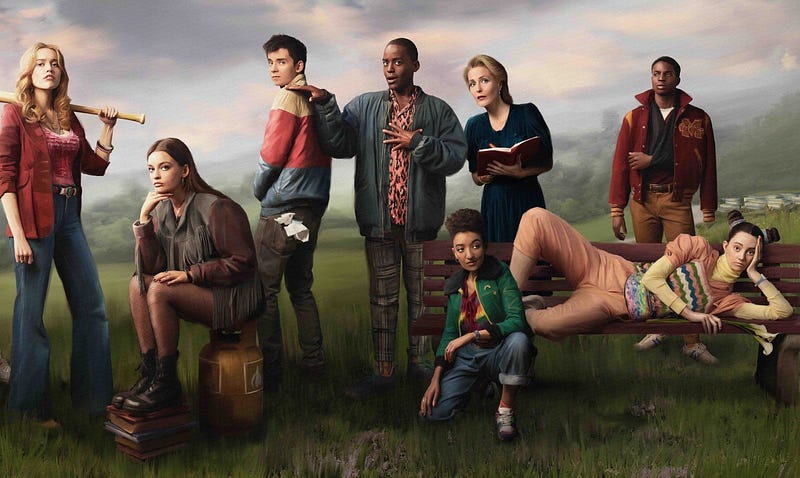
If we said Euphoria is a complete "DON'T EVER DO THIS", what I like about Sex Education is that it teaches you to say no, sometimes. Perhaps our parents tried very hard to teach us to always say no when what they should have taught us is that:
- It’s normal to err and you learn based on trial and error. Pretending that censorship works, is drawing you further into the problem — this it’s called psychological reactance, and was studied by Brehm (1966)—.
- Consent is both personal and situational. For instance, I may want to have sex with you one day, and not the next. And that’s fine. We have no obligation to anything or anyone despite our bonds.
Sex Education does teach this. In addition to a wide catalog of things. There would be a lot of characters to analyze, so, to summarize, here’re some of my favorite lessons from this TV show:
- We must report all sexual assaults, however insignificant it may seem.
- All vaginas are pretty.
- There’s sex life beyond the '50s.
- Nobody is gonna read your mind, say what you want and what you like.
- Everyone deserves a second chance, even bullies.
- As Otis said, “you can’t make people like you but love isn’t about grand gestures, or the moon and the stars…. It’s just dumb luck.”
Sex Education is the how-to book you can always turn to. The prototypical characters fail but end up progressively learning lessons and getting better and better. It’s a relational idyll.
NORMAL PEOPLE

The series deals with a somewhat broader period than Euphoria and Sex Education, as it follows the footsteps of Marianne and Connell from high school until after they graduate from college. Marianne is an intelligent and outgoing person with very low self-esteem and problems with abuse in her family. She’s also rejected at the high school. However, her social life begins to shine in college. Instead, Connell has a loving mother, is popular and also smart, as well as very introverted. His social life, unlike Marianne’s, begins to fall apart when he leaves high school and he becomes aware of his problems with social anxiety and depression, among other things. What does this TV show teach us? That the context and the family matter, a lot, but also our personality and tendencies. There’s a part of the equation that we can never control, which is called being human.
The traumas that our relationships cause us shouldn’t be normal, but they’re, sadly, very common. It’s also common (and normal) to have stupid reactions and the inability to polish our social skills. Our lives don’t have a nice soundtrack behind them or good lighting. It doesn’t rain when we are sad nor does the sunrise when we battle our fears. Life is imperfect.
And the last thing that I would like to highlight, central to Normal People: let's forget about the tyranny of having a large social circle! For some people, it’s very difficult to deeply connect with another human. Marianne and Connell only connect 100% between them, and as their lives progress they learn that true friends are less than a hand's fingers. There’s no need to have any plan B in friendship and love. We have what we have. We connect with whom we connect. And we’re not broken for being this way.
Normal People reminds us that we are indeed normal people, with mostly normal lives in which the most time we are staring at the wall drowned by the past and worried about the future. The normal thing is that everything takes time to learn… and most people don’t learn it never.
A perfect tandem
It may seem that adolescence is the time-lapse with the most relational and emotional problems, but it’s not true: every wound will accompany us all our lives until we decide to heal it. Adolescence is our first opportunity for self-affirmation and a better occasion to fail than in adulthood, where mistakes weigh much more heavily.
Let’s not get confused: teenagers will continue to make the same mistakes we did, but at least, nowadays, they have tools to solve them more quickly.
Years ago people began to talk about empathy, a concept that everyone wields but that few truly know what it means. We seem to have stayed there on an affective level. Or rather I would say on a mental level, because of how easy it’s to robotically say "I understand you" when you don't bother to understand anything. That’s not real empathy. Therefore, it’s time to start talking about other concepts such as emotional validation and affective responsibility and continue delving into the curious world of emotions and human relationships.
Euphoria, Sex Education, and Normal People explore these concepts together, but not all in the same way. In Euphoria the characters apply these tools badly. In Sex Education, they progressively learn it, and everyone improves their lives. And in Normal People, although they end up applying them, the ideal result is not often got.
- Emotional validation teaches us that everything we feel makes sense within our context and personal history. Therefore, our emotion and pain is no more no less than someone else's. It has the right to acquire a name, to be expressed, to be understood and even forgiven. For example, changing "don't cry, nothing's wrong" for "it's okay to cry and let go of what hurts". Normal People did that a lot. The ability to portray male fragility in the scene of Paul Mescal (Connell's actor) collapsing at the psychologist session is a masterful example. - Affective responsibility is a concept based on the dialogue about the feelings and needs that arise in a relationship. It requires a lot of courage to express ourselves assertively. For example, in a love relationship, make it clear when you want to be with more romantic interests at the same time, or when you're not in love. Ehem... Otis & Ruby in Sex Education. But it also helps us in a friendship relationship: it's ok to say when someone has ceased to be your priority and you aren't going to spend so much time on this person from now on.Without a doubt, among the three TV shows, Normal People would be my favorite for being as close to reality as possible. Because if you learn something, change, and start behaving differently, no one assures you that the other will too. Therefore, if you change, do it above all for yourself. Who reacts well to a better version of you, perfect. Who doesn’t, is no longer your problem. At the same time, if the others don’t change it’s not your fault nor your responsibility.
But all three TV shows together make a perfect tandem for us to learn, whether we are teenagers or adults, to be better people.
Not all of us have experienced the same Rue, Otis, Marianne, Connell, and many other characters, but we can understand parts of what they feel, and therefore forgive them for living in such a complicated world. And hopefully, they help us forgive our past selves and move forward trying to be our best versions.