
CINEMA — MYTHS AND MEANING🎥
Watch Again What The Very Best Of Film Offers
Perhaps for the first time
The genre that’s known as ‘Film Noir’ came to prominence in the post-war era with the emergence of stars like Humphrey Bogart and Edward G. Robinson. Some still argue that film noir isn’t a true genre at all. Regardless of its name, however, there is one film that blazed a trail of artistry in cinema that can never be denied.
While Ansel Adams was busily displaying his photographic work as a bonified artform with the study of shadow and light, there was one young filmmaker that drew on similar principals to usher in a new era of cinematic excellence.
Along with motion picture’s evolution came the disciplines of editing, frame structure, makeup, and sound, all of which are on display in a rich and layered spectacle. That may sound overstated, but how many films before or since have paid attention to as much acute detail as this single landmark in filmmaking?
If you were to view this picture in silence, without the benefit of dialogue or soundtrack, the visual cues would still tell you the story, and captivate your eyes.
But, this filmmaker does not stop there. Every scene is shot with meaning and purpose, using innovative technologies for its time, or any time for that matter, and then layers the narrative with sound effects that carry the story forward in transitional cutting.
Double exposures and scenes that fade into corners of frames like a tapestry of fine art, this motion picture delivers so much for the senses, it is impossible to take it all in with only one viewing.
Dispensing with the picture’s narrative and its respective flaws and controversies, in many respects, the story itself may feel outdated, but when seen in our current environment, this film suddenly seems topical again.
Because of the acting styles of relatively unknown players who had only previously appeared on live stage, it was remarkable for a first-time director to cast a theatre group with no film experience to fill almost every role in his movie; a miraculous feat in the Hollywood machine.
I’m sure you could have guessed by now who this director is, and what film I’m describing.
Of course, it can be no other than Orson Welles and his magnum-opus, Citizen Kane.
I know, “not another review of Citizen Kane!’, you cry.
Consider first, some of the evidence presented in the following, and there can be no doubt for anyone who calls themself a true lover of cinema, Orson Welles’ Citizen Kane is an iconic masterpiece on multiple levels.
Film buffs and critics have lauded its cinematic achievements for nearly eighty years now. What must be considered is that Citizen Kane as a film unlike any other, may be responsible for so much more than we realize, including with today’s movies.
What is most important to remember about a work of art like Citizen Kane, is that it could not have been made at all without the colaberattive minds of Orson Welles and his cinematographer, Gregg Toland. To achieve Welles’ vision, Toland’sexperience as a cinematographer was put to the ultimate test, and the result is nothing short of extraordinary.
Much like Adams the photographer, who was creating his blueprint, eight zone system of light and shadow, Toland developed the deep focus lens, which would revolutionize the way all future films would be made.
Scenes for example, where Kane’s trophy wife Susan, sits by the massive fire place while Charles takes a seat at the far end of the grand siting room. The distance between them in full focus, magnifies the rift that is building in their marriage.
There is also a distinct relationship between Adams’ use of light and shadow and that by Orson Welles in Citizen Kane. Characters moving in and out of shadows from silhouette are a definitive precursor to future works in film noir.
In the film’s major plot twist scene where Kane’s tryst with Susan Alexander is found out, Kane appears in shadow as Mrs. Kane, Susan, and Getties, his political opponent, stand in the foreground of natural lighting. Kane moves out of shadow as he announces the decision that will ruin his marriage, and his political career.
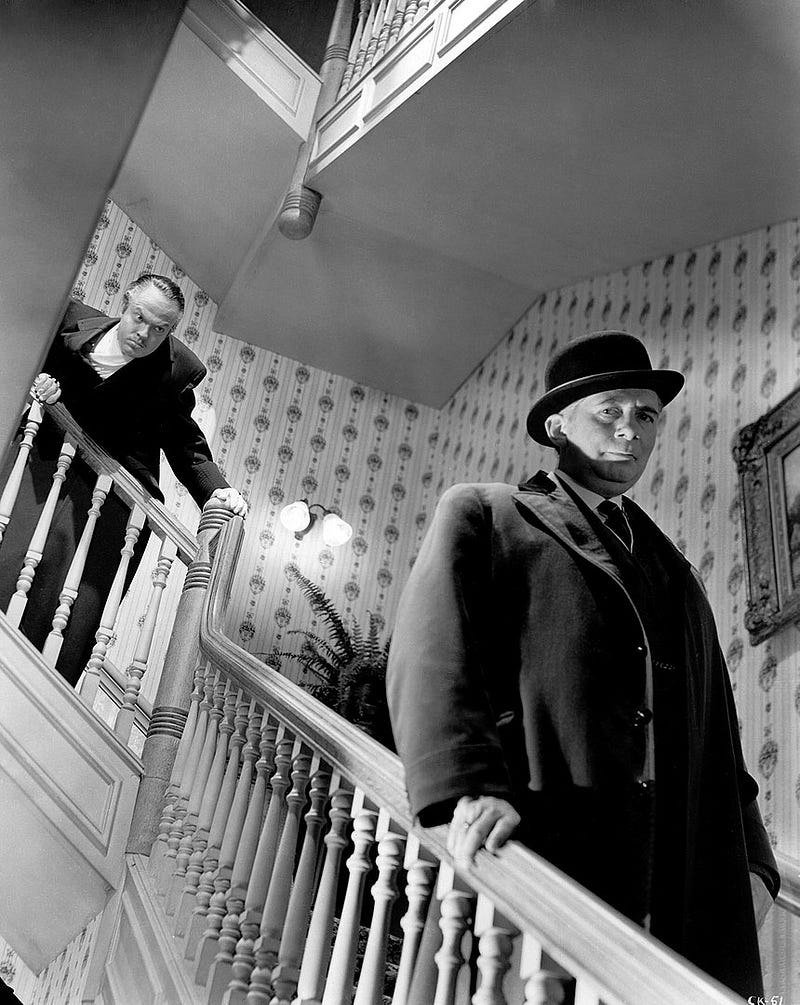
At the end of the same scene, Kane screams from the top of the house stairs that he will see Getties in Sing, Sing. As he repeats the prison’s name a second time, Getties and Mrs. Kane leave the building and Charles’ screams meld perfectly with a passing car horn.
The deep focus lens allowed Welles to convey a keen sense of mood for each scene. His grand shot of the Xanadu sitting room, the grand mansion that Kane has but as a testament to himself, emphasizes the vast chasm that has come between old man Kane and his miserable trophy wife. Susan sits in the foreground playing with puzzle pieces, while in the far recesses of the grand room, Kane stands with his entire figure surrounded by an open hearth.
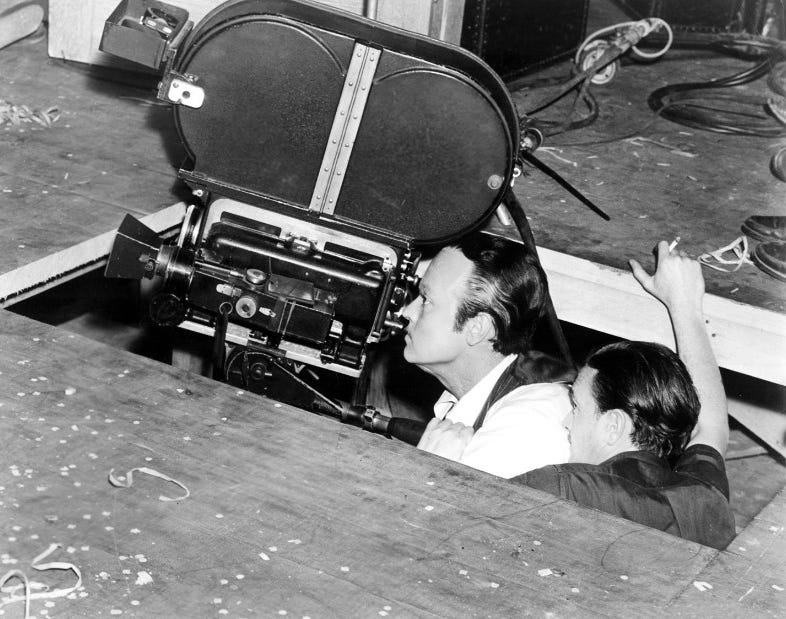
When Kane has been defeated by his political rival and his oldest friend, Jedidiah is drowning his sorrows in booze, the filmmakers cut a large hole in the studio floor so that they could achieve a low enough camera angle for maximum effect. As audience we see Kane just as the discarded flyers and confetti would.
To further emphasize the filmmaking prowess of Citizen Kane, are the dissolving shots that indicate a split-screen effect. Jedidiah Leland is an old man telling the reporter his views from a hospital ward corridor. Welles creates an angular shadow to introduce the montage that depicts the timeline of his first marriage in less than one minute.
We cannot forget either, that when Orson Welles starred as Charles Foster Kane from early adulthood through to his death as an old man, Welles was still only twenty-six-years-old,. A role like this is hard enough for even the best actors to pull off. Welles did it while directing and producing the picture.
The salient takeaway from revisiting Citizen Kane is that in every aspect of making this film, nothing has been left to chance. Factor this achievement with the knowledge that the entire production was executed in almost complete secrecy from the Hollywood executive elite, and you have a cinematic miracle that keeps on giving.
Then, the story’s presumed subject in real life, William Randolph Hearst, tried to wield his considerable power to prevent the film’s release because it hit too close to home in many respects. This still may be something worth remembering when viewing this iconic piece. The comparable egocentricity of Kane’s character relates very well to current circumstances.
Indeed, there are countless times you have probably heard the name Orson Welles uttered as the mastermind behind Citizen Kane, considered by many to be the greatest filmic achievement of all time.
If you are wondering why, watch this motion picture again and try to come up with a film that’s been made in the last twenty-five years that can compare to Citizen Kane’s artistic achievements. I can’t think of one, but if you think of one, I’d love to hear about it.
Picture, sound, editing, set design, makeup, and technology. They all play an integral part in what makes Citizen Kane the greatest film of all time.
As always, thanks for taking the time. Please enjoy some of my other entries in this series here: