
Was Julius Caesar a Fool or a Genius?
The Battle of Alesia or Siege of Alesia
In the 50s BC, the relentless struggle between the Roman Empire and the Gauls was still ongoing. Despite years of warfare, neither side had been able to gain a decisive advantage.
Vercingetorix, the leader of the Gauls, was carrying out sudden attacks on Roman settlements with his small raiding units and hunting down Roman citizens. Encouraged by these attacks, other Gallic tribes began to rebel and join Vercingetorix.
Julius Caesar, who was at the helm of the Roman Empire, knew that the complete eradication of the Gauls was necessary for the peace of his country. So Caesar marched into Gaul with an army of 60,000 Roman legions. Despite having an army of 80,000, the Gallic leader Vercingetorix, unwilling to risk a pitched battle and retreated to Alessia, his most protected fortress.
Alessia Fortress was situated on an elevation in a plain, surrounded by rivers on all four sides, making it an extremely secure stronghold for defense. When Caesar arrived in the region, he realized that a direct assault on this fortress would be suicidal. The Romans would not attack and the Gauls would not come out. As the war reached a deadlock, Caesar, a genius of strategy, came up with an interesting idea.
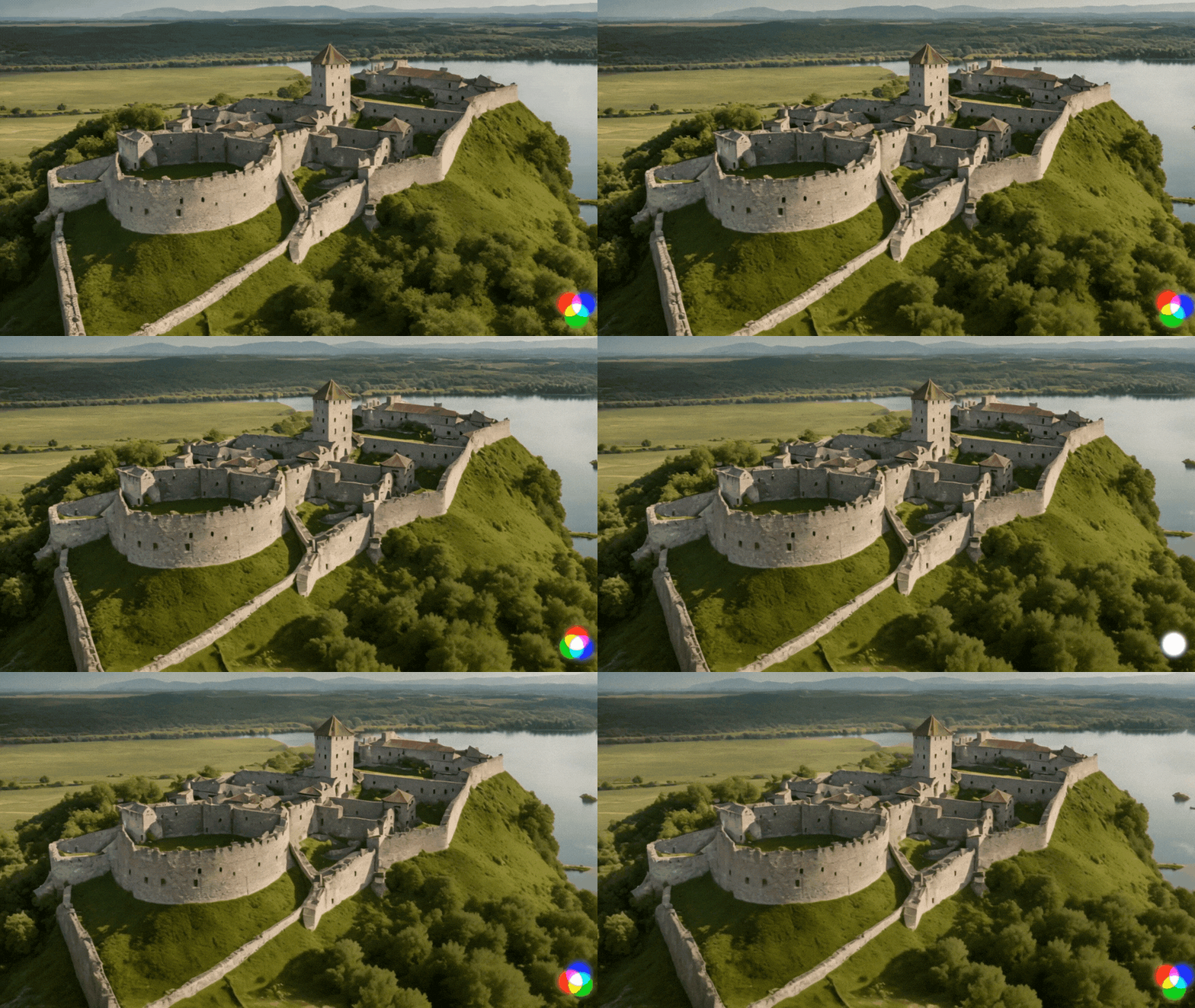
There were 80,000 Gallic soldiers and the people living there in the castle. This was quite a large population for a small castle, and it was difficult to feed this population for a long time. Therefore, Caesar decided to besiege the fortress and wait for the Gauls to starve. However, Julius Caesar was a leader who liked to ensure success. He ordered all Roman legions to build a wall around the fortress, 18 kilometers in length and 4 meters in height. Additionally,many stakes were planted in the ground to prevent attacks, ditches were dug outside the walls and filled with water, and archer towers were built at regular intervals.
The Gauls watched these construction works with astonished eyes from Alessia Castle. All these engineering works were completed at a tremendous speed, in just 3 weeks. Aware that the food supply in the city was insufficient and that they would be trapped if the wall was completed, Vercingetorix organized a breaching operation to call for help from other Gallic tribes.
He sent a large force to a small part of the Walls that was still open and not yet completed. During the clash, some Gauls managed to get out of the walls. Caesar knew very well that the fleeing Gauls would bring reinforcements, but he did not think about retreating for a moment, and made a much more intriguing decision than the first one, which will show us once again why Caesar is a great commander, and this time he ordered his soldiers to build another wall behind themselves.
Thus, the Gauls were besieged by the Romans inside the fortress of Alessia. Outside, Caesar was surrounded by walls, both on the besieging side and the besieged side.
As the days passed, Alessia Castle’s food supplies were no longer enough for the 80,000 soldiers and the people of Alessia. So the Gallic leader Vercingetorix forced all the civilians out of the city. He actually thought that Caesar would allow these innocent civilians to pass, but Caesar showed no mercy and did not let anyone pass. When the civilians returned to the castle, this time King Vercingetorix did not let his people in because he wanted to keep the remaining small amount of food for his soldiers. The Gallic army was demoralized by their leader’s behavior. While there was even some mutiny and disarmament in the castle, a trumpet sounded outside, but it was not a Roman trumpet.

The Gauls, who managed to break through the wall, returned with 70,000 soldiers they gathered from other tribes. As Caesar had predicted, he was trapped between the two armies in the Alessia region. Doomsday was about to break loose. The Gauls attacked simultaneously from both inside and outside. In the attacks that lasted until the evening, they failed to overcome the Roman walls and retreated.
Bloody clashes continued for successive days. Eventually, the Gauls found a weak part of the wall and forced their way into the area where the Romans were located.
The Gallic army was very outnumbered against the Romans. Even Julius Caesar was fighting with his soldiers on the front lines of the war, with a sword in his hand. Seeing that their commanders were shedding blood along with them, the Roman legions maintained their battle order and did not disperse. Starved, disorganized, and lightly armored, the Gallic tribes could no longer resist the Roman shields and retreated.
The Gallic army and the people were starving. Vercingetorix could take no more and surrendered to Caesar on his white horse in exchange for the forgiveness and release of the entire Gallic people. Vercingetorix was captured and suffered in prisons for five years. At the end of that period, he was publicly paraded through the streets of Rome in Caesar’s triumphal procession and killed for fun. However, the promises made to Vercingetorix in exchange for his surrender were not kept. According to the Roman historian Plutarchus, one million of the Gaulish population of around 3 million were put to the sword and another million were sold as slaves in the markets.
Thanks for reading ! Subscribe for free to receive new posts and support my work. “Coffee” #smileandjustread


