
Was G.K. Chesterton an alcoholic?
Christianity conceals facts about a hero
He is a Christian hero to millions, known for praises of “orthodoxy,” and Catholicism as the true faith. Was G.K. Chesterton also a fall-down alcoholic?
A startling charge had been made, I noticed, when doing research into his sexuality. It’d been denied—but there were clues.
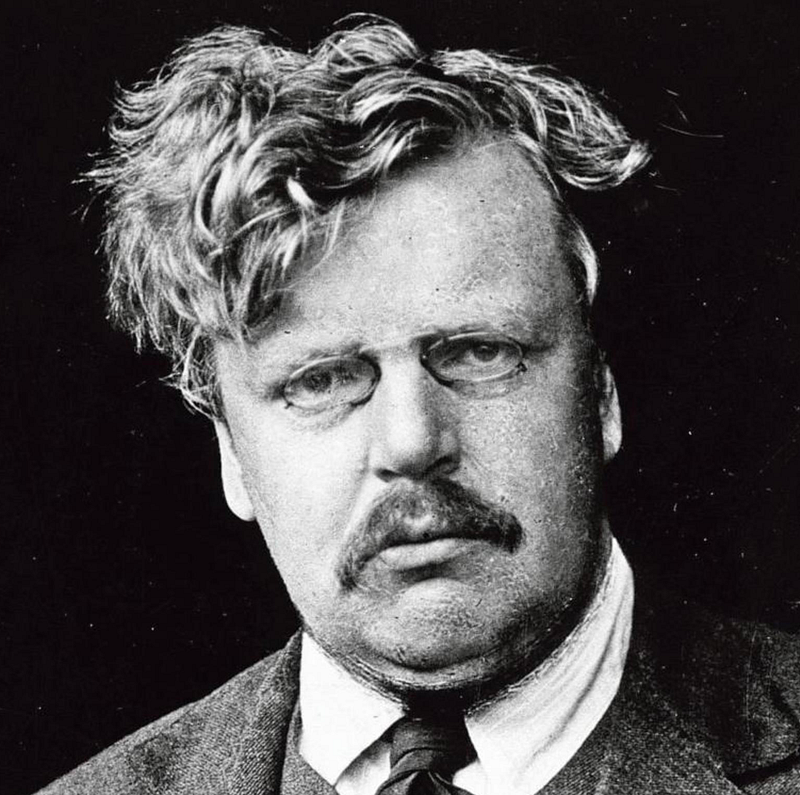
His drinking came up in 2013.
There was a movement at the time to suggest Chesterton for canonization as a Catholic saint. A post at a Catholic site by one Steven Drummel suggested that Chesterton was no saint, since he drank a lot.
A well-known Chesterton enthusiast named Dale Ahlquist wrote a post in reply in which he said that Drummel was an agent of Satan, and added: “Let us be clear. G.K. Chesterton was a virtuous man.”
The proof he cited was that Chesterton had not spoken of himself as alcoholic. Chesterton wrote of alcoholism as bad, and was a champion of moderate drinking, as in an oft-quoted line in Orthodoxy: “we should thank God for beer and Burgundy by not drinking too much of them.”
Therefore, he wasn’t an alcoholic.
No biography says Chesterton was alcoholic.
He is, however, discussed as drinking a lot. Even ‘official’ sources show his Christian writings as drenched in booze.
A 1973 biography by Dudley Barker uses phrases like “drinking too much” and “drinking more heavily”—but suggesting a man who drank socially.
Yet the details might be suggestive? Barker writes of Chesterton in 1912:
“He would drink almost anything put in front of him — wine, tea, beer, lemonade — almost without noticing that he was doing so; but usually it was either wine or beer. Moreover, the drinking took place when he was working harder than most men, and for longer hours.”
In 1912, at age 38, Chesterton seems to have gotten to a point of being alarming in his drinking. Barker writes: “Frances made several efforts to persuade him to limit his drinking; if for no other reason, he needed to do so, she stress, to lessen his obesity.”
A 1986 biography by Michael Ffinch has occasional reference to Chesterton drinking, as when he’d “drink in order to perk himself up,” or when under pressure from work, “he tended to drink more heavily.”
Chesterton died in 1936, at age 62.
The cause generally mentioned is congestive heart failure. His wife Frances wrote to a friend: “The main trouble is heart and kidney and an amount of fluid in the body that sets up a dropsical condition.”
But then in 1941, Chesterton’s sister-in-law, Ada Chesterton, published a family memoir that had startling details—like that it was not his heart but “his liver, poisoned, resentful and inert, that killed him.”
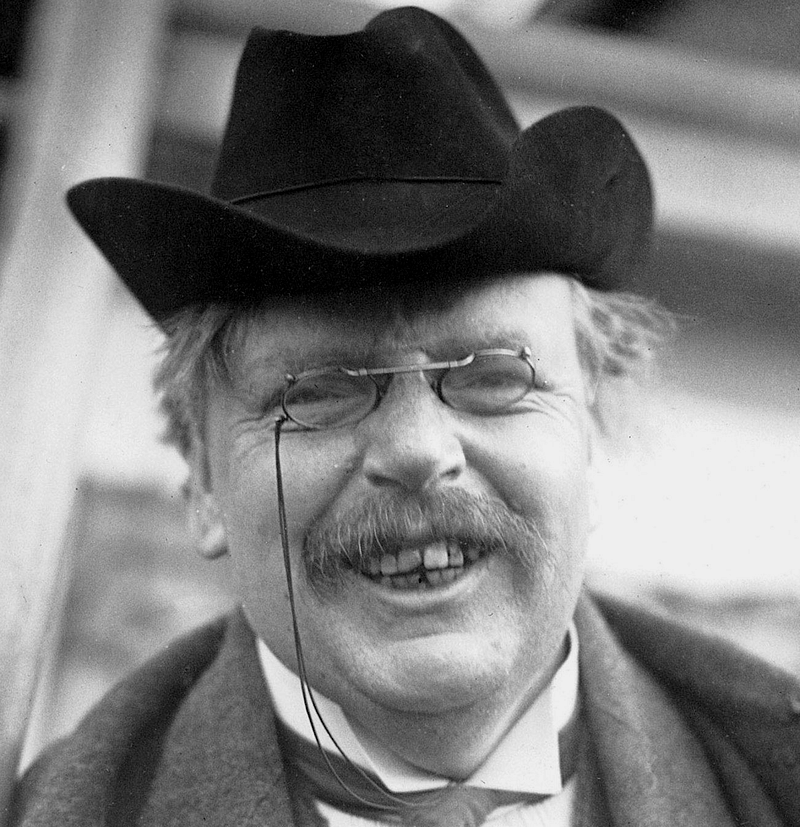
The official biographer investigated the claim.
Masie Ward was a Catholic writing about a man widely viewed as a Catholic hero. In her 1943 book, she calls Ada Chesterton’s claim of alcoholism an “attack,” and in refutation, produces notes from an interview with one Dr. Bakewell, said to be Chesterton’s longtime doctor.
The interview was not done by her, but by some unspecified person. She prints what was given to her, and we learn:
“Dr. Bakewell said that G.K. was his patient for nearly twenty years and during that time he never treated him for alcoholism or saw any trace of it, though in an absentminded way he was always liable to drink too much of anything if it were there — even water.”
The cause of death, Dr. Bakewell said, was “a failing heart owing to fatty degeneration, leading to dropsy.”
Was that the end of the matter?
It is for the biographers. But Steven Drummel questioned Dr. Bakewell’s veracity in light of many references to Chesterton’s drinking. There were suspicious scenes even in Masie Ward’s biography.
In 1911, Chesterton went to dinner and drank too much, then fell and broke his arm.
Friends told her, Ward reported, that “he had come to depend, ‘almost absent-mindedly’ one said, on the stimulus of wine for the sheer physical power to pour forth so much.”
That is, to maintain his enormous literary output, Chesterton had to drink.
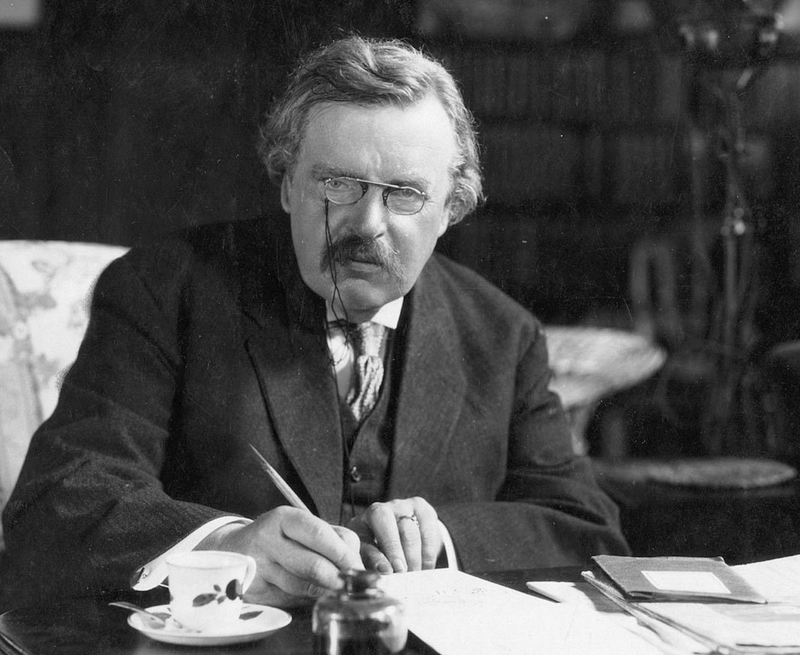
His visit to America in 1930 was remembered.
Wine wasn’t available during Prohibition. But a philosophy professor at Notre Dame, where was lecturing, made home-made ale, and Chesterton was recalled to drink it “by the quart.”
In 1952, in a follow-up volume to her biography, Masie Ward had a friend of Chesterton’s recalling his frequent joke:
“One pint is enough, two pints is one too many, three pints isn’t half enough.”
Was Chesterton really a believer in ‘temperance’?
What was his “heart trouble,” exactly?
To look over his life, it begins to be unclear that euphemisms weren’t employed all along the way. His ‘heart trouble’ is first noticed in 1914, when Chesterton was giving a lecture and became faint. He went home and collapsed on his bed—causing the bed to collapse as well.
“It is probably heart trouble but there are complications,” his wife wrote in a letter to a friend. But the episode seemed to involve a deep shock, mental and physical, to his whole being. The physical part was described as “gout all over. Brain, stomach and lungs were affected.”
Chesterton fell into a coma for ten weeks. When he woke up, his doctors insisted on “total abstinence.”
Could it have been the result of alcohol poisoning? Gout is stimulated by alcohol, and binge-drinking can induce a coma.
For several years, he stopped drinking.
In his late 50s, he started again. In her 1952 book, Masie Ward reports on a scene when a young male journalist visited, and Chesterton asked his wife for a glass of wine. She tried to divert him, but he insisted: “I want wine.”
After that, he seemed to continue drinking regularly—especially, it appears, from 10pm to 1am when he was in his study alone.
His death certificate listed alcohol as a contributing cause, a fact mentioned in the context of his possible canonization. But notice how the biographers had dealt with it, as by biographer Ian Ker:
“The death certificate listed three causes of death, which had essentially resulted from heart failure.”
In 2019, the Catholic church announced that Chesterton wasn’t a saint.
They cited, in part, the lack of a “pattern of personal spirituality…”
It might be the closest they come to saying the hero was a drunk. 🔶


