
Was Dennis Avner Actually A Cat?
That’s the bizarre question everyone is asking today
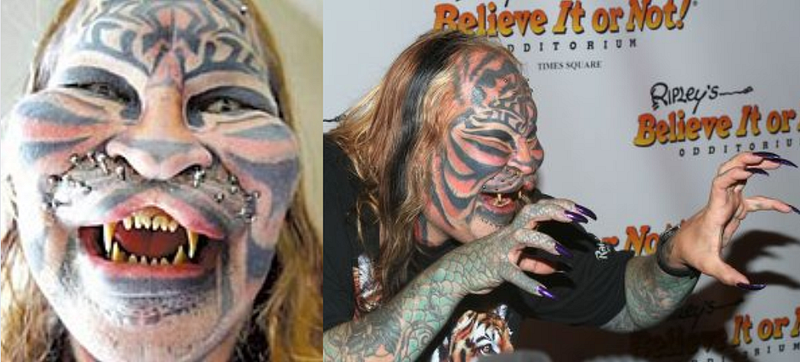
Who remembers Dennis Avner?
Born in 1958 in Flint, Michigan, Dennis Avner worked as a solar technician in the US Navy until 1981, when he left to become a computer programmer and technician in San Diego.
In the early 1980s, driven by a strong affinity for tigers, and in particular, for the tigress, he started getting extensive tattoos and body modifications to transform his appearance into something rather more cat-like than the body and face he was born with.
He became famous through media appearances, and was well-known at ‘furry’ conventions, where other people who strongly identified with non-human animals gather to celebrate their alternative lifestyle choices.
In a November 2009 edition of BBC News Magazine, Denise Winterman claimed that “Some furries assume animal traits — known as zoomorphism — and indentify strongly with certain species… But a small minority take it further still — believing they are animals trapped in human bodies, or consider themselves to be part animal. A study by [anthrozoologist, Kathy] Gerbasi at one furry convention found about a quarter of the participants did not consider themselves 100% human.”
A study at one furry convention found about a quarter of the participants did not consider themselves 100% human
Did this apply to Dennis Avner? Honestly, I’m not sure, but another story hit the headlines last month, involving a pupil at a school in Melbourne, Australia who apparently does identify as a cat.
And she’s not an isolated case — a number of other cases have recently been reported in Australia of students identifying as non-human animals, including four girls at a school in Brisbane, who apparently walk around on all fours and have cut holes in their school uniforms for their ‘tails’.
One girl, apparently, even screamed at a fellow pupil for accidentally sitting on her ‘tail’.
It’s an entertaining story — personally, I’ve always loved hearing about people who are different, who dare to step outside of mainstream society’s rules and expectations. Who push the envelope. Who dare to challenge what is considered ‘normal’.
However, here’s the thing.
There is a big difference between challenging what is considered ‘normal’ by society and challenging reality. The reality is that neither Dennis Avner, nor any of the above-mentioned schoolgirls were actually cats.
They might claim to identify as cats, they might adopt many of the habits of cats. They might even demand rights based on their identity as cats, but any cursory glance will tell you that they are not actual cats.
Still unconvinced? Test their DNA. That’s a sure-fire way to confirm one way or the other whether they are human, feline, or something in between.
The problem is that the teachers at their respective schools can’t quite grasp this. They’ve been so conditioned to treat all their pupils according to how they ‘identify’ that they are in danger of losing their own grip on reality.
Rather than nipping the girls’ delusion in the bud and explaining gently but firmly that they are not cats, but human children, the teachers have reinforced the girls’ delusional beliefs by going along with their claims of ‘catness’.
As an animal rights activist, I believe non-humans, including cats, inherently have equal rights to humans. Not the same rights, of course — it would be ridiculous to claim that cats have the right to drive a car or vote in elections.
But I firmly believe they have an equal and inherent right to life, an equal right not to be exploited. An equal right to freedom of expression, at least to the extent that it doesn’t harm anyone else.
What I don’t believe is that humans can become cats or cats can become humans. This is not to denigrate cats or humans, or humans who think they’re cats (or cats who think they’re humans). All deserve equal rights and respect.
I think humans should be free to tattoo tiger stripes on their faces and modify their bodies as they see fit and to walk around on all fours if they choose to do that, and we ought not to think less of anyone who does that. We ought not to mock or belittle or shun anyone for these lifestyle choices.
But cats are cats and humans are humans. It biology. It’s reality. You might not like the fact but that doesn’t change it. To refuse to accept this is to enter into some sort of global delusion where nobody knows what’s real anymore and where words and definitions cease to have meanings because ‘human’ or ‘cat’ can mean anything the individual wishes it to mean.
Let’s celebrate diversity, celebrate our differences (and our similarities) and respect everyone’s right to live as they choose — so long as it doesn’t impinge on anyone’s else’s right to live as they choose.
But let’s not lose our grasp on reality. If these girls truly believe they are cats (and I’m not in a position to say whether they genuinely believe that or not) then their teachers should be showing them compassion and respect. But neither the teachers, nor society at large, should be succumbing to the delusion that these girls are actually cats.
To do so would be to play out a version of ‘The Emperor’s New Clothes’ where everyone is too afraid to speak the truth that is glaringly obvious — if you weren’t born a kitten, you’re not a f*cking cat.
