
“Warming Up” To Black History: The Book That Seismically Rocked My World
I was raised in Columbus, Ohio, woefully unaware of my racial history. It was years later when, of all people, a white girlfriend brought this to my awareness. During a dinner conversation one evening, she had the audacity to state that I was “out of touch with the historical past of my people.” Feeling offended, I angrily denounced her silly statement.
Today, I am embarrassed to admit that at the time she was probably right. Sadly, it wasn’t until my 50’s that I began to develop a fervent curiosity and interest in the African American experience and my ancestral past.
Fast forward to 2016: That year I met an urbane, sophisticated, intellectual brotha by the name Paul Ross. Because of our shared interest in books, we immediately hit it off. Whenever we randomly crossed paths in Denver’s Cherry Creek North District, he always had a ton of book recommendations to weigh me down with, adding to the twenty others I had purchased but hadn’t had the time to crack open.
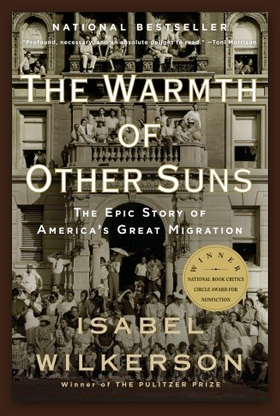
But there’s one book recommendation of his above all others that continues to have a significant impact on my life. Entitled The Warmth of Other Suns, this well-researched non-fiction masterpiece by Pulitzer Prize-winning author Isabel Wilkerson unearths one of the greatest, esoteric themes of American history: The “Great Migration” of black folks who sought a better life by leaving the Jim Crow South.
These migrants were in search of what the novelist Richard Write called “The Warmth of Other Suns,” the title of the book.
This bestselling read brings to life the fascinating stories of three people who offer a historical context for this time-period:
Ida Mae Gladney, a Mississippi sharecropper who left for Chicago in 1937 after the brutal beating of her husband’s cousin. Because African-Americans faced major barriers to relocation, she and her children devised an escape plan which involved meeting her husband at train depot so they could head north as a family.
George Swanson Starling, a Florida fruit picker who attempted to advocate for better pay for his fellow African-American workers in the fields. He barely escaped with his life in 1945, eventually ending up in Harlem, NY. This led to a career as a factory worker and then as a railroad porter — where he continued to be subjected to the ugly stain of racism.
Robert Joseph Pershing, a physician who after completing medical school in the 50s decided to leave Louisiana for what he thought would be a better life in California. He, however, found an unwelcome environment for African-Americans at the hotels he sought to stay at on his journey west. Even more striking, despite having a bachelor’s and medical degree, he was routinely denied privileges at white hospitals in California.
Many of Wilkerson’s stories about U.S. racial tensions were hard to fathom and frequently brought tears to my eyes. One of the reasons though I was inspired to keep reading was that it was during this historical time period my grandmother relocated from Union Springs, Alabama northward to Columbus, Ohio.
The book often conjured up memories of visits to my grandmother’s house in Columbus, Ohio. Whenever she would greet us at the door, I found it odd that she would often refer to Dad as “brother.” For many years I thought this was simply a term of endearment. Later, from evidence my brother obtained from one of the popular online ancestry sites, we determined that our grandmother may have indeed been our Dad’s brother. This was not an uncommon occurrence among African-Americans during the time period the book covered.
I also thought about my Mom and what her experiences might have been like growing up in Richmond, Virginia, the seat of the Confederacy. She was a proud graduate of Virginia Union University, one of several historically black colleges that were established to provide African-Americans educational opportunities otherwise unavailable to them.
In reading Warmth of Other Suns, I felt a sentiment similar to one Amazon reviewer who remarked:
“You’re Cheating Yourself If You Don’t Read This Book.”
I’m not going to lie! I’d like every person I know, particularly white folks, to read this book.
To this point, Russell Owens, a successful businessman, and business coach in Denver is someone I’ve long admired for his deep insights and wisdom about life. I recommended the book to him and was pleasantly surprised when he not only purchased it but read it in his entirety.
And his response, well it was priceless. Mouth agape as he walked through the door of the infamous Pablo’s Coffee to meet me one morning, he belted out something to the effect of: “Whoa! Man! I had no idea. The book, WOW!”
Not as much luck with another friend of mine, who made a sorry ass attempt to pour through the book after picking up at the library. He blamed his failure to complete it on the expiration date for return.
And my girlfriend, well she’s reading it now on her Kindle. We’ll see if she can pass the test.
In the end, Warmth of Other Suns offers a broad context of an important, little talked about theme underpinning our nation’s history, the Great Black Migration. This is a critically important piece of work that every American should read if we hope to advance our racial future by acknowledging the uncomfortable past.


