
Want to Read a Philosophy Book That Will Change You? Read This One
‘This Life: Secular Faith and Spiritual Freedom’ by Martin Hägglund
The number of people who consider themselves religious is diminishing all over the globe. According to Gallop, Americans who agreed that religion is very important oscillated between 58–61% in the 90s. In 2022, the number had hit a new low at 46%.
Germany has a similar trend, where 60% of the respondents said that religion played no role. Italians answered that religion is an important factor in their lives in only 26% of the surveyed.
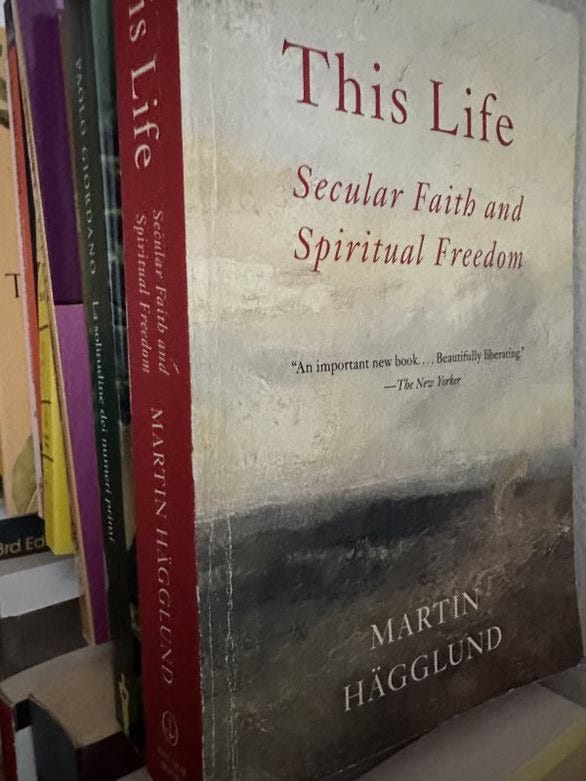
This Life
What do these statistics have to do with any of this? Now that god is dead because we have killed him, we cannot deny the void this has left. Some have replaced this with spiritualism, turning to Buddhism; others, to the teachings of Stoicism.
But let’s admit it, it is hard to be apathetic toward our cause. Much harder is emptying ourselves of desire. Carl Jung said it himself: it is hard for the Western mind to do this because we are too extraverted; we direct our energies outside.
We want our lives to matter. We want our causes to outlive us. We want our changes to be manifest in the outside world, not just inside.
What can we do? This is the answer that Hägglund tries to answer. His philosophy guides us. It helps us find the middle ground between purpose in finitude (living in the present) and extending into infinitude (through a cause beyond).
A World Without Religion
Hägglund — beyond attempting to prove or disprove a god — argues we should seek secular faith. Secular faith is “to be dedicated to persons or projects that are worldly and temporal.” It is believing that our cause may (or may not) go on even after we have died.
The author uses his book as an example. He cannot be sure that his book will reach us. It could be that catastrophe befalls him before he finishes; it can happen that his book falls into oblivion. But having faith in his cause is what allows him to continue.
“We must acknowledge the utter fragility of what holds our lives together — our institutions, our shared labor, our love, our mourning — and yet keep faith with what offers no final guarantee. This is the double movement of secular faith.” — Martin Hägglund
Thus, faith is not without risk of loss. If you follow Buddhist teachings, you may argue that to avoid heartaches, it is better not to desire. But it is by attaching ourselves that we make this life worth living.
“You must attach yourself to what you see — even at the cost of suffering — because without attachment there is no meaning: nothing to care for and no one who binds to the world.” — Martin Hägglund
Knausgard, Norwegian author of My Struggle, argues too that indifference should be among the seven deadly sins.
Death Is Necessary
Without death, life would be purposeless. If limited time wasn’t a factor, I wouldn’t be compelled to write this; there will always be — guaranteed — a tomorrow.
In this sense, Hägglund argues that “death is the purpose of life.” Furthermore, “Life can only matter in the light of death.”
Kierkegaard takes a similar approach.
“The earnest understanding is that if death is night then life is day, that if no work can be done at night then work can be done during the day; and the terse but impelling cry of earnestness, like death’s terse cry, is: This very day.”
–Soren Kierkegaard
We do not want a life of tranquil apathy like the Stoics or of peaceful detachment like the Buddhists. This makes life devoid of meaning.
Hägglund says about Kierkegaard that “He does not want to be free from passions; he wants to be passionately engaged.” Passion is inseparable from vulnerability.
If it wasn’t for the anticipation of night or loss, we would never do the most during out of the day or the time that is given to us.
Spiritual Freedom
The author argues why faith — not detachment — is fundamental to achieve spiritual freedom.
We have two freedoms, a natural and a spiritual. We share natural freedom with other animals; it is up to us to move within this world or how to preserve our lives.
But unlike animals, we additionally possess spiritual freedom. This means that we have the ability to question, challenge, and transform ourselves. We willingly choose “who I take to myself to be” and live accordingly.
Conclusion
There is much more to this book. The author draws from many sources to make his arguments: he quotes Dante, Kierkegaard, Saint Augustine, Knausgard, Proust, and the Bible.
If you enjoyed this quick glimpse, I highly recommend this book.