
Want to Increase Economic Growth? Give a Dollar to a Poor Person
The Economic Case For Income Equality

Income Inequality On the Rise
The overall state of the economy in the U.S and other developed countries has been improving in recent years. In 2017 U.S GDP grew by 2.6%, unemployment was down, businesses are posting record profits, and many of the stock indices such as the S&P 500 have been pushing all-time highs.
The unemployment rate in the U.S was 3.9% in April, the lowest it has been in decades. Historically, significant drops in unemployment are followed by increases in wages. This is due to the supply and demand principles of economics: When the unemployment rate is low, companies have a smaller pool of workers (limited labour supply) to choose from to fill vacant positions. This creates competition between employers and typically leads to upward pressure on wages as employers must outbid their competitors to hire the desired employee.
With unemployment dropping below 3.9%, history would tell us that wages must also be rising significantly, but they aren’t. According to a report by the Economic Policy Institute, the median wage increase was only 0.2% in 2017, not even enough to cover a Costco membership for many workers.
The very highest and the very lowest income earners had the biggest increase in wages in 2017, while everyone in between had practically no wage growth. Workers in the top 5% of earnings saw their wages rise by 1.5% while workers in the bottom 10% of earnings enjoyed an average increase of 3.7% in 2017.
As the graph below shows, the above average wage increase for the highest paid workers represents a continued trend over the past 20 years and the significant increase for the lowest paid workers appears to be an outlier.
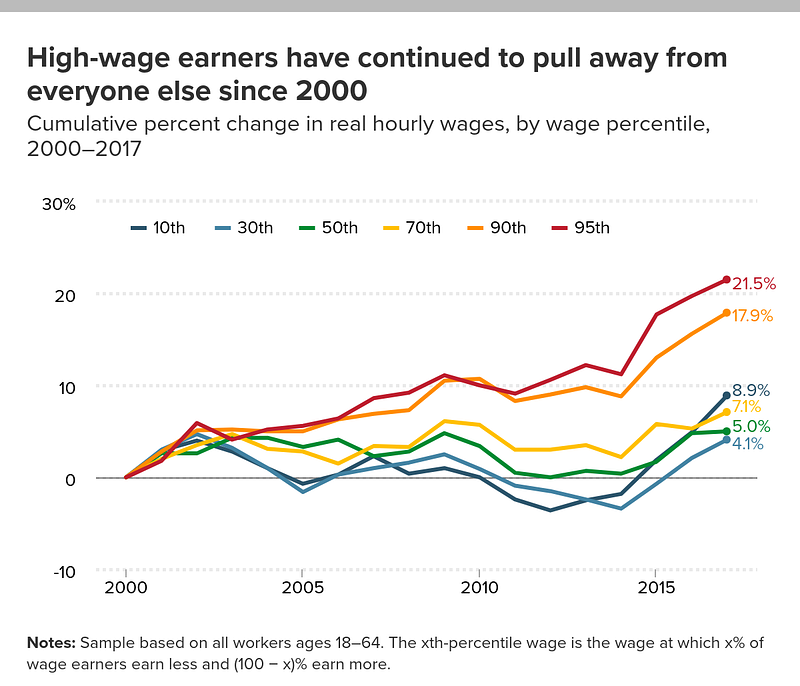
Since the year 2000, the real increase (accounting for inflation)in wages for top 5% highest income earners has increased by 21.5% compared to only 5% of the bottom half of income earners in the U.S. Put simply the income gap between the highest and lowest earners has been growing.
How Putting More Money in the Hands of the Poor Can Boost GDP
Let’s do a quick review of what Gross Domestic Product (GDP) is.
GDP= C+I+G(X-M)
where
C= Consumption
I= Investment
G= Government spending
(X-M)= Net Exports (exports minus imports)
Historically “consumption” (people buying stuff) has accounted for nearly 70% of U.S GDP. So, all other things being equal, the more we increase consumption the more we increase GDP.
To understand why closing the income gap between the highest and lowest earners can boost GDP let's consider another term from Economics 101: “The Marginal Propensity to Consume” (MPC). Basically, a person's MPC tells us this: “If you were given an extra dollar of income, how much of that dollar would you use to buy stuff and how much would you save?”.
The MPC for high-income earners is much lower than that of low-income earners. If you give a dollar to a rich person they are likely to save that dollar rather than spend it because they already have their consumption needs met. If you give a dollar to a poor person they are likely to spend that dollar rather than save it.
If we remember that 70% of GDP has been driven by consumption it is not a leap to say that an effective way to increase GDP is to increase consumption. To increase consumption we will want to find a way to get more money in the hands of people with the highest MPC (poor people).
No Simple Solutions
The challenge in the real world has been finding effective policies to boost the earning potential of the lowest income earners. I am not advocating any particular policy solution. If you know of any studies or policies that have been implemented that effectively (without causing economic damage elsewhere) address income inequality let me know in the comments, I would be very interested in reading up on it.