
Want to Feel Better? Try Helping Others
Or, how to make your affliction your salvation.
I have faced a lot of challenges in my life up to this point. Being suicidal when you’re 12 tends to fundamentally alter your worldview, and spending middle school with a voice in your head that tells you to hurt yourself and others leaves some weird scars.
Throughout these challenges, I have persevered with the help of many people close to me. My parents, my teachers, my therapists and counselors, my psychiatrists and nurse practitioners, my friends and partners, all have helped me make it through.
After an eye-opening experience going off my meds in my early 20s, I discovered what stable and unstable mean for me. I dedicated myself to being stable by taking my meds and being honest with my doctors and nurses. By and large, I have succeeded.
In some ways, going off my meds in college was the catalyst for the shift that would dictate my life for the next decade. I realized that my major at the time, chemistry, wasn’t what I wanted. I wanted to be a writer. Specifically, a technical writer, since they have set career paths and tend to bring in higher average salaries than many writers.
In the process of getting on new meds and becoming stable, I took writing and communications classes. I loved writing papers, and even when I had six term papers due in the span of two weeks, I hammered them all out and didn’t score lower than a B on any of them. Writing meant stability for me, and I loved it.
My new coursework required an internship. After failing to find a technical writing internship for a few months, I stumbled on an internship for a nonprofit doing grant writing. I had no idea what it was, but after some research and encouragement from a mentor, I went for it. Apparently being the only person to interview for it made me the most qualified.
Grant writing, for those of you who are unaware, is a field wherein I write and assemble narrative applications for grant funding on behalf of nonprofits. It requires good written and communication skills, abilities to persuade and do research, and a basic grasp of accounting. I was good at it.
My path from there led me from a volunteer position to a part-time position to a full-time position, with increased salary and responsibilities along the way. I did so well, apparently, that the CEO from my first full-time job absolutely had to bring me with him to his new job. Since he’s more or less a father figure to me, I was happy to work for him again.
So, by some weird phenomenon of nature, I had stumbled into what has become my life’s work as a direct result of going off my meds for a few months. I have held down a stable professional career for almost a decade.
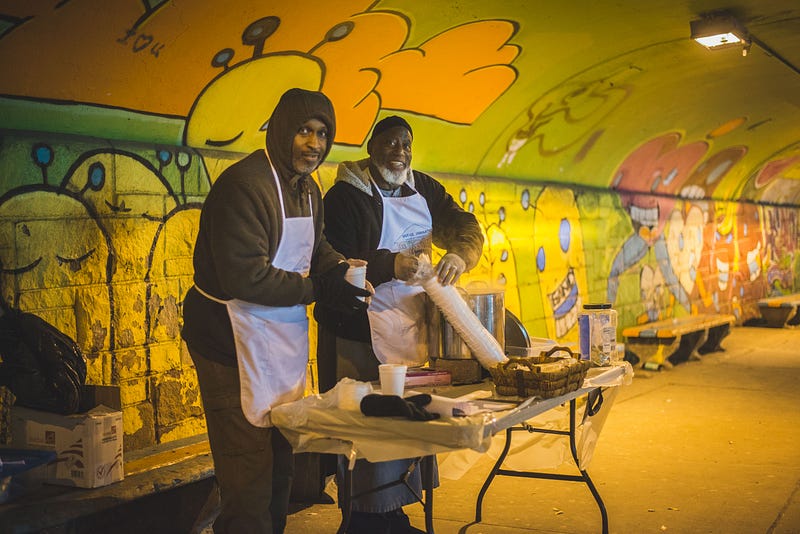
Having spent so much of my life being unstable and relying on others to help me through, I decided at some point that I wanted to give back. I’ve always done service projects, through the Boy Scouts, for school, and at a variety of other opportunities. It’s just the right thing to do.
I think that’s why grant writing appealed to me. It combined a skill (writing) with a passion (giving back). My job is to raise money so the nonprofit I work for can serve more people. I’ve worked for a variety of them, from a home for individuals with severe developmental disabilities (population: about 50 or so) to a mental health charity with a crisis hotline serving the nation (about 80,000 people served last year).
Along the way, I’ve raised nearly $10 million to help homeless kids, people with multiple sclerosis, and families in crisis. I’ve helped develop programs to bring psychiatric services to people in the area, and I’ve written 75-page applications in six weeks.
Right now, the thing that drives me is giving back. On days where my depression is whispering that I’m worthless, I remember that my work does good for the community. I think of the kids that are getting therapy because of the money I bring in, and I am happy that they get a shot to be stable.
That is part of what motivated me to start writing about my experience, first answering questions, then writing my life story, then posting to Medium. When I started telling people about my bipolar, they seemed interested, and I’ve had people tell me how much my openness has helped them.
I’ve found helping people to be incredibly cathartic. There have been times where I have been at the end of my rope, but made time to listen to a friend gripe and give them a friendly ear. Sometimes, listening to other people’s problems helps me forget my own for a while.
There are a lot of truisms about humans being social animals. “It takes a village,” “no man is an island,” and so on. I find this incredibly true, to the point where I almost can’t not help. It helps me feel better because it helps other people feel better. None of us is as strong as all of us.
I think this can be applied by people who feel depressed or isolated. It can be hard to care about yourself when you think you’re a worthless piece of garbage. It’s easier to care for something or someone you think highly of. Instead of reaching out for help, which feels impossible, reach out to a friend who’s having a hard time. Make it about them.
It may be only temporary, but I find that turning my negative emotions into the energy to help someone makes me feel better. I may not have showered in five days, but I’ll help you sort out your work stress and listen to you gripe about your boss for as long as you need.
In helping someone else, I often help myself. I feel as though my worthless self was able to make a small difference in the life of somebody that I care about. It makes me feel a little less worthless.
Granted, this is not always feasible. Sometimes, you just don’t have the spoons to do anything, and that’s okay too. But I’ve found that both me and many people near me will draw upon a reserve of energy that only seems available if it’s helping someone else. I’ve been absolutely at the end of my rope, unable to do anything to help myself, and still driven 40 minutes to help a friend do something. I’ve had friends who went to bat for me who were unable to help themselves with what they were dealing with.
Everyone I’ve talked to who has done this has told me that it helps them feel a little bit better. Being so depressed that you can’t help yourself is fairly common among people with mental illness, but I’ve observed enough people who dig deep to help others that I can imagine that it’s also somewhat common.
In the same vein, when you have the energy to be a person, helping other people is a way to give back some of the help that you’ve received. It is incredibly satisfying to be able to say “you helped me when I was down, and now I am in a position to help you.” Sometimes, it means helping a stranger because you are in a position to help now.
One caveat to this: don’t set yourself on fire to keep somebody else warm. If you need to damage yourself to help somebody else, don’t. They may be your best friend in the entire world, but you need to take care of yourself too.
For me, and for many I’ve talked to, helping people helps ourselves. We feel better because somebody else feels better. It may not be the thing that helps you, and that’s okay. Not everyone is physically, emotionally, or mentally able to do that kind of work — and it is work. But for those who can, the payoff is amazing.


