
Want a Great Life: Don’t Listen to 90 Percent of What Your Parents Say
They mean well, but in life, this doesn’t mean much

In a recent Making of a Millionaire article, I argued you should listen to Tom Petty, not your parents:
If I had told my parents — when I was 19 — that instead of moving to Miami, I was going to marry my high school sweetheart and stay in my hometown, firmly entrenched behind a white picket fence with multiple toddlers running around the over-sized backyard, they would have been all for it.
Because it would have been in their best emotional interests, if under this hypothetical, they understood and appreciated my best interests, they would have said, “We would love for you to stay, but it’s probably not the best decision if you want to live the life you want to live right now” and into the limitless future.
Parents just don’t understand.
Particularly if you’re in Generation X like me with a baby boomer Mom and Silent Generation Dad. The gap between us — 30 to 40 years — portends too many disconnects, from cultural to technological and beyond.
I have a 17-year old daughter. I feel like I can relate a bit better, given that we have both been young in a similar, fast-changing world. This said, several of the same disconnects still exist, and, to some degree, I want my kid to blow off anything I try to “tell” her. Thought I try to not “tell” her much.
In response to the above-linked article, Christina DeFalco makes an excellent point:
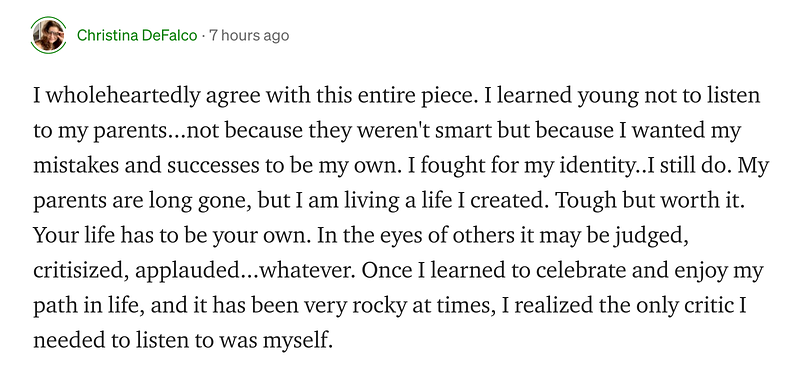
Well stated.
Here’s how Bruce Springsteen put it in a song called, Long Time Comin’:
Well if I had one wish in this god forsaken world, kids It’d be that your mistakes would be your own Yeah your sins would be your own
You can interpret those lyrics however you like. That’s part of the beauty of music.
As a parent, this is what I take from it, specifically as it relates to experiencing life and money.
The most difficult thing to do as a parent is to watch your kid go down what you think is the wrong path. Letting them fail — or merely run the risk of failure — that’s even more difficult.
It starts young when they fall on the playground. We have the tendency to rush to them. To make sure they’re okay. To comfort them.
I made my share of mistakes as a parent; however I was a solid playground Dad.
When my daughter fell on the playground, I let her deal with it herself. Usually, she looked ready to burst into tears. Sometimes she did. More often than not, that tendency to cry was little more than her calling me over. When I didn’t come, she realized she was on her own. She had to self-soothe. This is an excellent skill to teach your children.
There’s nothing wrong with crying. I encourage it. I do it frequently. So this example has less to do with crying (something I was discouraged from doing as a kid) and more to do with fostering independence.
We don’t know what’s best for our kids. No matter their age. As much as we like to think we do — we don’t. It’s a misnomer that this is your role as a parent. To know what’s best.
We have to give our kids choices. It’s time for something to drink in the morning. The parent who knows best thinks it’s milk in the cereal and orange juice in the glass. If you prescribe this each morning, you’re raising a kid who never gets to make small, day-to-day choices.
As a stay-at-home Dad for many years, I would offer several choices almost all of the time. I truly believe this sets the stage to equip kids with the basic and advanced critical thinking skills they’re going to need to make life’s bigger decisions. You’re just letting them exercise parts of their brains and hearts that come into elevated importance with age and experience.
As my daughter receives college acceptances (and I’m sure a few “rejections”), there are a whole host of challenges ahead. Just thinking about them brings a tear to my eye. She might have to suffer a bit. She might even fail.
And I have to let it happen. I have to fucking let it happen.
If I don’t, I’m not setting her up for success as an emerging adult. Instead, I’m ensuring her mistakes won’t be her own. Even worse, I run the risk of enabling her insecurities and shortcomings with a too hands-on approach.
On a slightly selfish note, she’ll blame me a bit more than she otherwise would if I try to direct her as she’s navigating these new and ultimately exciting rites of passage and experience.
Lightening the mood a bit, this approach applies directly to money.
I can’t get my daughter interested in saving and investing. It drives me crazy. She sees decent amounts of money in her savings and investment account. But she doesn’t want to learn how it all works, get into it, and do it on her own.
Even though I had an interest in the stock market at a young age, I was — for all intents and purposes — the same way. I never stayed the course because I didn’t really know what I was doing.
I viewed an investment like a savings account. The money sat there for a while in a stock or mutual fund. Then, when I “needed” it, I sold and bought something or went somewhere. Of course, I know now this is the last thing I should have done.
If I bought and held — even half the time — from my teenage years to now, I’d be a millionaire several times over at the not-so-ripe age of 45.
I made that money mistake and a whole host of others — from getting into credit card trouble to buying stuff I didn’t, by any stretch of the imagination, need. These mistakes had repercussions into my thirties and even to this day.
I’m lucky and privileged with the capacity to earn, so I’m hardly complaining. There really isn’t anything to complain about. By and large, I live how I want to live right now.
I can honestly say I’m better off not being a millionaire several times over. Too much money too soon would have wiped out all the progress I have made in recent years to turn into a grownup.
My daughter needs to make her own mistakes. If this means she needs to wake up at 35 and say, “Wow. I wasted ten or twenty years of…” whatever. Then so be it. She’ll better situate herself — from a personal financial perspective or otherwise — and be better off for it.
I’m happy with the way it worked out for me. I hope she‘ll end up saying the same.
All of this to say, there’s probably like ten percent (or so) worth of wisdom we should listen to.
It’ll be different for everyone.
My girlfriend told me a story the other day about her Mother’s theory on belly buttons. (I forget exactly what it is, but I don’t want to bother “guapita” at work to ask). She also relayed her Father’s take on how long you should chew your food. Both of these things make sense.
We should probably listen to stuff like that.
However, on the flip side, my Mother didn’t realize she could get her local newspaper delivered and online for like $12 a month. My Aunt Ida pays $120 a month for Sunday only delivery! This happens because she’s old, has no clue, and still makes landline calls to order things. The newspaper sees her coming from a mile away. My mother thinks this is just how it works.
Any way you define experience — from clipping an umbilical cord to getting your hands dirty with newspaper to life’s more profound and altering choices — you’re just not going to relate to somebody twenty years or more younger than you.
This isn’t to say you don’t relate at all. It’s not to say you can’t be their friend. But you also have to be their parent.
The most difficult part of the job of being a parent is not doing it most of the time.
It’s about being there without dictating the pace or trying to control somebody else’s life outcomes, even if you love them and they’re your own flesh and blood.


