
Walter Rodney, Marxism, and the Pan-African Struggle
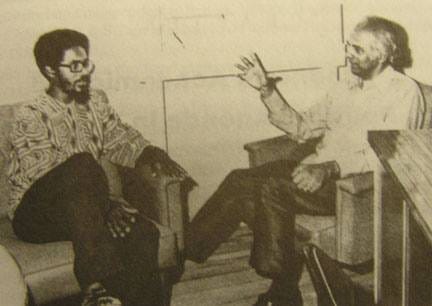
In the 1960s, a split emerged within the Black Power movement. This split was between the nationalists who saw the struggle of Black people in terms of being a racial struggle. There were those who began embracing Marxism as an approach to dealing with the struggle. The Marxists saw the struggle of Black people as being part of the larger class struggle to topple capitalism.
The split was not new. In the 1920s, the nationalist leader Marcus Garvey was criticized by Marxists such as C.L.R. James and George Padmore. The 1960s, however, this ideological debate became more heightened given the increased level of mobilization and organization among Black people around the world.
Walter Rodney was interesting because he was one of the few figures who accompanied the position of being a nationalist and a Marxist. He saw no contradiction between the two. In fact, Rodney was critical of Padmore because Padmore had abandoned communism in favor of Pan-Africanism. Rodney noted that this shift in Padmore’s politics resulted in Padmore taking a political position in Guyana which aligned him with the capitalist colonial powers. Rodney’s view was that class and race were both real factors in the struggle of Black people which had to be addressed and dealt with. He cautioned against an approach which ignored one in favor of the other.
Some nationalists dismissed the Marxist view out of the perception that Marxism was an alien ideology which was created by a white man. For Rodney, however, the relevance of Marxism was that it provided a detailed understanding and critique of capitalism. Marx’s critique of capitalism is a cornerstone of Marxist theory. He argued that capitalism is inherently exploitative, with workers being alienated from the products of their labor and subjected to harsh working conditions. Marx also criticized the capitalist mode of production, asserting that it perpetuates class divisions and fosters inequality. He predicted that capitalism would inevitably lead to its own demise, as the inherent contradictions within the system would intensify and give rise to revolutionary movements.
Rodney pointed out that Africans lived under a capitalist system which was imposed on them via colonialism. For this reason, Rodney held the view that Africans needed to understand capitalism and he believed that the theories of Marx provided the proper foundation for understanding the historical roots of capitalism, as well as capitalism’s inherent faults.
Marx’s ideas have had a profound impact on sociopolitical movements around the world. His theories provided a theoretical framework for socialist and communist movements, inspiring revolutions such as the Russian Revolution of 1917 and the Chinese Communist Revolution. Marxist ideas also influenced the development of labor unions and workers’ rights movements, as well as anti-colonial struggles in various parts of the world. Despite the shortcomings and failures of some of these movements, Marx’s ideas continue to inform and inspire those seeking social and economic justice.
Marx’s ideas also influenced anti-colonial struggles in Africa as well. Whereas many nationalist leaders believed that Marxism was alien to the African struggle, Rodney believed that applying a Marxist analysis to the Pan-African struggle provided the type of clarity which was needed in the struggle.
—
Dwayne is the author of The Political and Intellectual Legacy of Walter Rodney


