
Walt Whitman and Carl Sandburg Face Off With Their Poems “Song of Myself” and “Timesweep”
Traversing time to become part of the poet’s web
Failing to fetch me at first keep encouraged Missing me one place search another I stop somewhere waiting for you.
— Walt Whitman
So ends Walt Whitman’s compelling poem, “Song of Myself,” a masterfully written and reader-inclusive journey from beginning to end. Carl Sandburg’s poem “Timesweep” often feels like a much weaker and less skillfully written poem centering around the same theme.
Indeed, “Timesweep” reaches an adolescent stage of thinking, becoming stuck in a cycle of simple answers to complex questions. The speaker never succeeds in overcoming this hurdle, leaving us hanging, disappointed in what could have been a genuinely great poem that takes an easy way out by using religion as a cure-all.
Whitman was the master of addressing complex questions while including us, the reader, in the exploration. Sandburg does not achieve the absolute inclusion Whitman was able to attain.
“Timesweep” is, in the beginning, a wonderfully magical, captivating, freely flowing poem. The problem is science and religion interrupt its natural flow, creating a heavy-handed, even moralistic voice.
We receive our first warning of this about one-quarter of the way through the poem.
Who is the head one? Me? Man? Am I first over all, I the genus homo?
The answer:
Among killers and eaters I am first. I am the Head One.
Further,
What jargons, what gibberish, must I yet unlearn?
The speaker has decided Man is the Head One, if not only for his remarkable killing skills, even better than those of the animals. Sandburg is willing to acknowledge Man is inherently animal, but he believes our animalistic tendencies are something we must try to unlearn.
When Sandburg asks, “Who is the Head One?,” Whitman questions, “What is a man anyhow? What am I? What are you?” With each answer, their poems fork off in different directions.
Whitman’s questions elicit in the reader a sense of contemplative calm, and he proceeds to answer:
I exist as I am, that is enough, If no other in the world be aware I sit content, And if each and all be aware I sit content.
With these words, we know Whitman’s speaker is self-assured. We are soothed by his strong intuition that everything is in its place and that we must accept everything and every one just as they are, just as they exist. This feels like a divine directive, for meeting others where they are is often a challenging task.
Sandburg’s answer to Whitman’s question is Man is a supreme being, albeit flawed. However, by the end of “Timesweep,” Sandburg allows one being to be even greater than mankind.
“Timesweep” begins with the speaker explaining he understands the primitive desires of people. He speaks of love and romance.
Makers and givers [who] may be moon shaken, [who] may be star lost, …knowng love is a ring and the ring endless, Seeing love as a wheel and the wheel endless.
Sandburg reveals we are all part of a cycle, and he accepts love and desire as a natural part of life. Later, he will implore us to go beyond loving and accepting one another to loving and accepting his god as our creator. The poet uses vivid imagery to encapsulate this cyclical state of being:
And the sun governs valley lights, transforms hats into shoes and back again Before any long looking.
Imagine a working-class person reaching out for their hat, setting out to work and returning home, removing their shoes, and beginning the same routine all over again. Sandburg is saying this is life: life is a cycle, and it continues with or without us.
“Timesweep” climaxes in a lonely, meditative state. Sandburg likens man to page after page of animals. He then sculpts a vision of the earth:
The sea sang bye-lo bye-lo and the stars and the rains brought changing songs: so-long so-long joined to the sea’s old bye-lo bye-lo.
This part of Sandburg’s poem elicits a feeling the speaker, or perhaps the reader, is the sole inhabitant of the earth following final destruction. Interestingly, the “so” and “lo” above may subconsciously elevate the lonely feeling by creating the subliminal word “solo.”
Sandburg discusses an apocalypse in which “The autobiography of a wild rose will run: / My leaves pressed between the times/ of a fireball and an iceball.” Religion plays an increasingly large role in Sandburg’s poem. Perhaps he uses this end-of-the-world imagery to scare his audience into believing in heaven and hell if they don’t already. The heathen may be tempted to reconsider if there is heaven and hell, for with death becoming a sharp reality, heaven may become enticing. In the last stanza of his poem, Sandburg declares we are “All Horses,” “All Wings,” “All Men,” and “All Women,” but certainly not “The Maker.”
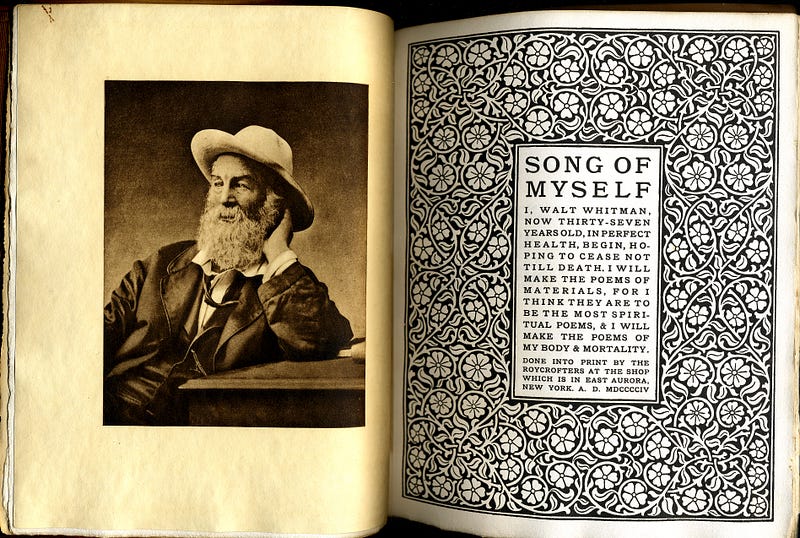
In “Song of Myself,” Whitman transcends Western theology: “Divine am I inside and out, and I make holy whatever I touch or am touch’d / from.” Whitman taps the philosophy that God, or a Divine Being is not only surrounding us, but this Divine Being is us. Where Sandburg feels the need to keep his Maker at a safe distance from Man, Whitman allows the Divine to be everyone, everything. It is precisely this attitude that invites the reader to be part of Whitman’s experience.
Near the beginning of “Song of Myself,” Whitman makes it clear he is our equal, dismissing religion even. “[There was never] any more heaven or hell than there is now.” This line opens up the poem to acceptance from a vast audience. Whitman isn’t about to engage in the never ending arguments for and against religion/s.
When we finish Sandburg’s poem with his extremely Western and Christian religious angle, some readers who don’t subscribe to Sandburg’s god feel left behind and possibly angered by his narrow viewpoint. If he had only considered the myriad world religions, he could have expanded his poem to be more inclusive.
Whitman embraces all parts of the universe, both good and evil. He seems to believe one cannot exist without the other. “I am not the poet of goodness only / I do not decline to be the poet of wick-/ edness also.” Whitman also accepts what we tend to consider opposing qualities within himself. He writes, “I am…maternal as well as paternal, a child as well as a man.” We are all made of the same layered elements.
Ironically, without mentioning the bible, Whitman teaches some of its fundamental principles minus the tone of condemnation elicited by some zealots. Whitman states, “Whoever degrades another degrades me, / and whatever is done or said returns at last to me,” echoing the golden rule to “love thy neighbor as thyself.” This is one of the earliest lessons most of us are taught. For non-religious readers, this poem is inclusive and mystical without purporting a theological purpose.
Sandburg and Whitman include animals in their poems “Timesweep” and “Song of Myself.” Whitman reveres animals.
I think I could turn and live with the animals…They do not make me sick discussing their duty to God…Not one is dissatisfied, not one is demented with the mania of owning things.
To Whitman, animals are sacred, lacking human conscience; he imagines being an animal instead of a human would be a serene experience. It would be a simpler, more present experience without a complex web of emotions and conscience to untangle during our lives.
When we finally come to the end of “Song of Myself,” we are a little sad because we cannot have this teacher talking to us all the time, but Whitman reassures us: “If you want me again look for me under your boot-soles…” Whitman reminds us his lessons are absolute everywhere — in the moon, the stars, and a pile of cow dung. Inspired, we are ready to witness the divine and develop an awareness of our divinity.
In contrast, Sandburg’s “Timesweep” ends with a stark image of the universe in which his God hovers like a star outside of our grasp. We feel hopeless and alone, and we have no teacher to turn to. We feel like Sandburg’s rose, about to be “pressed between the times of a fireball and an iceball.” Sandburg’s voice has become increasingly standoffish, and if we have any hope, it is something we have pulled from the deep recesses of our inner reserve.
As the respective poetic journeys come to a close, we find Whitman was an accessible poet. His inclusivity invites any reader to participate in his vision and wisdom. Whereas Sandburg was so focused on his flavor of religion that he risks excluding many potential readers. Because of Sandburg’s religious condemnation and redemption, his readership may feel weak and hopeless after reading “Timesweep.” Readers may wonder why Sandburg concludes humankind is a supreme being, only less supreme than God. Whitman’s whimsy and wisdom that we are all one and all divine certainly speaks more to me as a non-religious, yet spiritual reader.

As an aspiring poet, Sandburg’s “Timesweep” and Whitman’s “Song of Myself” have both had a profound impact on my life and the way in which I write. Last semester, I could not enroll in any English courses, and English being my major, I found this especially depressing.
One lonely Sunday afternoon, I went garage sale-ing. I came upon an in-home sale hosted by affable folk. Once inside, I discovered a vast library: romance novels, how-to books, and paperbacks in reds, blues, and yellows. I let my eyes skim the room until they paused on a section of poetry. A skinny book called Honey and Salt asked me to buy it. When I saw the author, Carl Sandburg, I remembered how much I like his poem, “Chicago,” and dug out some change.
A few months later, I finally opened the book. Turning to the back, I found a long poem, “Timesweep,” and read it aloud. I was taken in by Sandburg’s style of writing directly to the reader. However, Sandburg’s poem was shaded with an egocentric, Western religious tone that angered and alienated me. Ultimately, I finished “Timesweep,” feeling disappointed and unsatisfied.
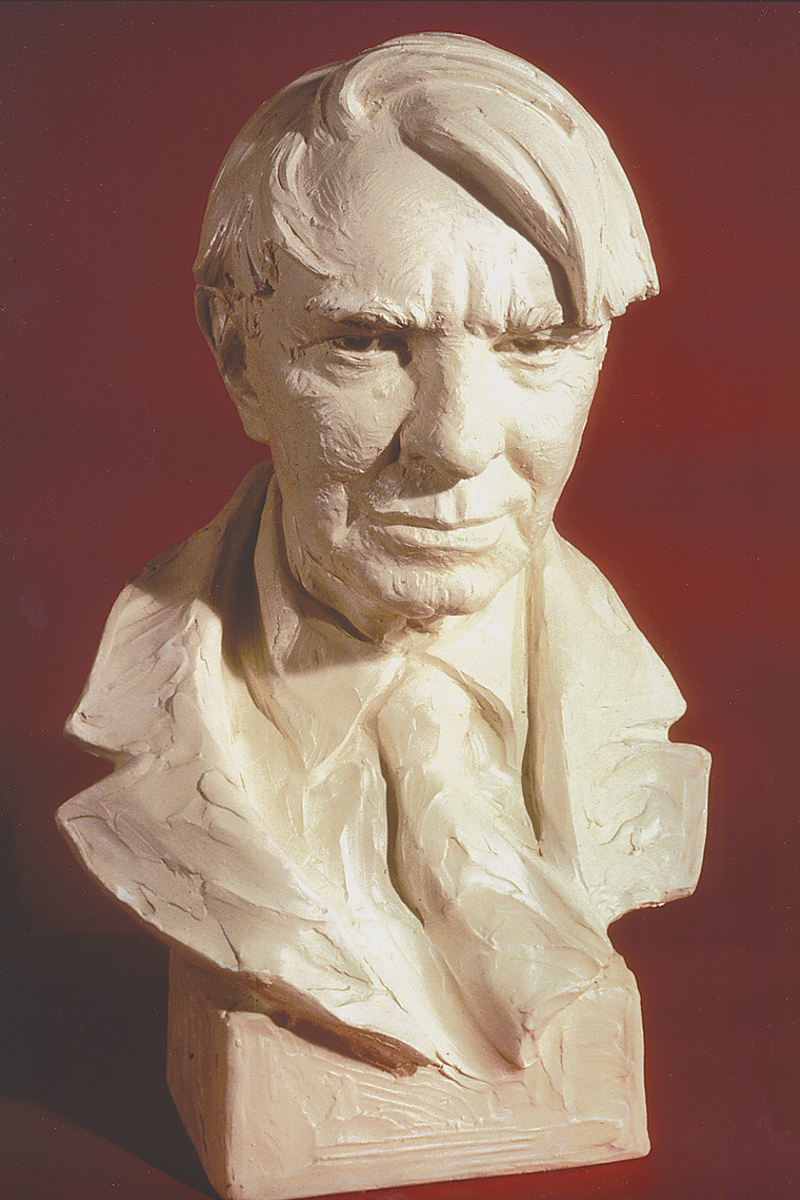

Later, when Sandburg’s “Timesweep” slept in my mind, I read Whitman’s “Song of Myself,” which then reminded me of “Timesweep.” Whitman achieved all the things I wished Sandburg had.
I began to draft poems, realizing there was no subject I should leave untouched out of loyalty to others or egoic thinking. I no longer felt social constraints restricting me from sharing, through my art, what resides in my soul. Whitman opened my eyes to the universe, reminding me of life’s sanctity and divinity. Sandburg scratched the tip of the iceberg with “Timesweep” while Whitman went straight to the iceberg’s base. In other words, “Timesweep” has a superficiality compared to the depth of Whitman’s “Song of Myself.”
Feeling like a young child again, I turned my older eyes to a word fresh with newness. The moon began to take on a crisp clarity, and one evening, I found myself sobbing, clutching a hard, cold steering wheel after seeing an especially touching movie. No longer were certain emotions banned from my life and my writing. Most importantly, Whitman taught me to re-examine life with renewed personal honesty. I reconsidered my wants, desires, and limitations and the wants, desires, and limitations of others.
One day, I was able to go through my older poetry without being harshly critical of it. I searched for material to submit to various magazines. A new calm accompanied this activity. I realized the poems I put aside weren’t more inadequate than others. I finally decided to stay true to my heart and try to find the best fit for the magazines to which I submitted.
The strategy worked. A couple weeks after submitting to three publications, I received an acceptance letter for my poem, “The Shapes Within.” Slogging through submissions is no easy feat. I felt jubilant, connected to creatives, connected to the universe, even connected to poets like Sandburg and Whitman.
After reading the last stanza of “Timesweep,” I felt like a heathen. Sandburg ends his poem by telling his readers there is only one Maker, and He is God (p 111). I am not a practicing Christian, although I subscribe to some basic Christian doctrines. “Timesweep” left me feeling small and degraded, not good enough for Sandburg’s Maker, his standard-setter supreme.
Instead of subscribing to the belief in human supremacy, Sandburg reveres his god, supplying us with a humanlike god, yet better than humans. I am disgusted with this egocentricity. Who are we to say if god exists, they are humanlike? I am redeemed by Whitman, who disregards heaven and hell as things that have always been here in a precise amount, and will never be any more or any less (p 938 sec. 3:7). Whitman goes on to discuss the sacred smell of armpits (p 953 sec. 24: 33). To make armpits an eloquent part of a poem is admirable.
I know all things on earth are meant to be here for some reason or another, and it is up to the artists to gather everyone together and acknowledge the wise presence of new-born babies, the dying words of elders. It is our job to capture the victories and defeats of the world, and bring them to a higher level, somehow explaining that what we perceive as victory may be defeat in the end and vice versa.
We are here to make sweeping strokes of an infinitely bigger picture, casting people’s attention away from the corner of the painting they reside in, and focusing their attention on the center where they will see a swirling, gurgling, bubbling over with life and death universe.
Original text: April 4, 1997. Revised and updated on December 29, 2022.
Works Cited
Sandburg, Carl. “Timesweep.” Honey and Salt.” 1953. New York: Harcourt, Brace & World, Inc. 1963. Whitman, Walt. “Song of Myself.” The Norton Anthology of Literature. Ed. Nina Baym et al. 4th ed. New York: Nortan & Company, 1995. 936–978.
Following is a link to listen to “Song of Myself.” I was unable to locate a complete audio version of “Timesweep;” only the first stanza seems to be widely shared. To read “Timesweep” in its entirety, read Sandburg’s book Honey and Salt.