
Walt Disney: The Man Behind The Myth
“All our dreams can come true, if we have the courage to pursue them” — Walt Disney

Today, when the word “Disney” comes to mind we tend to associate it with children’s cartoons, toys, theme parks, and a huge multi-billion dollar international evil conglomerate corporation that wants to take over the world, however, Disney was so much more than that, he was a real person, who had real problems and real struggles throughout his life.
Who was this man?
Walter Elias Disney (December 5, 1901- December 15, 1966), was a visionary who wished upon a star and turned his dreams into a reality. Most people know of Walt Disney and his successes, but what they fail to realize are his early struggles in the animation industry and how he overcame them.
Walt was a man who faced failure like most people, but unlike most people, he didn’t know when to give up. There was no reason why he couldn’t have found a more realistic job.
Today we associate the Disney brand with a monopolized conglomerate that owns everything, but what we don’t know is the humble beginnings of Disney and how hard early animation was for aspiring artists.
Early Animation
In the early days, animation was merely a hobby, nobody did it as a career because it just wasn’t profitable enough. It took too much time, effort, and people just to make animation shorts.
Despite popular belief, Disney did not invent animation, but he was one of the first to go mainstream. The Phénakisticope (1833) and Zoetrope (1834) were the earliest animation devices created to display an illusion of still images moving, kind of like a flipbook. Fantasmagorie (1908) was the first animation film, it was a shot that ran for 2 minutes.
Early Disney animation dates back to 1921, over a hundred years ago with Walt’s first studio Laugh-O-Grams. Although in the beginning, it was just like Kansas City’s Spring Clean-up Alice’s Wonderland short series. Producing this early animation
He started from nothing, he was broke had to mortgage his house and survived on a can of beans diet, and eventually worked his way to success. This success did not come overnight but during a long road of hardships and failures.
Father
Growing up Walt and his brother would deliver newspapers for their father, Elisa Disney, who was unable to work due to a handicap condition. Reports say was abusive and angry a lot toward Walt and his siblings.
Despite the negativity, Walt always found a way to smile and be optimistic. To escape his home life he would get lost in his drawings. He would always look on the bright side of life. Walt’s father discouraged a young Walt not to pursue a career in drawing, saying he was not good enough and would never be successful as an animator.
“I always like to look on the optimistic side of life, but I am realistic enough to know that life is a complex matter.” — Disney
Disney’s Failures
- Laugh-O-gram
- Lacking creativity
- Oswald The Rabbit
- Mickey Mouse
- Snow White The Seven Dwarfs
- Fantasia / Bambi/ Pinocchio
Laugh-O-Grams Studios
Disney’s Laugh-O-grams was founded in July 1921. Disney was not shy of failure from the very beginning Walt’s first studio, went bankrupt a year after beginning.
He made a deal with a distribution company to pay him for spreading his work, however, when that distribution company went out of business, Walt had to close his as well. Walt was living on dog food and unable to pay his rent. His next company would be much more successful.
Walt along with his brother Roy would run the business producing classics
“The difference between winning and losing is most often not quitting.” — Disney
Fired for Lacking Creativity
The Wonderful World of Disney, one of the 20th Century’s most enigmatic creative visionaries was actually fired for lacking creativity from his local newspaper, The Kansas City Star. The newspaper was later bought by Disney in 1996.
Oswald The Rabbit — First Successful Failure
Everyone knows Mickey Mouse, Disney’s most recognizable symbol, but what they don’t know is Mickey’s predecessor, Oswald The Rabbit. In 1928 Disney was finally seeing some success with his new mouse-like character Oswald The Rabbit, it was so successful that Disney’s producer, Charles Mintz would end up stealing it along with Walter’s crew who made it. The only people who would stay loyal to Walt were long-time friend Ub Iwerks and long-time business partner and brother, Roy Disney.
Charles Mintz was hoping Walter would stay with Universal to make Oswald cartoons for 20 percent, but Walter did something unexpected that would surprise everyone and affect the future of Disney and animation, he left. Thus giving up up the rights to Oswald and giving up the artists he stole.
Walt simply just let it go.
Walt accepted the outcome of this devastating loss and allowed him to look to the future for greatness to come. Greatness would come in the form of Disney and Iwerks’s next new rodent character, they called him Mickey Mouse.
After Universal successfully stole Oswald The Rabbit, Disney had to rethink his career. Fortunately, Disney did learn from this failure, the importance of having ownership for something you created. As we see today since Disney owns everything.
In 2006 Disney would eventually buy the rights back along with the original cartoons that were made by Walt, himself.
Mickey Mouse
Walt did not have any success finding a distributer to spread his Mickey Mouse shorts.
When Disney tried to get MGM to distribute his Mickey Mouse cartoons, they said women are afraid of mice and it will never sell.
The answer to this dilemma was sound. In 1928 sound on film was a new filmmaking technique that has never really been done before. Walt found a way to synchronized sound (dubbing) on a Mickey Mouse cartoon, Steamboat Willie.
Walt gave Mickey a voice, literally through vocal dubbing which made Mickey sound iconic.
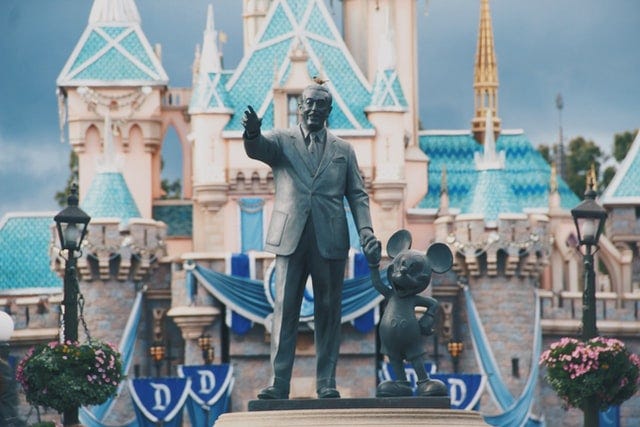
“I only hope that we don’t lose sight of one thing — that it was all started by a mouse.” — Disney
As big as they were growing, Disney still gave respects to where it all began.
Snow White and The Seven Dwarfs (1937)
Disney’s first full feature-length, Snow White and The Seven Dwarfs, was Disney’s most ambitious project. Disney saw the only way to survive in this industry was to make feature lengths, not just shorts.
Before it even premiered, critics were convinced it would fail they labeled it as “Disney’s folly”, a total failure. It took 3 years to produce. Being a full-feature length, it was also very expensive, Disney would initially estimate the costs at $250,000, but due to various delays, it rose to $1.5 million, Disney would have to mortgage his home to fiancé this costly production.
If that’s not motivating enough, critics would also claim it will never sell and people would hate it because it would hurt their eyes if they had to stare at color images for an hour and a half long without a break, if only they were around today, they’d probably go blind.
After all that, Snow White and The Seven Dwarfs became the highest-grossing film ever, until it was surpassed by Gone With the Wind a year later. It was nominated for 7 Oscars and today it grosses over 418 million. Talk about that for a folly.
Fantasia / Bambi/ Pinocchio
These three films released right after each other nearly put Disney out of business. Although the quality of these films was high-pristine ahead of its time, that was not the issue. The problem for these box-office flops was this little thing called, World War 2. The war was cutting off overseas revenue. Disney’s first film after the war, Dumbo will finally get him out of a losing streak.

Fantasia
Although initially Mickey Mouse’s feature debut was a failure upon release, today it is considered an occult classic for it’s trance-like melodic music score and lucid visuals. This film was different from any film of the day, using a revolutionary surround sound system called, Fanta sound. which was a precursor for the modern-day Dolby surround sound system.
“Everyone falls down. Getting back up is how you learn how to walk.” — Disney
Takeaway
There is no denying the greatness of Walter Disney. His influences had a profound impact on Animation. He’s a shining example of how entrepreneurs should operate in the face of adversity.

Modern-day entrepreneurs can learn a lot from this early struggling visionary. Even with all those failures, he remained optimistic and looked forward. He will continue to light the way for generations to come.
Today when we think ‘Disney’ we associate it with children’s cartoons, however, Disney is so much more than that. He dreamed one day that creative artists would have the opportunities to express themselves and get paid as a living.


