
Newsletter
Walmart’s RomCommerce Hit / Gemini Stumbles At First Hurdle / Mad Men’s Creative Boozing
Discomfort Zone, mid-December 2023 edition

Walmart’s Xmas romcom melds hearts and carts
At the start of the month, Walmart launched a 23-episode webseries called Add to Heart (a play on “add to cart”) with the tagline, It’s not a RomCom. It’s RomCommerce. Each webisode runs for 1.5 to 3 minutes, and centers on an NYC-based interior design assistant named Jessica, whose boyfriend prematurely proposes to her. But this isn’t simply big-budget branded content that leverages Hallmark-style movie tropes and casting. As the trailer makes clear, Add to Heart is a shoppable interactive series that asks viewers/shoppers to “Fall in love with a new way to holiday.”

Walmart’s agency, Publicis Groupe, not only came up with some spot-on copywriting (Watch. Shop. Swoon.), they hired top TV talent in UK/US production house Merman and director Erica Dunton, who helmed the romcom episode of Ted Lasso. So how did brand positioning, product promotion, and creative storytelling come together? Dunton is quoted as saying that, “the feel-good entertainment factor had to come first. Everyone from the top down was on board with that. As storytellers, we always felt supported and seen. Whatever you are making, be it feature, TV show, or a commercial, you can shoot all the pretty pictures in the world — but if your audience doesn’t feel for the characters, doesn’t root for them, or doesn’t understand them, then all is for naught.”
Whatever the audience figures are on Roku, TikTok, and YouTube, the world’s largest discount retailer seems to have hit a holiday home run by leveraging a fun formula to encourage Christmas cart clicks.
Google’s Gemini wows then wobbles
Google DeepMind has revealed three versions of the company’s multimodal AI, Google Gemini, called Ultra, Pro, and Nano. The Pro model can be used right now for free through Google’s Bard chatbot, which is currently available in 170 countries but, bizarrely, still not in Canada, the UK, and the EU. (Tip: Use a VPN and Bard isn’t smart enough to know that you’ve tricked it!)

The launch videos show how useful Gemini is for extracting relevant information for large datasets such as scientific papers, or for helping with a high-schooler’s math homework, but, like the other AI companies, Google is obfuscating when it comes to concepts like intelligence, understanding, and meaning.
Presenters in the videos use phrases like “Gemini understands” when what they really should be saying is something like, “Gemini is able to process”. As I discussed in the intro to the previous edition of Discomfort Zone, “intelligence” is a misnomer if we believe that AI works in a similar way to human minds. And the word “understanding” is similarly misleading. Machine learning platforms do not create models of the world in the same way that humans do, and literally understand nothing about our world and our experience of it. In no human sense do AI tools truly understand the meaning of anything.
When you look at the benchmarks, it’s interesting to note that by far the worst performances by AI are in translation. Remember the sci-fi movie Arrival? The key interlocutor with the aliens wasn’t a scientist, politician, or engineer — it was a linguist who specialized in translation. Why is this relevant? Because translation isn’t about words, it’s about meaning, and while Gemini might be slightly better than ChatGPT for many things, the benchmarking only goes to prove that it works faster than humans, not better.
Earlier this week a mini-scandal erupted when it was revealed that some of Gemini’s impressive use-case videos were heavily edited to make the human-AI interaction seem far faster and more fluid than it really is. Then a random YouTuber called Greg showed how it was possible to achieve the same results faster using ChatGPT-4. Although his stumble tarnished Google’s announcement, let’s not forget that Google owns the search interface in everyone’s phones and computers, giving it a huge advantage over OpenAI when it comes to AI adoption by regular folk.
Does Gemini work? Yes. Will search on Google be revolutionized? Yes. And here’s the kicker: Google’s machine learning products run on its own chips, not Invidia’s. Whatever happens with OpenAI after the massive Sam Altman firing fiasco, the AI market share war might be Google’s to lose in 2024. My perspective? Google should focus more on improving the company’s human intelligence when producing demo videos.
McDonald’s retro cafes and futuristic operations
McDonald’s is trying to take a gulp out of Starbucks’ cold drinks market share by testing a small-format drive-thru concept “inspired by nostalgia and powered by a menu of bold, refreshing beverages and tasty treats.” Although the name is really hard to type quickly when you’re writing a newsletter, the new café brand, CosMc’s, looks cool on a sign.

CosMc is an almost-forgotten McDonald’s alien robot character that originally appeared in ads in the late 1980s. The CosMc’s website plays heavily on fun extraterrestrial vibes and design tropes that evoke 1950s space-age illustrations. The fast food giant also announced a partnership with Google last week to connect Google Cloud technology across thousands of restaurants worldwide and roll out generative AI “to power exciting new experiences for crew and customers.” Exactly what these experiences will be is unclear, but it’s safe to say that McDonald’s has come a long way since I worked at the Hackney store in North London for a grand total of one day in 1986. Mind you, the location still seems dangerous.

Edward Slingerland, philosophy professor
Q. We are familiar with the Mad Men stereotype of a booze-fueled advertising industry in the 1960s. Your research surprised many by showing that the consumption of alcohol has played a key role in human evolution, especially with regard to creativity. Could you explain to readers how intoxication produces the creative leaps that help make the most successful ad campaigns?

A. The ancient association of alcohol with creativity is no myth. The human adult ability to stay focused on task, delay gratification, suppress unhelpful behaviours and reshape behaviour is dependent upon a part of the brain called the prefrontal cortex (PFC). This is the last part of a human being to develop, not fully maturing until the mid-20s or so. The reason for this slow development is arguably because the PFC presents evolution with a design trade-off: it allows one to be a fully-functioning adult, but also interferes with creativity and openness to experience. Our ability to solve tasks requiring creative insights or “lateral thinking” decreases steadily over time, mirroring the maturation of the PFC. Little kids are great at these tasks, grown-ups less so.
Experimental research on creativity has shown that, when PFC function is depressed, adults return to child-like performance on creativity tasks. Adults who suffer PFC damage through strokes or other accidents show a creativity boost. So do adults who have their PFCs temporarily depressed by, for instance, zapping it with a trans-cranial magnet.
Inducing strokes that permanently impair the PFC is not a great cultural strategy, however, and trans-cranial magnets are large, expensive, and a very recent invention. Fortunately, super-focused, responsible adults have an ancient cultural technology that functions as a low-tech trans-cranial magnet: alcohol. Alcohol affects the brain-body system in a variety of ways, but one of its main functions is to downregulate the PFC. The only experimental study to date that directly employed alcohol as a creativity booster found that creativity peaked at about .08 BAC, or about two drinks in. Other indirect suggests that making it difficult or impossible for people to drink together socially reduces intellectual innovation.
In any case, whatever its obvious drawbacks in many regards, the Mad Men of the 1960s did get something right. In an industry completely dependent on creative insight, it makes sense to provide a role for alcohol in the workplace. This is something that contemporary companies, like Google, also understand. When Google engineers hit a wall on a particular coding problem, they don’t continue to sit at their computers consuming PFC-enhancing coffee. Instead, they turn to the company-provided Whisky Room, packed with bean bag chairs, whiteboards, and a world-class collection of single-malts Scotches, in order to gently downregulate their PFCs in search of the needed creative workaround.
Edward Slingerland is Distinguished University Scholar and Professor of Philosophy at the University of British Columbia. His research specialties and teaching interests include Warring States (5th-3rd c. B.C.E.) Chinese thought, religious studies, cognitive linguistics, ethics, and the relationship between the humanities and the natural sciences. His publications include Drunk: How We Sipped, Danced and Stumbled Our Way to Civilization (Little, Brown 2021).

Peter Gabriel and the return of surrealism
Although he isn’t as famous as the Beatles or Stones, Peter Gabriel is another British rock act who released original music at the end of this year after more than two decades out of the limelight. Gabriel’s groundbreaking stop-motion extravaganza Sledgehammer is MTV’s most-aired music video of all time, and for his new album i/o that was released earlier this month, he again chose to go with cutting-edge visuals.
AI image generation platform Stable Diffusion ran a contest called the #DiffuseTogether Challenge where creators were asked to produce videos for several of Gabriel’s new songs. The videos that placed equal first and second were both for the song Panopticom, whose lyrics and these accompanying visuals echo the fears and innovation (fearovation?) that social media and AI have accelerated.
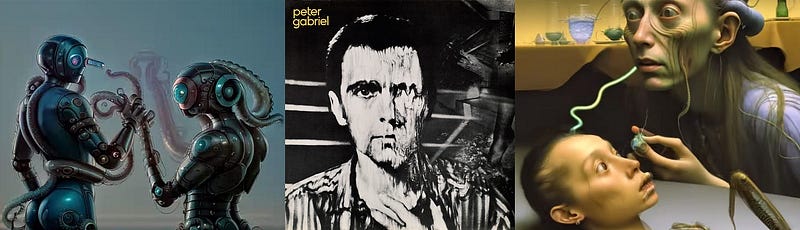
The diffusion video esthetic creates a kind of extreme surrealism that dovetails neatly with Gabriel’s previous visuals. The singer employed surrealist imagery way back in 1980 for the cover of his melting face” album (the image in the middle of the montage above) and at the start of his career as the original lead vocalist for Genesis. Not only is the Grzanowski video for Panopticom fascinating and disturbing, it highlights how diffusion AI videos are a new way of imagining film language. Instead of editing (montage) or image-transforming animation (like in Sledgehammer), this new esthetic features constantly morphing scenes that reflect the overwhelming pace of tech acceleration and social change. Plus tentacles. Lots of tentacles. Director Steve Grzanowski commented, “This video captures the raw output capabilities of AI technology without the bells and whistles of post-production.”
Is it possible that the surrealist esthetic becomes this decade’s signature look in popular culture and advertising as AI-generated images and videos enter the mainstream?
Want to read more about the feedback loop between brands, culture and tech? Become a Discomfort Zone subscriber on Substack or check out my other Medium articles at the link below.


